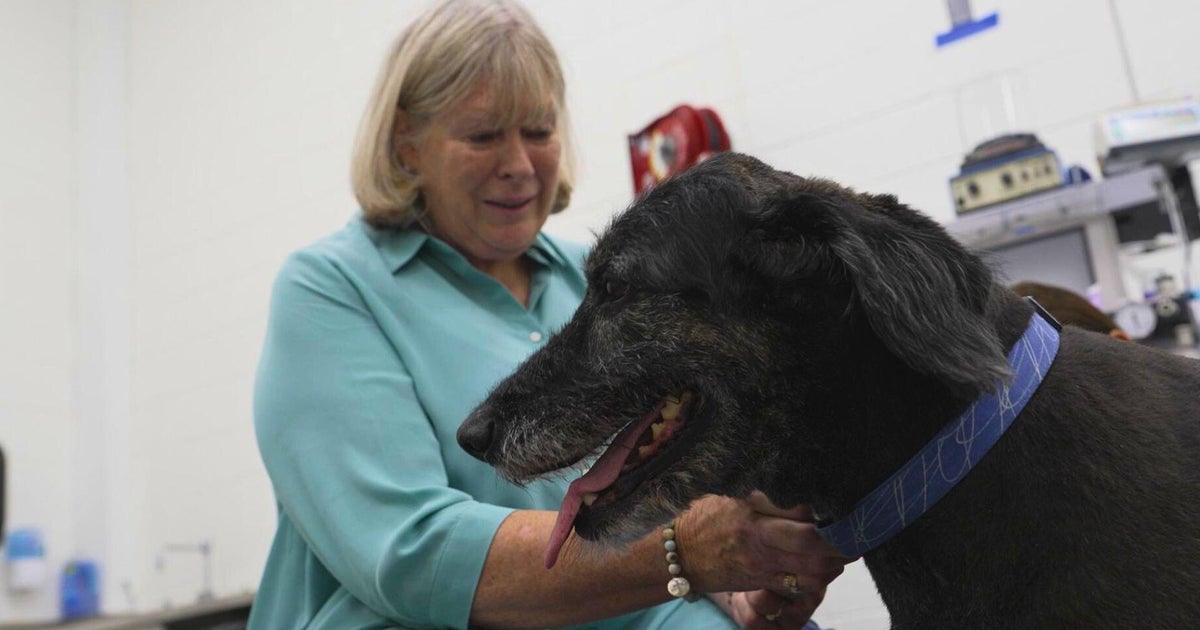
Breakthrough genetic therapies can save lives, but many cost millions for single dose
A new class of drugs is saving the lives of children who once had no hope. These high-tech medicines can replace defective genes. But there's a catch. Many cost millions of dollars for a single dose. And American health care hasn't figured out how to pay. We wondered how medicine could be priced so high and how insurance plans could refuse a life saving treatment. So we asked the people you're about to meet: a drug maker whose company charges three million for its medication, a CEO whose insurance plan won't pay, and a mother named Ciji Green. Ciji was overjoyed that a new drug could save the life of her daughter, Maisie, until she found no one would pay the price of life.
Tiny Maisie was born in 2017. Ciji Green says that from the start, her daughter was mysteriously ill.
Scott Pelley: When you brought Maisie home, what did you begin to notice?
Ciji Green: Initially, she just sounded like she had a cold all the time. She just sounded really congested. And after-- I'd say, like, two weeks I noticed that Maisie, like, wasn't holding her head at all. She was just like Jello. Her head, like neck, was like Jello. And her head would just flop.
Ciji had a feeling something was terribly wrong — something doctors couldn't name until one took a blood sample to test for spinal muscular atrophy — SMA.
Ciji Green: And she left with the blood, and she came back, and she goes, "You heard me when I said we're testing for SMA?" And I said, "Yes. I heard." And she goes, "Do you know what that is?" And I go, "No." And she put her hand out, and I said, "Please don't touch me. Please don't touch me," 'cause I knew-- I knew everything I had been feeling. "Please don't touch me." I said, "What can-- what can we do? What can you do?" And she shook her head. And she said, "Love her and squeeze her."

A missing gene caused Maisie's muscles to waste away. SMA is often fatal by age 2. Then, just in time, in 2019, something like a miracle was approved by the FDA. Just one dose of a drug called Zolgensma can replace the gene to stop the disease. But the dose is $2 million. Maisie was on her state's Medicaid. The insurance company that managed Medicaid said it would not pay.
Ciji Green: I became very angry, to know that there was something that could help her. And I knew without a shadow of a doubt I was burying my daughter before she was 2. It was cheaper for her to die. They were banking on her dying.
Maisie's story is a view on what's coming to American health care because, today, there are more than 300 high-cost genetic therapies in clinical trials — some for diseases suffered by millions of patients.
Jonathan Gruber: I liken it to a coming tsunami, which is basically gonna overwhelm the employer-sponsored insurance system.
Few know health care finance as well as Jonathan Gruber. He's chair of economics at MIT and an architect of the Affordable Care Act.
Jonathan Gruber: What happens when you have genetic cell and gene therapies that treat cancer or heart disease, which are much more common? That's when the tsunami hits, and we're threatened to be under water.
Scott Pelley: What problems are the high prices already causing today?
Jonathan Gruber: The first problem is that many companies in America are what we call self-insured. They pay their own medical bills. About two thirds of the insured in America are in such arrangements. They can't afford to pay this, so they're facing a difficult financial decision, which is, "Do I cover this drug and potentially go bankrupt? Or do I not help my unlucky employee?"
- Send a secure tip to 60 Minutes: Here's how to confidentially share information with our journalists
That's the painful question Mike Poore faced.
Mike Poore: It should not be that only the rich can afford the best care.
Poore is CEO of Mosaic Life Care, a nonprofit hospital system in Missouri with about 5,000 employees. In 2023, Mosaic decided not to cover gene therapies — because, Mike Poore told us, employee premiums would jump $125 a month. But a few months later, an employee had twins with SMA — like Maisie.
Scott Pelley: And the gene therapy for the twins would be $4.2 million.
Mike Poore: Yes.
Denied coverage, the family went public and blamed Mosaic.
Mike Poore: I got death threats. My family-- was threatened.
Scott Pelley: What did you do to protect your family?
Mike Poore: Actually sent them away and decided to you know stay on at the hospital and then just work, to make sure that the children got the care they needed.
From the moment his health plan denied the claim, Mike Poore appealed to philanthropists and legislators. Finally, state Medicaid paid to treat the twins.
Mike Poore: What's really important here is to understand that this is one situation. But it is a bellwether of what is to come. Every new gene therapy breaks a record for the most expensive drug ever.
Scott Pelley: You seem to be saying there's a storm coming.
Mike Poore: There's definitely a storm coming.
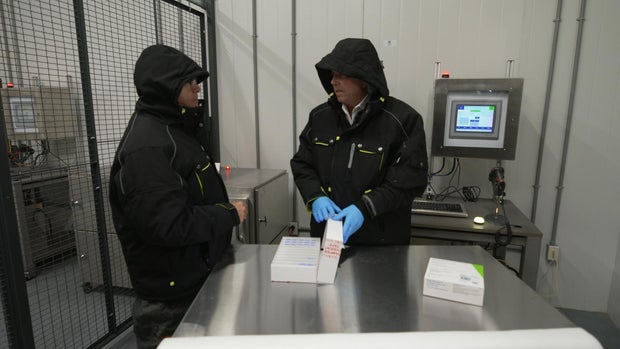
Who charges millions for a drug? Doug Ingram is among them. The CEO of Sarepta Therapeutics took us into a freezer at 4 degrees below zero where he stores Elevidys which costs $3.2 million for one dose, which may be all that is needed to slow Duchenne muscular dystrophy, a muscle wasting disease that confronts parents with this prognosis.
Doug Ingram: They're always-- told, "Your boy has Duchenne muscular dystrophy. There's nothing we can do about it. Go home, love him, because this disease is gonna steal him from you bit by bit, day by day, and he will die. And you gotta get used to that."
Scott Pelley: People hear $3.2 million for your drug, and they think, "Greed."
Doug Ingram: Here's what they should think. So, first of all, if the question is, "Is this the right price, or only price, and can society afford this?" You're going to hear me say that it absolutely is and society absolutely can afford it. And we'll go into that. If you're asking me whether this is the sort of price that we should be happy with and satisfied in the long term with gene therapies in genetic medicine, I'm gonna tell you absolutely not.
Ingram's company uses an engineered gene that instructs the child's cells to make a protein to protect the muscles. A modified virus carries the gene to the cells. Development took 18 years.
Doug Ingram: So the first question is could you even do this and do this safely? The second question that was obvious is if you could, you have to manufacture this stuff. And at the moment in time we did the calculation you needed more gene therapy manufacturing capacity than all of the capacity that exists on the planet earth, at the time. Every company, every research facility, every university. And we'd never made a vial of anything that looked like a gene therapy at that moment. And the next thing, you'd have to raise billions of dollars. You have to go to investors and paint a picture of the future and literally raise billions of dollars to do this. We didn't have billions of dollars.
It took 3 billion to create Elevidys, according to Ingram. One of his challenges now is recouping that investment in a rare disease that has only about 15,000 patients in the U.S. Ingram says the price will come down with manufacturing experience, future competition and, in his view, streamlined federal regulations.
Doug Ingram: Today, on average, it takes more than 10 years to develop a therapy. It costs nearly $3 billion on average to make a therapy. And at the beginning of that journey, the probability of it being successful is nearly zero. And in the context of that, of course therapies when they're eventually approved are going to be very expensive. So what we need to do is fix that. We've had 60-70 years of layering and layering and layering of requirements, all for the laudable goal of ensuring that the therapies that are approved in the United States are both safe and effective. We have to do the hard work of getting under that and stripping it down to those things that are absolutely necessary, informed by the science that we have today, not the science we had in the '60s, and find a way to make therapies less than $3 billion with a higher probability of success.
Despite mixed results, the FDA approved Elevidys. About 1,100 patients have been treated. Two died of liver failure. About half of the patients were covered by Medicaid. It's too soon to fully evaluate how well Elevidys is working. But the vial Doug Ingram showed us was made for a boy named Leighton. And months after his treatment, Leighton's parents told us he is, quote, "thriving," "stronger," and "more independent."
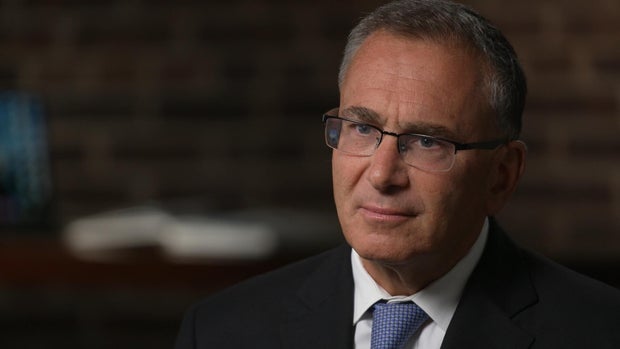
Scott Pelley: Is there a bad guy in this equation? Employers who won't pay, drug companies that are charging enormous fees for these drugs?
Jonathan Gruber: The manufacturer is not the bad guy. The company's not the bad guy. Really, there's no bad guys here Scott. We just have to recognize as society that something's changed. We have a new miraculous and expensive mode of treatment, and we society need to recognize that we need to act jointly to absorb those costs.
Economist Jonathan Gruber says in his view, absorbing those costs will require government support and negotiated prices. Until then, parents, including Ciji Green, must improvise. Green pursued philanthropy for her daughter Maisie, set up a GoFundMe page and demanded a meeting with the insurance company.
Scott Pelley: You wanted them to look her in the eye.
Ciji Green: Yes, I wanted them to look her in the eye and say we're the reason you are going to die.
The insurance board blinked. Masie received the genetic therapy drug Xolgensma in 2019.
Scott Pelley: One dose, one hour, and the effect was what?
Ciji Green: You can't even describe it. Amazing. Amazing Maisie. It changed her life. It changed our life. It was what she needed.
Scott Pelley: Can we meet her now?
Ciji Green: You sure can. We'd love to meet Maisie.

Expected to die by age 2, she was 6 when we met, after a treatment so successful that Ciji has appeared in testimonials for the drug company. The impairment suffered before the drug cannot be reversed. Maisie doesn't walk, but she's making straight A's in school.
Scott Pelley: Hi, Maisie.
Maisie: Hi.
Ciji told us the progress of the disease appears to have stopped. And what is the price of that?
Ciji Green: That precious little wave.
Scott Pelley: I'm so glad to meet you.
Ciji Green: Can you say, "Nice to meet you?"
Maisie: Nice to meet you.
Scott Pelley: Your own miracle.
Ciji Green: My very own miracle.
Produced by Aaron Weisz. Associate producer, Ian Flickinger. Broadcast associate, Michelle Karim. Edited by Joe Schanzer.