For some Pakistanis, anti-U.S. anger still burns
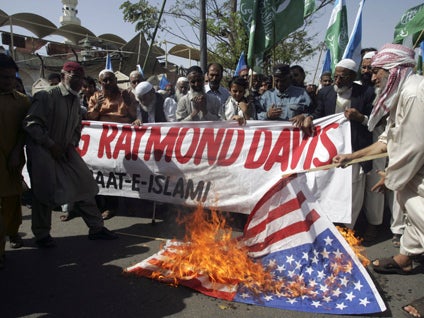
ISLAMABAD - A decade after the 9/11 attacks unleashed the United States' global war on terror, Pakistan's Islamic hardliners have become adept at frequently using slogans such as "death to America" and "down with America" in venting their anti-U.S. anger.
So it was not surprising that hardline Islamists in the days ahead of the 10th anniversary of 9/11 chose to note just one side of the picture - theirs.
"If America would not have launched this big and bad global war in the name of combating terror, the world would have been a more peaceful place today," said Maroof Khattak, a young firebrand Islamist student from a religious 'madrassah' school in Pakistan's capital city of Islamabad. "The 9/11 attacks were a reaction to U.S. policies, especially the U.S. support for Israel. There was no justification for the U.S. to launch a counter-attack."
Khattak's sentiment was echoed by Usmanullah Khan, another young Islamist. In an interview just outside Islamabad's "Red Mosque" near the city's Aabpara district, Khan predicted an eventual popular Islamic uprising in Pakistan "which will be driven by anti-U.S. sentiment".
In 2007, Pakistan's army troops stormed the Red Mosque after more than a week-long gunfight between well-armed and war-hardened Islamists inside the compound and government troops. The army eventually seized control of the mosque.
Four years later, the Red Mosque remains not only a regular place of pilgrimage for Islamists but also a spot for venting anti-U.S. anger. "The U.S. takes the lead on human rights violations all over the world. Where was America's conscience when so many of our people were killed too? There was not a single word of protest from Washington after the Red Mosque episode," said Khan.
Special section: 9/11 - Ten Years Later
Special section: 9/11 Videos
Special section: 9/11 in Photos
At the time, independent analysts said the 2007 encounter became unavoidable for Pakistan's army after Islamists holed up inside the Red Mosque began firing at troops deployed nearby.
Despite the heated rhetoric, senior officials in Pakistan's government claim that anti-U.S. sentiment across the country is often exaggerated.
"Most Pakistanis just want a quiet and peaceful life for themselves, for their children," said one Pakistani diplomat who previously served at the country's embassy in Washington and agreed to speak to CBS News on condition of anonymity. "Today, the problem is that any demonstration by these people (Islamists) immediately gets huge play on our media, especially TV channels. Ordinary people just want to go about their lives in search of a better future."
Others across the Aabpara district are keen to leave behind the 2007 Red Mosque episode and move on.
"I don't care so much about what America is doing to the world," says Saleem Malik, a fruit seller. "As long as my family's needs are met, I will be happy."
Malik, a father of six, laments being forced to keep three of them at home because his meager monthly wage - the equivalent of $75 - is not sufficient for their school fees.
Western official say an important driver of political sentiment, including anti-U.S. feeling, relates to widespread poverty in Pakistan, where at least one-third of the population lives in a state of extreme impoverishment.
"These poverty-stricken people are angry at the way they live their lives. For many such people, expression of anti-U.S. feelings is a consequence of their own living conditions," one United Nations official told CBS News on condition of anonymity.
Hasan Askari Rizvi, a Pakistani commentator on politics and security affairs, said anti-U.S. feeling, though spread over large parts of Pakistan, also gets exaggerated at times.
"You can't disagree with the claim that the anti-U.S. feeling in Pakistan comes from important groups who are also well-organized in expressing themselves" said Rizvi. "But beyond a certain stage, you have to ask yourself, exactly how widespread is this feeling?"
Khattak and Khan, the two hardcore Islamists, eventually agreed that the fault lines that have aggravated conditions for Pakistanis in the decade since 9/11 lie within their own country.
"In the past 10 years, Pakistan's economic conditions have become worse than before because we have had a succession of corrupt leaders," concludes Khattak. But Khan insists "at the very least, countries like the United States should have abandoned support to Pakistan's leaders. These people are too corrupt."