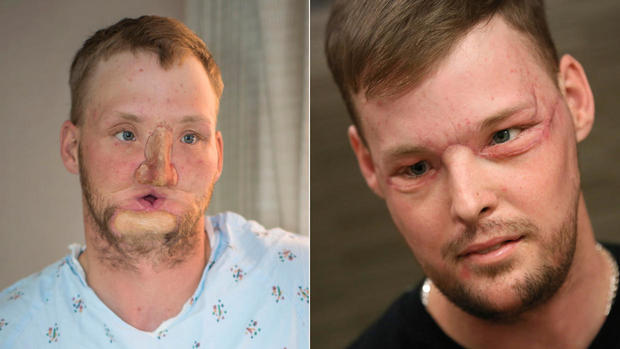
Face transplants no longer seen as daredevil medicine

(CBS/AP) Face transplantation is far from the medical mainstream. But as more face transplant recipients like chimp mauling victim Charla Nash open up about their experiences, the procedure is no longer seen as daredevil medicine.
PICTURES - 7 amazing face transplants (GRAPHIC IMAGES)
Around the world, at least 18 face transplants have been performed. The first was on a French woman who had mauled by her dog. She got a new face in November 2005, said the Cleveland Clinic's Dr. Maria Siemionow, who performed the first face transplant in the U.S. in December 2008.
Brigham and Women's Hospital in Boston has done three this year alone. The U.S. Department of Defense is funding more of these surgeries in Cleveland and Boston in hopes of helping disfigured soldiers. The University of Pittsburgh plans to offer face transplantation soon.
"It isn't mainstream yet," said Michael Cunningham, a University of Louisville psychologist. "It's a last resort surgery." But the face transplant experience so far shows that "there were a lot of naysayers and worries that just didn't seem to come to pass," he said.
On Thursday, Brigham and Women's released a photo of Nash, who received a face transplant in May. "I will now be able to do things I once took for granted," the Connecticut woman said in a statement. "I will be able to smell. I will be able to eat normally. I will no longer be disfigured. I will have lips and will speak clearly once again. I will be able to kiss and hug loved ones."
Not all face transplant recipients have recovered hoped-for capabilities, and some have less-than-stellar aesthetic results. But the more recent ones in particular, where full rather than partial transplants have been performed, have fared well.
"They look from the very beginning quite natural and quite normal," said Dr. Bohdan Pomahac, who has performed four face transplants at Brigham.
Here's how some others have fared:
*Dallas Wiens, a 25-year-old Texan severely disfigured in a power line accident, looked like a sock of flesh had been pulled over his face - no eyes or nose and barely a mouth. After his transplant earlier this year in Boston, he said the first thing his young daughter told him was "Daddy, you're so handsome." He said his new face felt "natural," and that right away he could smell the hospital's lasagna.
*Connie Culp, 48, an Ohio woman who was the first U.S. face transplant recipient, has made several TV appearances and become an advocate for organ donation. Doctors have refined the droopy jowls and extra skin, and she now has "a normal face," Siemionow said. "She's smiling, she's perfect. When she jokes, she kind of flickers her eyes. Her face is vivid. You can see emotions."
*Mitch Hunter, 30, of Indiana, wore a prosthetic nose and had a distended, lopsided jaw after being disfigured in an accident. Now, he could pass you on the street and you wouldn't guess he has a new face, so good is his cosmetic result.
So far, only two face transplant-related deaths have been reported, said Dr. John Barker, a reconstructive medicine researcher at the University of Frankfurt in Germany. A Chinese man reportedly was not given or did not take medicines to prevent his body from rejecting his new face. In Paris, a man who received a face and a double hand transplant suffered a heart attack during surgery to address a complication, Barker said.
Overall, "I think it's gone fabulously," he said of face transplantation. "It is a clinical alternative now, not experimental," he said. "It's been done and it works. For a select group of patients, it is a viable treatment."