Everest's Sherpas, often with little recognition, risk their lives to help others reach the summit

At 18, Nima Rinji Sherpa became the youngest person to have summited the world's 14 highest mountains – accomplishing it in about two years. It took the previous record holder nearly a decade.
Sherpa, which is an ethnic group, a last name and a job description, risk their lives to help others reach mountain summits. It's a risk Nima knows all too well.
"You have to be more careful when you're in the mountains because every time you go, you are so energized, and you feel like nothing is gonna happen to you," he said. "Then when you see someone pass away or, you know, then you feel like, "OK, this is – this is real."
The Sherpa legacy
Almost 150,000 Sherpas live in Nepal, making up less than 1% of the country's population. Renowned for their endurance, they thrive where oxygen is scarce.
Nima grew up learning about Tenzing Norgay, a Sherpa who, in 1953, guided Sir Edmund Hillary of New Zealand on the first ever summit of Everest. While the trek cemented Hillary's name in history, Norgay's contribution was largely overlooked — at least outside of Nepal.
"I think it was because of him, like, who made the Sherpa a brand today," Nima said. "For me, he was always a very big motivation, just to understand that, okay, maybe we can also be someone like him."
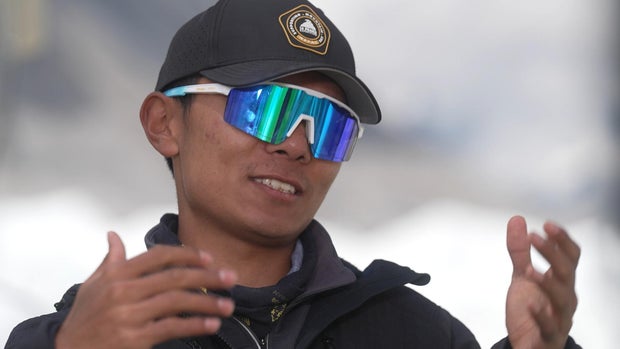
Today, Nima is part of a new generation chasing the recognition that eluded Norgay.
Nima comes from mountaineering royalty: his dad holds the record as the youngest person to summit Everest without supplemental oxygen and his uncles were the first brothers to conquer the world's 14 highest mountains.
One of his uncles, Mingma Sherpa — a former yak farmer — started his mountain work as a porter, earning $1 a day carrying loads for foreigners. He said he'd carry loads up to nearly 200 pounds.
"I show off [to] the people, 'I am strong,'" Mingma said.
Mingma climbed the ranks and became a Sherpa guide, a role reserved for the strongest and most skilled.
- Trekking to Everest Base Camp with 800 pounds of camera gear
- What it takes to film 60 Minutes on Mount Everest
- Everest is a multi-million dollar business, complete with private chefs, espresso machines for some climbers
"Every step is do [or] die," he said. "Every step is maybe we are alive or not alive."
Mingma and his brothers started their own company, Seven Summit Treks, in 2009. The company is now responsible for nearly a third of all Everest expeditions.
They want to prove that Sherpas are more than just the indispensable guides to Western climbers. They're banking on Nima to show that Sherpas can be climbing stars, too.
Rising above — literally
At 16, while most teenagers his age were in a classroom, Nima was climbing into what's known as the death zone: that's when the altitude is above 26,000 feet and the body's organs begin to shut down, minute by minute. For his first summit, in 2022, Nima climbed Nepal's Mount Manaslu.
His main challenge was muscle cramps.
"I think it's mostly because I was too young for my age to start at that time," he said. "I was sleeping at night, I had some pain in my lungs, some pain on my heart. But for some reason, I don't know why, I kept wanting to go up."
Nima faced serious injuries and avalanches as he worked to summit the world's 14 tallest mountains.
"I was on a mission to finish all the 14. And I knew I belong in this industry," Nima said. "Everyone has their own reason. And the reason has to be really big [so] that you don't give up."
The 19-year-old Sherpa is still hoping to receive major endorsements.
"But I know my time is going to come," he said. "I don't want to rush."
One of Nima's mentors is Conrad Anker, a top American mountaineer. Anker opened the Khumbu Climbing Center in Phortse — a remote village on the way to Everest's Base Camp — in 2003. The center provides Sherpas with specialized technical training to improve safety on high-altitude expeditions. Nima trained there and graduated top of his class.
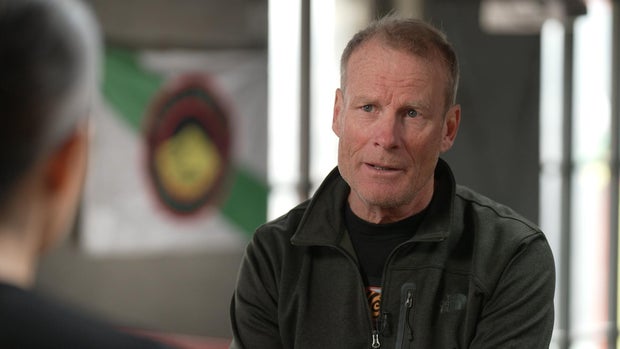
Anker sees inequity between Western and Nepalese climbers — and it's not just the sponsors.
"It's the value of what they do. I mean, a Western climber dies. And the community rallies up. And there's fundraising," Anker said. "Yet for the Nepali climber, it's not recognized in that same sense."
The risks on Everest
About a third of deaths on Everest are Sherpas, with deaths happening so high up the bodies are almost impossible to recover. In 2023 alone, 18 people died.
"I have seen many people pass away. And, yeah, it's always there," Nima said. "But you believe that you're not going to die."
Sherpas shoulder the burden on the trek to Base Camp, which can take days, and on the journey to Everest's summit, which can take weeks.
They navigate shifting towers of ice and deep crevasses when they hit the Khumbu icefall. Elite Sherpas, called icefall doctors, go in first. They build the route with ladders lashed together over sheer drops.

Every step is a gamble. Sherpas cross far more than any other climber, risking everything for someone else' summit.
Inexperience can be deadly. In Everest's death zone, one stalled climber can trap dozens behind them for hours, turning Everest into the world's highest traffic jam.
Making the trek up Everest safer
Innovation is taking flight to make the trek up Everest safer. Companies have started using drones to ferry loads in high altitudes.
"The drones are now helping the icefall doctors," Nima said. "They're helping to take the ladders, the ropes. And at the same time, the drones are helping to bring down all the trash and many things."
The hope is that the new technology might reduce the number of fatal accidents.
While it will take a porter hours to climb from Base Camp to Camp One, a drone can do it in minutes.
"The job has not gone away. It's just making the job easier, and safer, and faster," Nima said.