Egypt: Bombings Linked To Past Attacks
This week's bombings in Sinai are linked to the terror attacks in the peninsula's resorts of Sharm el-Sheik last year and Taba in 2004, Egyptian Interior Minister Habib el-Adly said Wednesday.
"The information we have indicates that (the perpetrators) are Sinai Bedouin, and the latest operations are linked to the previous attacks," el-Adly told state television, referring to the terror attacks in the Sinai resorts of Sharm el-Sheik last July and Taba in October 2004.
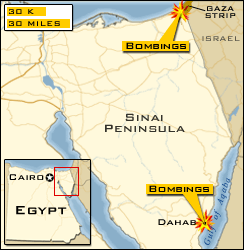
Three bombs exploded nearly simultaneously Monday in the Sinai resort of Dahab, killing 21 people and wounding more than 80, mostly Egyptians. On Wednesday, two suicide bombers attacked international peacekeepers and Egyptian police on the northern edge of the Sinai Peninsula; only the suicide bombers were hurt.
Security officials said Wednesday's bombers struck about 35 minutes apart near the main Multinational Forces and Observer base about 3 miles south of the Rafa border crossing to Gaza in northern Sinai.
On the Gaza side of the border at about the same time, five Palestinians were injured when militants fired at them while trying to ram an explosives-laden car into the main Israel-Gaza crossing, Palestinian security officials said.
Israel has warned that since it pulled out of Gaza last summer, the Rafa crossing has become a smuggling zone for terrorists and weapons, reports CBS News correspondent Robert Berger. It was closed Wednesday after the attacks.
Egyptian authorities have rounded up dozens of suspects and are studying the dismembered remains of three men to learn if they were suicide bombers in the Dahab attacks. Three detainees were released after questioning Wednesday.
Egypt's intelligence chief, Omar Suleiman, flew to Yemen on Wednesday for talks on the Dahab bombings, according to intelligence officials who spoke on condition of anonymity because of the sensitive nature of the information. They said Egypt wants to know if al Qaeda activists who escaped from a prison in Yemen might be connected to Sinai terror cells.
 CBS |
"It's clear these people are from some al Qaeda derivative group," terrorism expert Steven Emerson said by telephone from Washington. "The Egyptians have a real problem in the Sinai where these jihadists are able to move in with impunity and collaborate with the local Bedouin. The bombers couldn't operate in the Sinai without the support of the Bedouin."
Emerson said he believes the attackers' goal was destroying Egypt's tourism industry — which brought in $6.4 billion last year — and overthrowing President Hosni Mubarak, whose quarter-century in power has been marked by harsh crackdowns on militant groups.
The Sinai is about the size of West Virginia, and is home to the mountain where the Bible says Moses received the Ten Commandments. Its long coastline — washed by the warm waters of the Red Sea — is being rapidly developed for tourists.
But Sinai residents, mainly nomadic Bedouin, complain they are poorly served by the government.
After 34 people died in bomb attacks on the Sinai resorts of Taba and Ras Shatan in October 2004, Egyptian security forces rounded up thousands of people — including Bedouin women. In the Bedouin culture, the detention of women by a male police force is a violation of honor that must be avenged.
The arrests prompted New York-based Human Rights Watch to criticize Egypt, maintaining that as many as 2,400 people remained in custody in February 2005. It said some prisoners were tortured.
Similar roundups occurred after suicide bombings in Sharm el-Sheik killed 64 people last July. Some analysts believe the heavy-handed tactics have only made residents more receptive to militants.
"I think Egyptian authorities have not yet gotten the measure of the Sinai problem," said Hugh Roberts, the Cairo director of the North Africa project at the International Crisis Group.
The strike on the multinational force in Sinai was the second in less than a year. In August, a crude roadside bomb blasted a vehicle belonging to peacekeepers, slightly wounding two Canadians.
The 1,800 peacekeepers monitor the 1979 Egypt-Israeli peace deal. Ten countries make up the force — the United States, Canada, Australia, Colombia, Fiji, France, Hungary, Italy, New Zealand and Uruguay. Norway provides three officers.
The peacekeepers' mandate is to ensure enforcement of the provisions of the 1979 peace treaty between Israel and Egypt, which led to Israel's withdrawal from the Sinai. In practice, it serves mostly as a buffer between the countries.