Debunking Earth's oldest fossil find?
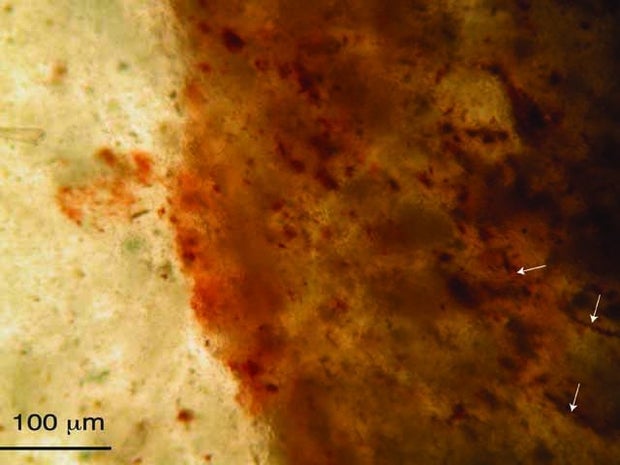
Chalk it up to a case of mistaken identity?
Over twenty years ago, researchers came upon what they said were the 3.5 billion-year-old remains of bacteria fossils in western Australia's Apex Chert Formation. But new research by a team of geologists from the University of Kansas debunks that claim, arguing instead that what was under review was actually an assortment of minerals - basically a "series of quartz and haematite-filled fractures."
If their contention holds up, it would overturn what had supposedly been the oldest example of evidence of life found on Earth.
Examining 30-micrometer thick samples of the rocks, the researchers said they found no sign of microfossils, according to Alison Olcott Marshall, assistant professor of geology at KU and part of the group, whose findings appear in the latest edition of the journal Nature Geoscience.
"What we found were minerals that took the appearance of life," she said in an interview with the university. "We went into this assuming these were microfossils -- as was pretty well accepted in the scientific community," she said, describing it as "a good lesson in trusting your data over what you'd been told you should find."
Another member of the team, Craig Marshall, added that the new findings would have "direct implications" on the search for life on Mars. Alluding to an ongoing debate over the evidence of ancient Earth sediments, he said that more rigor in the search methods used for ancient biology "is going to be very applicable for Mars, particularly the ExoMars European mission in 2018."
That probably can't be said too many times. In 1998, NASA announced - and then backed away - from a claim that a meteorite from Mars found in Antarctica showed evidence of alien life. And earlier this month, the agency distanced itself from claims by a member of the Marshall Space Flight Center in Huntsville, Ala., that he had uncovered fossils of extraterrestrial microbes.