"Covenant of Liberty: The Ideological Origins of the Tea Party Movement" by Michael Patrick Leahy
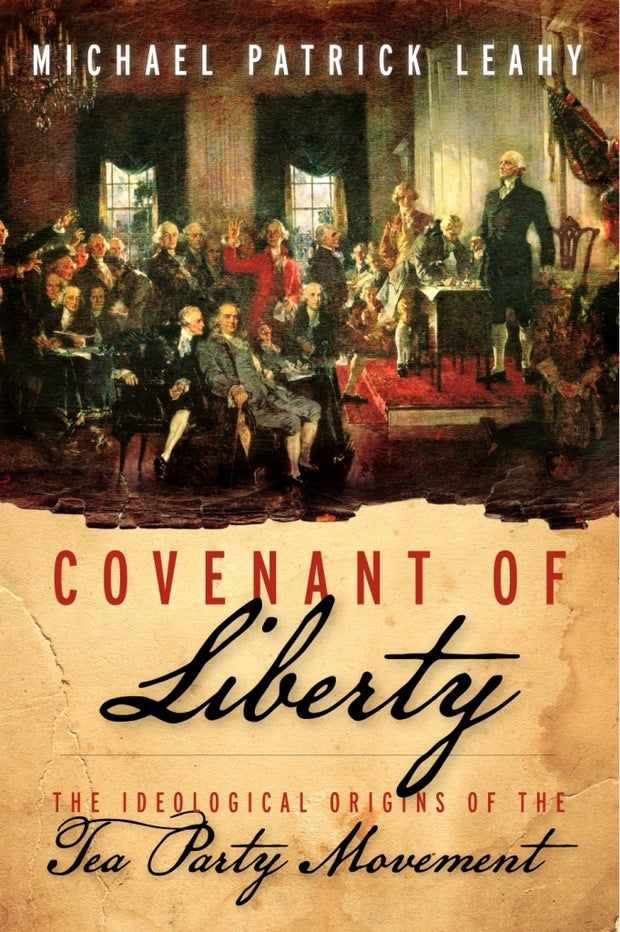
Jeff Glor talks to Michael Patrick Leahy about "Covenant of Liberty."
JG: What inspired you to write this book?
ML: I've always wanted to write a book that captured the essence of the idea of America, told in a sweeping narrative. Until now, the timing wasn't right. With the rise of the Tea Party movement, and my role as a central figure in its launch, I finally had a unique and compelling perspective to tell that story.
JG: What surprised you most during the writing process?
ML: How much I needed to improve.
I had self-published four books before my agent, Don Fehr, secured the contract for Covenant of Liberty with HarperCollins. (The book was published by HarperCollins' new imprint, Broadside Books). I was probably pretty close to Malcolm Tidwell's 10,000 hours, so I thought I was a pretty decent writer.
There's a world of difference between self-publication -- where your editing consists mainly of one copy editor you pay to help with grammar and the like -- and publication with a world class organization like HarperCollins.
The scope of editing assistance and review I received from HarperCollins is just orders of magnitude superior to my self-publishing experience. At first I thought the process was too slow. From the signing of the contract to the publication date took about a year and a half, but it's clear in retrospect that was exactly the amount of time I needed to write an excellent book.
I probably wrote about 1500 pages, of which 263 ended up in the final edited version of the book. But I must say they are 263 really good pages, and my editor, Adam Bellow, really helped me get there.
What I learned from Adam was the importance of simplicity and focus.
JG: What would you be doing if you weren't a writer?
ML: I love history, politics, technology, media, and freedom of speech. For most of my adult life, I made my living in the technology and media sectors. Politics, history, and writing were just an avocation. I wrote for publication because I had a point of view I wanted to express, one that I thought deserved consideration somewhere in the public dialogue.
Now, I'm a writer whose avocation is politics and history. What could be better?
JG: What else are you reading right now?
ML: I like to split my reading between contemporary fiction and history/biography. Fiction writers like Ken Follett, Michael Connelly, and John Grisham give me a much better sense of pacing and narrative style, so I'll always read their most recent works as soon as they're published.
As for non-fiction reading, I usually focus on one or two historical periods at a time. Currently, I'm reading a biography of Robert Morris, the financier from America's Federal Era, and a fairly academic history of every-day life in a Medieval village.
JG: What's next for you?
ML: Two things.
From a political activist point of view I'm working on a get-out-the-vote project, ElectionDayTeaParty.com , that will continue until this November.
I'm also finishing up an exciting book proposal about the history and future of what I call the constitutional liberty movement throughout the Anglosphere. The American Tea Party is but one manifestation of this nascent worldwide movement, albeit the most well-known and currently most successful.
For more on "Covenant of Liberty," visit Michael Leahy's website.