Conjoined twins separated at Va. hospital: How are they doing?
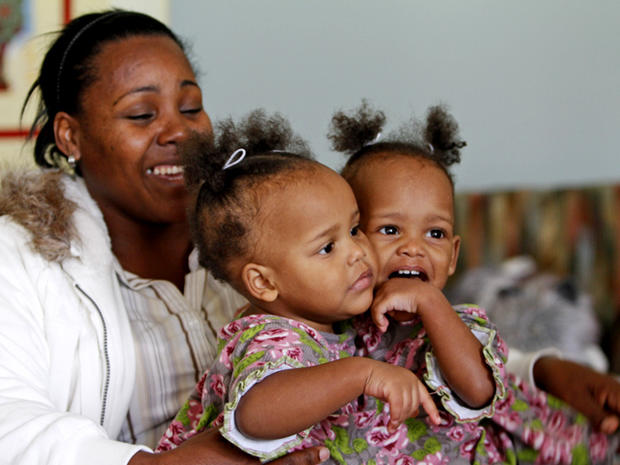
(CBS/AP) A pair of conjoined twins are paired no more, now that doctors at a Va. hospital separated them during a 20-hour procedure.
PICTURES: Conjoined twins separated in 20-hour surgery
Nineteen-month-old Maria and Teresa Tapia were separated at Children's Hospital of Richmond at Virginia Commonwealth University, CBS 6 WTVR in Richmond, reported.
The surgery took a team of 45 medical personnel to separate the twins. Maria's surgery lasted a total of 20 hours, while Teresa's clocked in at 18.5 hours. Dr. David Lanning, associate professor of surgery at VCU led the squad of surgeons.
"Everything just went so smoothly over the last 24 hours," Lanning said, adding that he expected the twins to "grow up to be healthy, young independent girls."
The girls, who hail from the Dominican Republic, shared a liver, pancreas, part of their biliary system (gallbladder, bile ducts, and surrounding structures), and a part of their small intestine.
The girls and their mother arrived in Richmond two months ago to prep for the procedure.
The surgery was an all-hands affair. Students from the University's department of fashion design and merchandising created outfits for the girls, an occupational therapist modified a car seat, and a sculpture student created foam models of the twins' bodies so pediatric plastic surgeon Dr. Jennifer Rhodes could practice before playing her role in the surgery.
"It's more than just an operation," Rhodes said. "To get patients from start to finish you need to get involved and care for them in a holistic fashion."
The World Pediatric Project, a nonprofit surgical-care provider for children in Central America and the Caribbean, sponsored the twins' medical care. Lanning has volunteered with the group for several years.
The girls are expected to remain hospitalized for about two weeks and stay in Richmond at least another month so they can undergo physical and occupational therapy. They could return home by the end of the year to reunite with their father and three other siblings.
Worldwide, conjoined twins account for between 1 in 50,000 and 1 in 100,000 live births. The condition is three times more likely among females than males. A third of conjoined twins are attached at the lower chest, as in the case of the Tapia twins. About a half-dozen separation surgeries are done in the U.S. annually, Lanning said, and maybe double that number worldwide.
The surgery is a dream-come-true for the girls' mother, 24-year-old Lisandra Sanatis.
"It may be a little strange at first, but it really is what I wanted," Sanatis said through an interpreter. "I'm so happy to be able to see them be the individuals they were born to be."
These amazing twins weren't the only ones to make national headlines for being separated this month. On Nov. 2, two-year-old conjoined twins Angelica and Angelina Sabuco were separated following a nine-hour procedure at Stanford University's Lucile Packard Children's Hospital, CBS News reported.