Cockroaches, fitted with tiny backpacks, could be part of the future of spycraft, search-and-rescue missions

The future of spy bugs may be an actual insect: the Madagascar hissing cockroach.
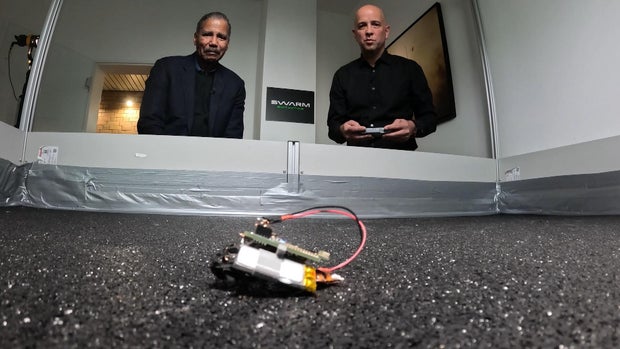
SWARM Biotactics, a German startup, is working to fit cockroaches with tiny backpacks that could carry cameras, microphones, and Doppler radar. The species is small enough to fit almost anywhere and resilient enough to survive environments that could be dangerous to people, CEO Stefan Wilhelm said.
"Millions of years of evolution actually produced a very resilient, a very mobile and a very capable insect," Wilhelm said. "That is, for what we want to do, a perfect, perfect animal, actually."
Why cockroaches?
For Wilhelm, the idea started with discussions on bringing biology, electronics and robotics together. SWARM is currently working with the Madagascar hissing cockroach because it is well researched and has the ability to carry "a significant payload."
Right now, Wilhelm said the cockroaches carry backpacks up to 15-grams, though the company is working to reduce the weight to 10-grams.
Cockroaches are able to withstand dangerous environments, including exposure to chemicals, heat and radiation, Wilhelm said.
"It's low signature, it's super energy efficient. It's almost undetectable in terms of when you bring it out into the field. And you can scale it almost unlimitedly," Wilhelm said.
Other types of cockroaches are faster and some can carry more weight, so there's room to test different varieties of cockroaches depending on the specific need, Wilhelm said. While SWARM is focused on cockroaches for now, Wilhelm said the company is looking at locusts and grasshoppers, too.
How it all works
SWARM's insect neuroscientists attach electrodes to the roaches' antennae to stimulate the insects' natural ability to navigate.
"It's a roach with a backpack, and we're nudging him into the right direction," Wilhelm said.
SWARM can use controllers to direct the cockroaches. The company is also developing algorithms to control them autonomously.
"With that algorithm we create, you can steer a whole swarm of insects towards a target. And that could be 10, that could be also, like, a hundred," he said.
SWARM says the process is painless for the cockroaches.
"They're very important for us, and they need to be in very good condition, and have a good life, in order to, you know, perform well in their missions," Wilhelm said. "We make sure we take good care of them."
What SWARM sees as the future of cockroaches
SWARM Biotactics was launched against the backdrop of German concerns about Europe's security as the war in Ukraine continues and the U.S. increases pressure on the continent to shoulder more of its own defense.
"It gives you, you know, a capability no other system can give you because it can go to places where you otherwise couldn't go with any other technology," Wilhelm said.
Drones or soldiers would be needed to deliver the swarms to certain areas, he said. Different cockroaches in the swarms can be equipped with different types of tiny backpacks.
"Some cockroaches are more for the camera, some are more for communication, for positioning. We triangulate between the swarms to get a good sense of where the swarm is exactly, if it's underground or denied areas. But you can carry a lot of different sensors, according to what you need," Wilhelm said.
SWARM is working with the Bundeswehr, Germany's military, to test the cockroaches' capabilities in the field. The company's focus right now is on defense and reconnaissance — not using roaches to carry explosives, Wilhelm said. He acknowledged that could change in the future.
"But it needs to be, of course, you know, within the legal framework," he said, later adding, "That is something we need to develop over time, whether that is an application which is useful or not. We don't focus on that right now."
Wilhelm believes cockroach swarms can also be used for search-and-rescue operations. The insects can crawl through unstable areas to look for survivors.
The first larger deployments of swarms could be in 18-24 months, Wilhelm said.