Alabama governor commutes death sentence of inmate who didn't kill victim
Alabama Gov. Kay Ivey on Tuesday commuted the death sentence of a 75-year-old inmate who was set to be executed this week, even though he was not in the building when the victim was killed.
Ivey reduced Charles "Sonny" Burton's sentence to life in prison without possibility of parole, marking just the second time the Republican governor has granted clemency of a death row inmate since taking office in 2017.
Burton was sentenced to death for the 1991 shooting death of a customer, Doug Battle, during a store robbery. However, another man, Derrick DeBruce, shot Battle after Burton had left the building. DeBruce's death sentence was later reduced on appeal to life in prison.
Ivey, who has presided over 25 executions, said she firmly believes in the death penalty as "just punishment for society's most heinous offenders," but said it also must be administered fairly and proportionately.
"I cannot proceed in good conscience with the execution of Mr. Burton under such disparate circumstances. I believe it would be unjust for one participant in this crime to be executed while the participant who pulled the trigger was not," Ivey said in a statement.
Burton was scheduled to be executed Thursday night by nitrogen gas. Members of Burton's legal team cheered when they received the news Tuesday.
Jurors, family supported commutation
Battle was shot in the back during an Aug. 16, 1991, robbery of an AutoZone auto parts store in Talladega. Burton and other robbers left the store when Battle entered and exchanged words with DeBruce, according to court testimony. DeBruce shot Battle after the robbers had left the store.
Burton told The Associated Press in February that no one was supposed to be injured in the robbery and that he didn't know until later that DeBruce had shot anyone.
"I didn't know anything about nobody getting hurt until we were on the way back. No, nobody supposed to get hurt," Burton said in a telephone interview from Alabama's Holman Correctional Facility.
Burton said he wants to apologize to Battle's family. "I'm so sorry. If I had the power to bring him back, I would. I'm so sorry," Burton said.
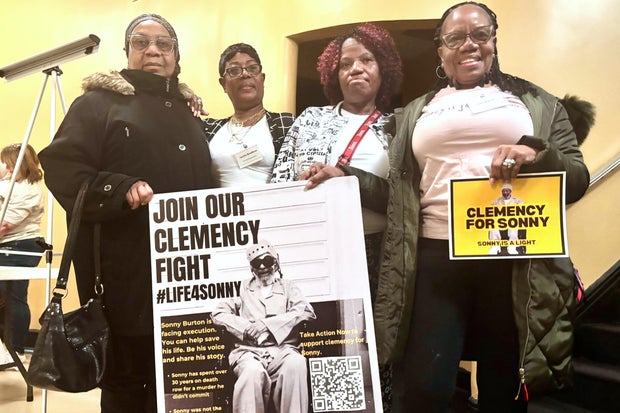
Burton's supporters and family members had urged Ivey to consider clemency for the inmate, who is sometimes confined to a wheelchair. Multiple jurors from Burton's 1992 trial were among those urging his life be spared. In an essay published on AL.com in January, juror Priscilla Townsend said she was wrong for recommending Burton receive the death penalty.
"Mr. Burton was not inside the AutoZone at the time of the murder. He was not the shooter, and yet the state sought and secured a death sentence against him anyway. At the time, I did not fully understand what that meant. I do now," Townsend wrote. She said that prosecutors had painted Burton as the "ring leader," which "shaped everything" about the trial and its outcome.
"It shaped how the evidence was viewed, how responsibility was assigned, and how punishment was justified," the essay read. "I believed it. The jury believed it. I no longer believe it was true."
Battle's daughter sent a letter to Ivey urging clemency, asking "how does it legally make sense" to execute Burton.
Twenty-seven states allow people to be executed for taking part in a felony that led to someone's death, even if they did not directly kill anyone themselves, according to the American Civil Liberties Union.
According to the Death Penalty Information Center, Alabama has carried out 83 executions since 1976.