Bureau of Prisons faces scrutiny over startup's exclusive deal to sell non-FDA-authorized nicotine pouches to prisoners

A Florida company that was established in May won an unusual and potentially lucrative deal to be the only business permitted to stock the commissaries of the Bureau of Prisons' 118 institutions with flavored nicotine pouches.
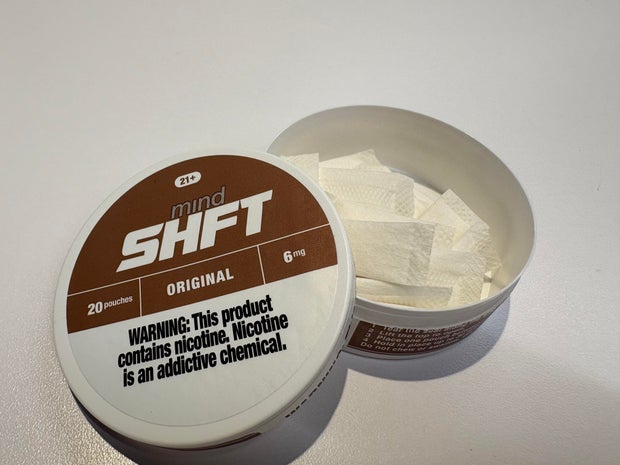
The brand of 6-mg pouches being sold to federal prisoners, called "mindSHFT," is not authorized by the Food and Drug Administration to be marketed and sold in the U.S., according to a review of FDA data. It is also not sold commercially.
After CBS News began investigating the nicotine pouch deal and an anonymous federal employee this week emailed the Justice Department's inspector general and Attorney General Todd Blanche to raise concerns, a senior prison official on Thursday paused the arrangement. The official ordered all prisons to cease procuring them until further notice, according to a Sept. 3 internal memo reviewed by CBS News.
"This situation deserves immediate attention," the anonymous employee wrote in a whistleblower complaint to Blanche and DOJ Inspector General Don Berthiaume.
"The Bureau of Prisons is responsible for the health and safety of individuals in its custody. If an improperly authorized or contaminated product is being purchased and distributed throughout the federal system, the consequences could be extremely serious," the whistleblower warned, according to a copy of the complaint reviewed by CBS News.
"BOP began offering nicotine pouches through institution commissaries to combat the trafficking of contraband tobacco and nicotine products by criminal organizations inside federal prisons," a BOP spokesperson said.
"BOP has suspended all additional purchasing of these products until further notice while under review," the spokesperson added.
The decision to suspend purchasing and selling the products came about after BOP consulted with the FDA this week, and a legal review of existing inventory was still ongoing, a source with knowledge of the procurement told CBS News. The person added that no illnesses or adverse effects have been reported by anyone who may have used the products.
The company supplying the prisons with nicotine pouches, SHFT Holdings Enterprise LLC, was incorporated in Florida one week after the BOP published a nationwide "request for information" on May 15 that asked about vendors who could produce "FDA-authorized nicotine pouch products" to sell to federal prisoners.
The company's domain name — https://shftholdings.com — was created on May 7. A copy of the BOP's trust fund manual approved by Bureau of Prisons Director William Marshall, also dated May 7, shows that amendments were made to permit the sale of nicotine pouches in commissaries.
Kevin Mastaler, who is listed as the main point of contact on registration and BOP sales records for the product, contacted CBS News by email after publication. He said that SHFT "learned of the opportunity from that (May 15 Bureau of Prisons) posting and responded through the published channel." He added that SHFT "used no channel unavailable to any other respondent."
"Selling like hotcakes"
The BOP never formally issued a request for proposals for bids on a provider for nicotine pouches — any RFP would be publicly available online. The BOP does not have a signed contract with the company, according to a person familiar with the arrangement.
But its trust fund chief, Adam Morrow, on July 21 informed all federal prisons in a memo that the sale of nicotine pouches "has been authorized," and the sole approved vendor would be SHFT Holdings Enterprise LLC, according to a copy reviewed by CBS News.
A week later, on July 29, BOP officials announced that Citibank was able to "fully process" institutional orders, and they recommended that each prison consider ordering "three tins per inmate" to ensure product availability, according to an internal memo reviewed by CBS News.
There are currently just over 153,000 inmates in federal custody.
SHFT Holdings Enterprise charged BOP $6.99 per tin, or $174.75 for five packs of 25 tins, according to internal pricing records seen by CBS News. Inmates are charged $9.10 each, and in prisons where they have been available, they have been "selling like hotcakes," one source with direct knowledge said.
Federal law prohibits the sale and marketing of nicotine and tobacco-related products that are not authorized by the FDA.
After questions arose about the company's claims about its nicotine pouches, BOP halted all purchasing and sales of the products after consulting with the FDA, a person close to the matter said. The BOP said the company told the bureau it was selling the products legally and had obtained FDA approval, the person added.
Mastaler said in his email that the company "has never represented" to BOP that its product had been authorized by the FDA.
By law, anything that is sold without FDA authorization is deemed "adulterated," legal experts told CBS News.
"There has been no determination by FDA that this product is appropriate for the protection of the public health, which is required before the product can be sold," said Andrew Goldfarb, a partner at Zuckerman Spaeder and former Justice Department attorney who specializes in FDA laws.
"There is no basis to think that FDA, let alone anyone who might use the product, knows what is in it, where any of the ingredients are sourced from, or the conditions in the facility where it was made," he added.
Nicotine pouches are the fastest growing segment of the U.S. tobacco market. Some of the brands contain synthetic nicotine that is not derived from tobacco, while others are tobacco-derived, and they deliver a jolt of energy that users describe as a mild buzz.
The website for SHFT Holdings Enterprise describes the pouches as being a healthier alternative to cigarettes. "From toxic" to "healthy," it says. "Replacing carcinogens, tar, and smoke" with a "clean delivery format" that causes "95% less harm" than tobacco. Nothing on its website or on its packaging references receiving FDA authorization.
CBS News could not determine why the Bureau of Prisons selected SHFT Holdings Enterprise to provide the product.
The process to select the company occurred over many months, and no BOP officials involved in the selection have relations to this company or interest in its operations, a source familiar with the procurement process told CBS News.
As of Friday, there were only two companies authorized by the FDA to sell nicotine pouches: One is a subsidiary of Philip Morris International, and the other is an Altria Group subsidiary.
The FDA in May issued a memo saying it would exercise enforcement discretion on nicotine pouch makers, as long as the company has submitted an accepted and pending application.
CBS News could not immediately determine whether SHFT Holdings Enterprise had filed an application with the FDA because the agency does not comment on the status of applications. An FDA spokesperson said that the agency has not issued an authorization to mindSHFT nicotine pouches.
Lawyers who specialize in FDA law said that these types of applications are very complex, and a small company that had just incorporated would face steep challenges in completing the paperwork.
"It is a very big deal to file one of these applications," said Howard Sklamberg, the former top enforcement official at the FDA who is now a partner with Arnold & Porter. "You spend a lot of money on consultants. You have to have a lot of science. It's not a box-checking exercise."
Mastaler said in his email that two applications, one for each of the two products, "have been submitted to and accepted by FDA," and both are now being reviewed.
He also contended that there are other nicotine pouch products "from dozens of manufacturers" that are "sold with an application before the FDA," rather than with FDA authorization. And he noted the FDA guidance that it would not prioritize enforcement actions against nicotine pouches with pending applications.
Mastaler told CBS News in the email that SHFT Holdings Enterprise is owned and controlled by AmeriBrands LLC. The product, he said, is made in the U.S. by AmeriPouch LLC, which he described as an "American nicotine pouch manufacturer that also supplies established national brands sold through the major convenience and big-box chains."
Complex business connections
Limited information on SHFT Holdings Enterprise exists online, apart from its Florida incorporation records, a June 4 trademark application, a bare-bones website and its registration on SAM.gov, the government contracting website operated by the General Services Administration.
But those documents and internal BOP sales records reviewed by CBS News offer a few clues.
Mastaler, SHFT's main point of contact on documents regarding the deal, was as of June the chief of staff at the fitness supplement company Redcon1, according to Florida business records.
When reached by telephone by a CBS News reporter before publication, Mastaler said he wasn't aware that procurements of the nicotine pouches were being stopped. At the time, he declined to answer questions about how the company started selling nicotine pouches to the Bureau of Prisons and said he wanted to speak to his lawyer before speaking further to the press.
A second point of contact for the company listed on its SAM government contracting registration is Ryan Monahan, Redcon1's former chief marketing officer. Monahan did not return a phone call seeking comment.
RedCon1 was previously led by Aaron Singerman, a businessman, body builder, and vocal supporter of President Trump who served about 10 months in federal prison after he was convicted of selling unlawful anabolic steroids and other non-FDA approved products marketed as dietary supplements.
On his Instagram page, Singerman can be seen posing with Mr. Trump, Donald Trump Jr., and others at the president's Mar-a-Lago club on the night Mr. Trump won the 2024 presidential election. Singerman, a member of Mar-a-Lago since 2021, according to membership documents viewed by CBS News, often attended events at the club.
Recent Florida corporation records and social media posts show that Singerman and Mastaler continue to maintain other business ties that use the same mailing address and law firm used by SHFT Holdings Enterprise. None of the available public or internal BOP sales records connect Singerman to Holdings Enterprise.
Singerman did not respond to calls or emails seeking comment about whether he is involved with SHFT Holdings Enterprise.
Mastaler did not address questions from CBS News on whether Singerman is involved in the company.
Concern among correctional staff
The decision to start selling nicotine pouches to federal inmates has flummoxed long-time current and former correction officials, who told CBS News they had numerous health and safety concerns.
CBS News could not determine precisely how many nicotine pouches have been purchased by prisons since July, though sales records from some prisons in the Northeast and Southeast regions show purchases have been made for both smaller orders of $3,000, as well as larger orders ranging from $8,000 to more than $28,000.
The sale of smoking and tobacco-related products in federal prison commissaries has been prohibited since 2014 by a BOP rule. But this regulation does not address the use of nicotine pouches, which did not exist as a commercially available product in 2014 and do not necessarily contain tobacco-derived products.
A corrections official who has worked for the Bureau of Prisons for 18 years said he hasn't seen a directive to sell nicotine or nicotine products to inmates since he started working within the federal system.
"This is crazy that they are selling nicotine pouches to inmates," the corrections official told CBS News, citing the sale of nicotine as a possible security issue for staff and noting that correction officers are prohibited from smoking on prison grounds.
But Mastaler told CBS News that safety measures were built into the shipping and packaging. He said the container is made of plastic, rather than metal, and it's "deliberately thin and unstable so it cannot be worked or sharpened into anything hazardous." He also said that the container has a "tamper-evident seal."
Prisoners use trust fund accounts, which are often replenished by their family members, to purchase items for sale in commissaries such as phone calls, emails, food and beverages. Proceeds from those sales go into the prison system's trust fund, a revolving account that is not federally funded.
In a memo to staff on May 14, Marshall said the bureau was seeking market data, known as requests for information, on a variety of services, including food, commissary and medical services, to help address financial challenges facing the trust fund. His memo did not explicitly mention nicotine pouches.
"The Trust Fund is operating at an annual loss of $23 million," he wrote. A person familiar with the matter told CBS News that the trust fund is now profitable again — without the nicotine sales.
Editor's note: SHFT Holdings Enterprise emailed an additional response to CBS News after the article was published, and the report has been updated to reflect that. A previous version of this article referred to the company as SHFT Enterprise Holdings LLC.