How many Amsterdam improv theaters does it take to make some of the biggest names in comedy?

Talk show host Seth Meyers, fresh out of college, had no idea what he was getting into when he auditioned for an English-language improv theater, Boom Chicago, in Amsterdam.
Meyers secured the gig and started in 1997. His first thought about his new home? Does "Hamlet" or, perhaps, "The Sounds of Music" take place in the Netherlands? Would he need hiking shoes? Meyers was wrong on all accounts, but his decision to take the job proved to be the right choice.
He went on to spend four years at Boom Chicago, honing his comedic chops at the storied club in the heart of Amsterdam. And he's not the only American comic whose career launched from Boom Chicago; Jordan Peele, Amber Ruffin, Jason Sudeikis and Ike Barinholtz all got their starts at the club.
Setting up the punch line: How Boom Chicago came to be
Boom Chicago got its start in 1993, when Andrew Moskos and Pep Rosenfeld, two young, American comedians and recent Northwestern graduates, were struggling to make it in the Chicago comedy scene.
They were drawn to Amsterdam for the appeal of sex, drugs and rock 'n' roll, Moskos said. Along with a third classmate, Ken Schaefle, they decided what Amsterdam needed, of all things, was an English-language comedy joint.
At the time, the idea sounded more like a punchline than it did a winning business idea.
"It was probably the best stoner idea ever. You know, 'Let's quit our jobs and move to Amsterdam and start a business,'" Moskos said.
They roped in local Saskia Maas, who brought a level of sobriety and savvy to Moskos and Rosenfelds' fledgling business. She also later married Moskos.
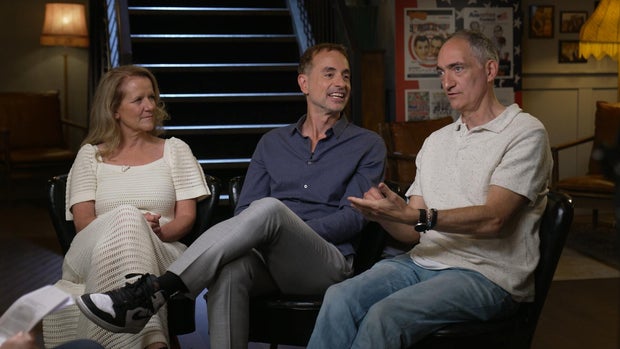
The comedic hopefuls wrote to the local tourist board, asking for advice and seeking validation. They were told their idea wouldn't work.
Moskos, reading the letter, decided they should go for it anyway.
They named the club "Boom Chicago," a nod to their hometown. They found a stage in the back of a bar, and eventually their own proper theatre off the Leidesplein, the Times Square of Amsterdam.
"And our little summer project became a year-round business," Moskos said.
Making a name for themselves in comedy
Moskos and Rosenfeld went back to Chicago to recruit talent for their new stage. They made their pitch to two Northwestern grads, Seth Meyers and Peter Grosz, who's now an actor and Emmy-winning comedy writer.
Once Boom Chicago had comics, the club needed an audience. Rosenfeld would go out on the Leidseplein — a bustling, central Amsterdam square — and hawk tickets.
"We didn't have a bank account, so the money went in my boots. I wore cowboy boots then," Rosenfeld said.
One night, Rosenfeld knocked on Moskos' door after a show.
"Pep is over there and goes, 'Yeah, I brought this girl home. And I don't know if I want to leave her in the room with the boot.' And he handed the boot over to me for safekeeping that evening," Moskos said.
Back in U.S. comedy circles, word spread. Josh Meyers, Seth's younger brother, and Ike Barinholtz were hired 25 years ago. Today, Barinholtz is an actor in ascent, just nominated for an Emmy for his role in the Apple TV show, "The Studio."
What American comedians learned on a Dutch stage
Comics learned quickly to avoid cheap jokes. References to the Cleveland Browns or the Olive Garden didn't cut it with audiences in Amsterdam.
"English isn't all their first language, so you have to learn how to be bigger," Barinholtz said. "You have to learn how to own a room and make references that are a little more universal and deal with concepts and themes that someone from Australia or someone from Finland or someone from New Jersey can all relate to."
Josh Meyers remembers one time he referenced keying someone's car during a show.
"And then our director was like, 'People don't know what keying a car is over here,'" he said.
Brendan Hunt, actor and "Ted Lasso" co-creator, was doing improv in Chicago in the '90s when he decided to cross the ocean to join the Boom Chicago troupe.
"If you happened to live here long enough to have, like, one or two Dutch words in your pocket, and could throw one Dutch word into your improv, you were a god to them," Hunt said.
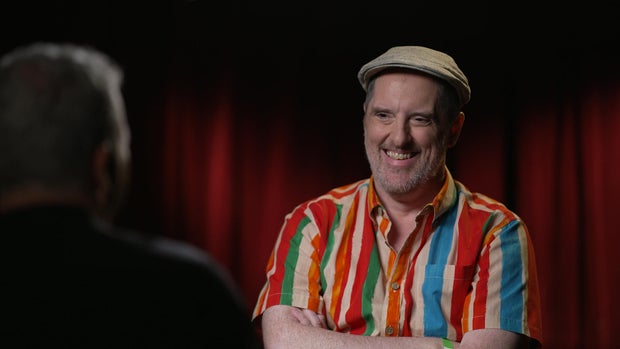
Then, as now, the 10 or so comedians in the troupe commit to one year minimum and are paid enough to make it a full-time job. Performing six shows a week means a lot of reps on stage, with little time to wallow after the inevitable rough nights.
Stacey Smith, who's in the current Boom Chicago troupe, said that because the ensemble works together so often, they can use intermissions during shows to go over what's worked and what's flopped.
"When you're working on a team, you do need to come in with the mindset that you're building that piece from start to finish as a unit," she said.
Improv has an unpredictability and reliance on teamwork that makes it a critical building block of true humor.
"We do believe that if you are a good improviser, then you already have the tools to be a good stand-up comedian," Smith said.
Boom Chicago booms
Seth Meyers' work at Boom helped him make his name in comedy. A touring show he developed with Boom and fellow comic Jill Benjamin caught the eye of "Saturday Night Live" in 2000 and he was offered a writing job with the long-running comedy sketch show.
"It was really special to know it was the sort of thing that made people want to see more of you," Meyers said.
He and Brendan Hunt both draw a direct line from Boom Chicago to their success today. Hunt became obsessed with European soccer while in Amsterdam.
"I don't think 'Ted Lasso' does happen without Boom Chicago," Hunt said. "It opened us up to the view of Americans abroad, and viewing yourself outside of your own home."
Today, Business at Boom Chicago is, well, booming. The troupe's comedians host global corporate events, in addition to five days of shows a week. Plus, the club's comedy academy teaches improv to more than 200 students.
Annual earnings are now measured in the millions — and it's no longer stored in a boot.