Book excerpt: "Where We Keep the Light" by Josh Shapiro

We may receive an affiliate commission from anything you buy from this article.
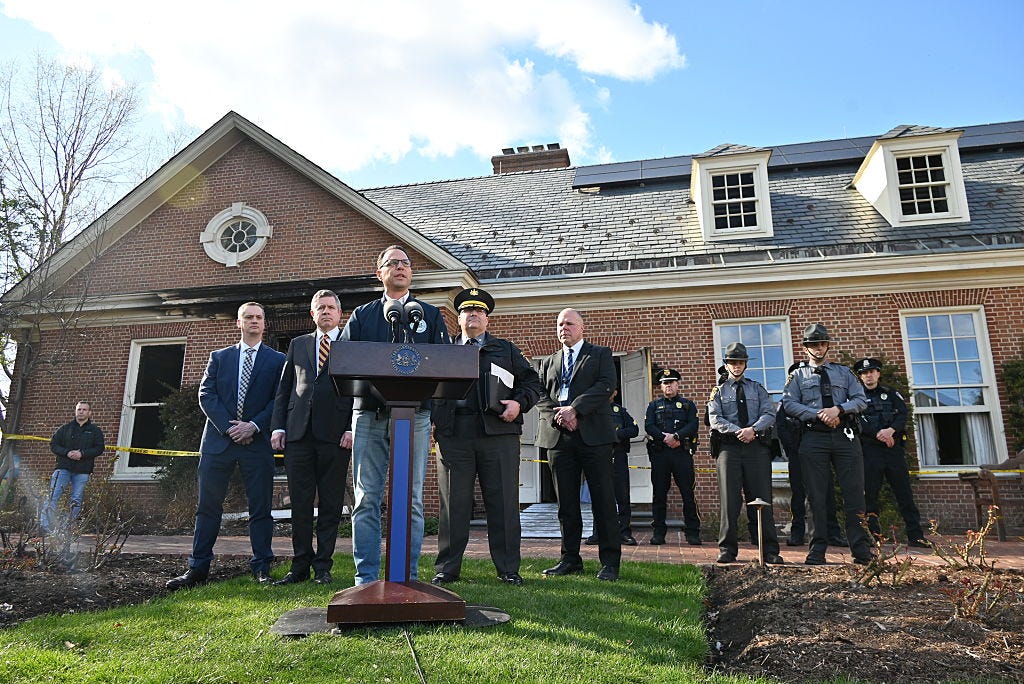
In his new memoir, "Where We Keep the Light" (to be published Tuesday by HarperCollins), Pennsylvania Governor Josh Shapiro writes of his lifetime of public service, as well as the aftermath of the April 2025 arson attack on his home, and of the character of ordinary Americans – determined to build and strengthen community – who represent "the bonds that lead to a more perfect union."
Read an excerpt below, and don't miss Norah O'Donnell's interview with Josh Shapiro on "CBS Sunday Morning" January 25!
"Where We Keep the Light" by Josh Shapiro
Prefer to listen? Audible has a 30-day free trial available right now.
Five months later, in the weeks following the arson attack on the Residence, as I sat in a pew at Salem Baptist Church, I felt a tap on my arm. It was a woman from the congregation who had been sitting in the pew across from me. She was in a baby-pink T-shirt and sweatpants and a matching baseball cap, suited up to join the other church ladies on a fitness walk after the service. She was in her seventies, at least, and greeted me with a smile. "Governor, I've been praying for you," she said. I was touched, of course. "We will take care of you like you took care of me all those years ago and lifted me up."
She had tears in her eyes as she told me that seventeen years ago, when I'd served this district in the state House, we had met at a local event. Her husband had been sick, and she'd been having a hard time. They'd needed help with their medical benefits. I'd heard her, she said. I could see how down and out they had been. I'd told my team that they needed to figure out a way to get them what they needed, and we had. And now, here she was, in this church, at a difficult point in my life and for my family. She was here praying for me, lifting me up. I could feel the power of her prayers. The sense of connectedness to someone I hadn't really seen in many years.
Those days after the attack on the Governor's Residence felt, at times, heavy and unrelenting, like we were wandering through the dark. And yet, as we navigated the challenges and shouldered the weight, what we remember most is not the hardness and the weight. What we carry forward are the moments like this. Because this light, it was all around us. We were overwhelmed by the outpouring from people all across this country whose shared humanity, shared sense of decency, shared agreement of what is right and what is wrong and of what our country should be and who Americans are at our core, overrides all of that.
In days like that morning at Salem, or when I am in a synagogue or any place of worship, which is often in the course of my work, I find myself thinking more and more about William Penn. That he arrived on our shores in October 1682 aboard a ship named Welcome. His Pennsylvania would be a place that would be open to all people, grounded in free expression, freedom of religion, free elections, and respect for others. I think about my responsibility to carry this forward—to go a few more miles in the journey Penn began, to build a place that remains warm and welcoming for everyone—no matter what you look like, where you come from, who you love, or who you pray to.
Now, I assume Penn could have never imagined a Governor who prays like me or a Lieutenant Governor who looks like Austin [Davius] in the land he once led. Or that he ever would have envisioned a world in which a Jewish Governor would host a giant iftar during Ramadan, obsess about needing more and bigger Christmas trees at the Governor's Residence in December, or host his son's bar mitzvah in the same spot where both of those expressions of other people's faiths took place. Though I do bet he'd be proud of how far we've come.
His ideas of faith and his acceptance of others set in motion something that we need to find our way back to today. It's a foundational principle of this great nation. A band of patriots gathered at Independence Hall in 1776 to declare our independence from a king and set ourselves on a path of self-determination. Those patriots plotted, planned, and organized in taverns and town squares and decided that they wanted to live in a place grounded in the notion of real freedom and self-determination. And over the last two and half centuries, our American story has been defined by people from all walks of life who have followed that lead and done their part. Ordinary Americans rising up, demanding more, seeking justice, and working to build a better life for their children. The story of our nation has not been written just by people with titles next to their names or by people in government offices but by everyday folks believing in each other, standing up, raising their voices, and using their power.
I've been privileged in my life to know those people—the ones who will be in the history books and the ones I've written about in this book. The ones I feel blessed to know because they taught me something and helped me grow as a public servant, as a father, a husband, and a person, and brought me closer to my own faith.
That is the American way. Those are the bonds that lead to a more perfect union. Those people, those bonds, that deeper connection to my faith are how I have learned to fish differently. To show up, to listen, to leave this place better than we found it. That's the cornerstone of my faith—of all faiths, really. It's elemental, even as it is sometimes hard to see and feel today.
This has been true at all the most significant moments in American history—the commitment to doing the hard work required to have faith in these ideals and the people to perfect them. That is our shared story. It was true for our Founders at Independence Hall. It offered courage to the brave souls who wore our uniform and landed on foreign beaches to protect our freedoms here at home and defeat fascism abroad. It was on display when our neighbors, who sought a more perfect union, sat down at the lunch counter so the next generation could stand taller.
I've witnessed this in the many millions of quieter moments of goodness, too. The way my father showed faith that new moms could tell him what they needed for their babies, not the other way around. The way my mother taught me to care about the world around me. In how the survivors of abuse found the courage to expose the truth. I've seen this with the dedication and bravery of the Hawbaker workers who were unafraid of corporate power. And with the law enforcement officers who care so deeply about their neighbors that they're willing to give their lives for the rest of us. I witnessed the fortitude of moms who lost their kids to fentanyl, who turn their pain into help for others; the craftsmen who wouldn't let an arsonist's crimes keep the people's home closed; the brave couples who pushed for marriage equality and moved the needle; the lady at Sheetz who got her husband the care he needed, along with thousands of others in dire straits; a community ravaged by an attack on their neighbors determined to show a capacity to love rather than succumb to hate.
All those people and their actions and their belief in common good have propelled us forward, just like our Founders intended, and helped us find our faith in a brighter, better day. Ordinary folks doing extraordinary things each day to build a more just and connected nation. To not be consumed by darkness or chaos.
Now more than ever, we yearn for and need a world defined by faith. It's universal, this belief in others to help us through what feels unsettled, uncivil, un-American. It's a guidepost, a path through the woods. When the dark feels like it could consume us whole and churn us up and lose us, it is where we keep the light.
Reprinted with permission from the book "Where We Keep the Light." Copyright © 2026 by Josh Shapiro. Published by Harper, an imprint of HarperCollins Publishers.
Get the book here:
"Where We Keep the Light" by Josh Shapiro
Buy locally from Bookshop.org
For more info:
- "Where We Keep the Light: Stories from a Life of Service" by Josh Shapiro (HarperCollins), in Hardcover, eBook and Audio formats, available Jan. 27
- Commonwealth of Pennsylvania: Gov. Josh Shapiro