Book excerpt: "The Colonel and the King" by Peter Guralnick
We may receive an affiliate commission from anything you buy from this article.
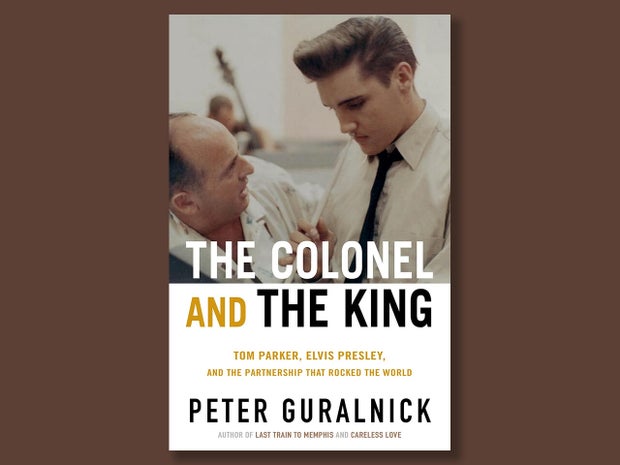
Elvis Presley biographer Peter Guralnick's latest book, "The Colonel and the King: Tom Parker, Elvis Presley, and the Partnership that Rocked the World" (Little, Brown & Co.), traces the relationship between the King and a manager whose marketing savvy helped launch a rock 'n' roll revolution.
Read an excerpt below, and don't miss Anthony Mason's interview with Peter Guralnick on "CBS Sunday Morning" December 7!
"The Colonel and the King" by Peter Guralnick
Prefer to listen? Audible has a 30-day free trial available right now.
The Beginning of It All
He first became aware of the boy in early 1955 through an old pal in Texarkana, Arkansas, a DJ, radio personality, and promoter named Ernest Hackworth who went by the name of Uncle Dudley. Hackworth, who, like so many other promoters, worked on his own shows as a country comedian, reported that this kid from Memphis had drawn more than eight hundred people to a little schoolhouse in New Boston, Texas, on January 11, which was a heckuva draw for an unknown artist whose name he usually got all jumbled up.
Oddly enough, Colonel was later reminded, he had actually been told about the boy two months earlier by another old colleague, Oscar Davis, who was wont to say he had made several fortunes (true—he had managed Hank Williams at the height of his career) and lost even more (equally true). Davis, a smooth-tongued, silver-haired operator who went back even further than Colonel in the world of carnivals and show business, was a peer- less pitchman, always immaculately dressed, always sharp as a tack—in the view of a mutual acquaintance who did business with them both, he differed from Colonel in only two ways. Unlike Colonel, Oscar Davis looked the part, "he looked like the man with the money"— but also unlike Colonel (with whom you could operate with complete confidence on a handshake basis) you couldn't trust a word that he said.
Oscar had hit a rough patch lately and was advancing an Eddy Arnold tour for Colonel when he met this Presley boy in Memphis and had even gone to see him perform at some little club where the kid had really gotten the audience worked up. But for one reason or another, it seemed like Oscar wasn't emphasizing the point too strongly, or maybe Colonel just wasn't listening that closely (with Oscar Davis, you didn't want to over-listen), so it wasn't until Uncle Dudley spoke to him the day after the New Boston show that he paid attention.
This time there was no hesitation.
He and Tom Diskin went to see Presley perform at the Louisiana Hayride three days later, and he was so knocked out, not so much by the music—he really wasn't sure at first what to make of the music—as by the reaction of the crowd, that he got in touch with Presley's manager, a Memphis DJ named Bob Neal, right away. Within a week he had him booked on the Hank Snow tour that was about to begin in New Mexico on February 14. Even before the start of the tour, apparently on the strength of the Hayride performance alone, Colonel approached Steve Sholes about signing him to RCA, but as it turned out, the head of Presley's little record label in Memphis, Sam Phillips, wouldn't hear of it, in fact he seemed almost insulted by the idea, so Colonel was forced to let Steve know that it looked like Presley was "pretty securely tied up" for the time being.
From the very first dates on the New Mexico tour, the boy's talent—not just his talent but his drive, and especially his capacity for growth—were unmistakable. When asked some eighteen months later if he took credit for Elvis Presley's unparalleled success, the Colonel uncharacteristically demurred. "I think Presley was a star from the first day he ever started going into show business," he said. "I knew I could help him, [but] I think anyone could have helped him that knows something about show business."
It was astounding, the speed with which it happened.
Everywhere the Hank Snow–headlined revue played, the clamor over Presley's performance only grew, and many nights he took the show. Hank Snow tried to hide his reaction, but Colonel could not help but be aware of it and all the ways his client's wounded vanity played out. The boy never seemed to notice, though; he clearly thought the world of Snow, and Colonel did all he could to smooth things over, pointing out that everywhere they went, they were breaking attendance records, which surely had to be considered a tribute to the star of the show.
Things could not have been going better, in fact, for the new partnership between Colonel Tom Parker and Hank Snow. Record sales were up, and due to his assiduous efforts, Colonel never tired of reminding Snow, all sorts of new, high-paying opportunities in radio and television were starting to open up. The trades attributed these rapidly expanding horizons to a unique artist-manager relationship which Cash Box would describe as "based on loyalty, mutual respect and a common objective," not to mention the uncommon efforts of Tom Parker, "a colorful personality [with] a natural flair for showmanship [who is] known from coast to coast . . . and respected for his sound business principles [and his] policy of doing more than he has promised."
But, tellingly, Colonel didn't book Elvis with Hank again until May, while Hank continued to do record-breaking business on his own.
One of the stumbling blocks—the principal stumbling block—to his doing more with Presley was the boy's manager, Bob Neal, who seemed infuriatingly unsusceptible to persuasion, promotion, or even recognition of his own (let alone his artist's) ever-increasing opportunities. During a brief break from touring at the beginning of March, Colonel wrote to Tom Diskin, clearly disheartened by his inability to make any headway with Neal. "I don't see much use in wasting any [more] money or time on Presley till we know that they need us, and only when they contact us direct for help in some way." Things were slow in the business in general, he noted, but he had not given up on improving Hank's royalty situation with RCA, or maybe even moving him to his old friend Randy Wood's Dot label (though in all likelihood, here he was merely musing out loud, for his own and Tom Diskin's benefit, about something that would almost certainly have been little more than a negotiating ploy). Meanwhile, he thought he would set up another strong ten- or fifteen-day tour for Hank, "keep getting special deals lined up," and focus on getting him another guest shot on TV with Perry Como.
But as frustrated as he was by the Presley situation, he was not about to give up. Finally, on March 29, he was able to come to some sort of agreement with Bob Neal for a two-week series of one-nighters in Florida with Hank Snow, but he couldn't resist needling Neal while at the same time trying to steer him toward a more realistic appraisal of the situation. Neal had to pay more attention to business, he wrote with unfeigned indignation. He had to get the Colonel a complete supply of photos and records right away. And most important of all, the boy was never going to get anywhere so long as he was on Sun Records. "I am finding out that in some places they have never heard of Elvis. . . . this I am not saying to knock, as you well know but to drive home the fact how sad it is that this boy does not get the spread he needs on his records." And when Neal failed at this task, as at every other, he wrote again—and again.
The Florida tour was a triumph beyond anything that could have been imagined.
On the first date, in Daytona Beach on May 7, Mae Boren Axton, a forty-year-old high school English teacher and sometime songwriter from Jacksonville, who had been doing advance press work in the area for the Colonel for the last year or two, witnessed a kind of crowd reaction she had never seen before. A well-educated woman from a prominent political family in Oklahoma (her nephew David later became governor of the state and a three-term U.S. senator), she had grown up, she said, with "no idea" of what hillbilly music was, but she had come to like it from all the promotion work she had done for numerous hillbilly jamborees over the last few years. Now, in her capacity as Colonel's designated press officer, she undertook to conduct an interview with Elvis before the show, one of the first real interviews he had ever done, she imagined, judging from his polite, tongue-tied responses—but then she was almost struck dumb herself by the altogether unexpected explosiveness of his act. At one point she ran across one of her former students while Elvis was still onstage, "and she was just right into it, didn't know who he was, none of them did. But she was just ahhhh—all of them were, even some of the old ones were doing like that. I looked at the faces—they were loving it. And I said, 'Hey, honey, what is it about this kid?' And she said, 'Awww, Miz Axton, he's just a great big beautiful hunk of forbidden fruit.'"
In Orlando, four nights later, the crowd called for Elvis to come back when Hank Snow took the stage, and could not be quieted during Snow's performance. The reporter for the local paper, a complete neophyte to this kind of music (it provided "a poignant contrast to Metropolitan Opera in Atlanta, I must say," she acknowledged to her readers), gave a reasonably enthusiastic account of the entire evening, "but what really stole the show was this 20- year-old sensation, Elvis Presley, a real sex box as far as the teenage girls are concerned. They squealed themselves silly over this fellow in orange coat and sideburns who 'sent' them. . . . Following the program, Elvis was surrounded by girlies asking for autographs. He would give each a long, slow look with drooped eyelids and comply. They ate it up." Which evolved in the blink of an eye into a full-scale riot in Jacksonville, when, at the conclusion of his act, Elvis announced, "Girls, I'll see you all backstage."
"I heard feet like a thundering herd," Mae Axton recalled, "and the next thing I knew I heard this voice from the shower area, and Elvis was on top of one of the showers looking sheepish and scared, and his shirt was shredded and his coat was torn to pieces . . . he was up there with nothing but his pants on and they were trying to pull at them up on the shower." The Colonel, said Mae, "and I don't mean it derogatorily, got dollar marks in his eyes."
But I think even Mae would be willing to admit that this was a reductive picture of a man she had come to admire for both his intellect and determination. Because she could tell even then that from Colonel's perspective Elvis Presley was not just another passing fancy to be cashed in on and forgotten, he was, potentially, a once-in-a-lifetime phenomenon.
Within days Colonel was hard at work trying to set up another Florida tour. Once again, Bob Neal's refusal, or simply inability, to take a businesslike approach was an obstacle, but one which Colonel was confident he could overcome. On May 25 he wrote to Neal in what could be taken as a lesson in coercive persuasion: "I was most happy to do what I could to help Elvis and you in getting him across in these new markets. . . . I am always glad to work with both of you, I am not one of the type of personalities that tries to cut out a manager, as you well know a good many would do. . . . If ever you wish to tie in with me closely and let me carry the ball I will be happy to sit down with both of you and try to work it out." Evidently that must have struck a chord with Neal, who instantly initiated a phone call, which in turn prompted a second letter from Colonel, spelling out terms and conditions and laying out "the protection I must have to enable [me] to tie these things up and not be fanning the air and spent my money foolish."
He felt no need to mention it at the time, but the second Florida tour, scheduled to begin in just two months, would take place without the presence of Hank Snow. Snow instead would be heading up a West Coast tour of his own, his first all-out assault on that market, which would be operating under the direction of Tom Diskin and conclude with a triumphal appearance at the Hollywood Bowl. Colonel made sure that Hank understood that he was not abdicating managerial responsibility, that every aspect of the tour would be plotted out by himself and Mr. Diskin, and that it would, of course, be fully supported by RCA. But in fact Hank couldn't have been more pleased, and if he were to be perfectly honest about it, he would not miss the presence of Presley in the least. And it wasn't as if he were losing anything on the deal. As a partner in Hank Snow Enterprises–Jamboree Attractions, he stood only to gain by the addition of another big moneymaking tour in whose profits he would be a full participant.
In the meantime, while fully engaged in the setup of both tours, Colonel continued to go back and forth with Bob Neal about the smallest, and largest, of matters. He dangled the promise of two weeks in Las Vegas ("The [club] owner is a good friend of mine"), which surely he would have had difficulty delivering on, but Neal didn't bite. He continued to hector Neal about his inattention to business ("I have been waiting to hear from you," again, and again, and again), without any tangible results. Finally, he arranged to meet with Neal in person about a whole panoply of issues, including, once again, trying to shop Presley's record contract to a major label, about which he believed they had finally reached agreement, only to hear back from Neal three days later: "Hold off any further announcements regarding Elvis until I have more time with him."
On June 25, Colonel wrote to Tom Diskin in what appears to be barely concealed, barely punctuated frustration. "Get it in your mind that there is no future in anything but big deals, no small time stuff it takes as much time and no money can be made of it. You have to believe this so strongly that you will let no one get your time and ear on junk deals. Everytime we have become involved in something small [and here it is hard to believe that he is not for the first time wondering if this is how the whole Elvis experience will turn out] we have lost time money and get nowhere."
Just how discouraged he must have been feeling is evident in the entirely unaccustomed rush of emotion that he pours into what he writes next to Diskin, with whom he has been working in perfect harmony for three years now without ever once communicating just how much the younger man's contributions have meant to him. "The future looks very good for you if you want to make it that way," he writes, in a passage posing as well-meant advice for a junior partner who needs bucking up, but which could just as easily be taken as a confidence-building message to Colonel himself. "I will always protect you all I can/and I know you do the same. You are good for me and I know that I do understand you better than any-one could. Your closer to me than any-one ever has been and will be. and I know you understand me."
The return to Florida, beginning on July 25 and ending seven days later with a benefit show in Tampa sponsored by the Sertoma Club and Clyde Rinaldi, proved to be even more spectacular than the first tour. The all-star cast was headlined by comedian-actor Andy Griffith, but it was Elvis who took the show every night, astonishing not only the audience but his fellow performers. Once again there was a riot in Jacksonville in the course of which Elvis once again had his clothes torn off, something the Colonel made sure to mention two weeks later in an exhortatory letter to Sam Weisbord, one of William Morris' most senior West Coast agents.
He was enclosing a set of action pictures he had had taken in Tampa, he wrote to Weisbord. (One of them would become the arresting cover of Elvis' first RCA album some eight months later.) He was also enclosing a selection of his records. "He is presently on a small record label and they have sold this year over 100,000 of this boy's records already, and they have no distribution whatsoever. . . . This artist seems to me to be right in line for motion picture material, television, and a stage career. . . . With the right training and advice and good material the possibilities are unlimited. His exposure on the stage does 75% towards the public accepting this artist. The talents that are hidden in this personality are unlimited."
He didn't hesitate to invoke Hank Snow, another well-regarded William Morris client, who "has done much to expose the talents of ELVIS PRESLEY, as he has taken him more or less under his wing and has been plugging away on all his personals and blowing the bugle about ELVIS PRESLEY."
And he summed it all up on a not altogether unexpected note. "I can only go so far without the help of friends like you towards making the world aware of such great talent. You have forgotten more than I'll ever know about how to bring this out in an artist and I'm asking you for advice to carry on and get the best results out of and for ELVIS PRESLEY and all of us."
He copied the letter to Harry Kalcheim, the head of William Morris' New York office, who had been instrumental in helping to broaden Eddy Arnold's appeal with key supper-club and television bookings. And he continued to bombard Steve Sholes at RCA with letters and telegrams, ostensibly under the guise of tipping him off to something that Colonel was good enough not to want him to miss.
This might all be taken as Colonel's usual method of operation, of course—and in many respects it was. But the lack of caution, the abandonment of all of his usual, carefully calibrated reserve, was something new. Certainly he had felt the same kind of full-blown belief in Eddy Arnold and the vast potential of his talent—but he had always proceeded with an element of circumspection, taking each incremental step only after he was confident of the success of the last. With Presley he was making no such allowance for failure. If the boy failed, he was leaving himself nothing to fall back on. Because here it was not just Elvis Presley's musical talent that foretold an almost limitless future (though that may well have been enough in itself), it was his spongelike ability to absorb and reshape everything that he took in and experienced, his seemingly inexhaustible appetite for self-improvement. As Colonel would one day remark in comparing Presley's talent with that of Gene Austin, his first superstar, both were "individual artists [who] have a feeling inside them for what they are doing which you can't teach anyone." And as he was quick to point out with more than just a smidgen of irony, "I, as a salesman and drummer, know this [better] than the average guy."
From "The Colonel and the King: Tom Parker, Elvis Presley, and the Partnership that Rocked the World" by Peter Guralnick. Copyright © 2025 by Peter Guralnick. Reprinted by permission of Little, Brown and Company, a division of Hachette Book Group. All rights reserved.
Get the book here:
"The Colonel and the King" by Peter Guralnick
Buy locally from Bookshop.org
For more info:
- "The Colonel and the King: Tom Parker, Elvis Presley, and the Partnership that Rocked the World" by Peter Guralnick (Little, Brown & Co.), in Hardcover, eBook and Audio formats
- peterguralnick.com