This teacherless school says AI can teach students in 2 hours a day
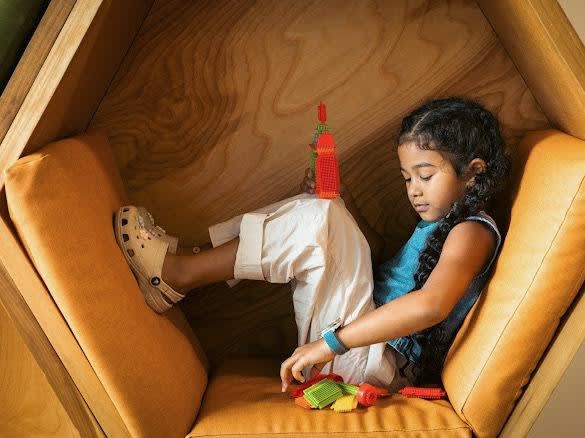
Zane Shah arrives at school at 8:45 a.m., greets his friends and stores his backpack in the assigned cubby. It could be any middle school morning. But one thing about Shah's school is different: There are no traditional teachers.
Shah, 13, is an eighth grader at Alpha School, a network of private, for-profit institutions that opened its first Chicago campus this fall for students in pre-K through eighth grade. The adults in the building are called "guides," and artificial intelligence handles all the academic instruction.
When school starts at 9 a.m., students work on math, reading, writing, language and science on laptops, using adaptive software that Alpha says lets them master core subjects in roughly two hours a day.
That mastery doesn't come cheap. Attending Alpha Chicago costs $55,000 a year, or roughly $8,000 more than the average annual cost of a private college, according to U.S. News & World Report.
Alpha was founded in Austin, Texas, in 2014 by MacKenzie Price, who has become an outspoken critic of traditional schooling. Alpha says its students score in the top 1% on national standardized tests. The school also says it does not screen applicants based on previous grades or test scores. Instead, they look for students who are coachable, self-motivated and open to the learning model.
The school says students are only asked to leave for behavioral issues, not failure to meet academic standards.
"They're getting accepted to fantastic schools — Stanford, Northwestern, Rice," said Brian Howell, dean of parents at Alpha Chicago and formerly an anthropology professor at Wheaton College in Illinois.
Shah, who started at Alpha this year, previously attended traditional schools. Two hours of daily academic instruction is enough to accomplish everything he had learned in a typical eight-hour school day, he told CBS News.
"I feel like I can be more focused instead of having 20 to 30 kids in a classroom all talking at once," Shah said.
"Not interacting with chatbots"
Learning at Alpha centers on the school's proprietary educational software, which is used across all of Alpha's campuses and at a handful of affiliated private schools. The system, called TimeBack, was developed by a research team led by cognitive scientist Carl Hendrick of the Netherlands' Academica University of Applied Sciences.
TimeBack is designed to adjust to students' individual skills and capabilities over the course of the school year. For example, if a student repeatedly errs in tackling the same type of problem, the software returns to earlier concepts to fill in any knowledge gaps, according to Alpha.
Alpha also relies on a learning science team comprising subject-matter experts based globally, including licensed teachers, curriculum experts or specialists in early childhood education. They review student data daily, tracking each child's progress and whether they've met their academic goals. The team also builds the curriculum and steps in through remote coaching calls as a last resort if students bog down and need additional help.
Alpha says their approach works more like a private tutor than a chatbot because the software doesn't provide answers; instead, the system is designed to test students' knowledge until it determines they've properly learned a given lesson. The technology is also "closed," meaning it doesn't draw on information from the open internet.
"It's important to understand that they're not interacting with chatbots. They're not getting answers from AI," Howell said.
Replacing teachers with "guides"
Another unusual aspect of Alpha schools is that most guides don't have a background in education. A February analysis from the University of Colorado's National Education Policy Center, a nonpartisan think tank, reported that only about one-third of Alpha guides have education training or degrees.
Carrington Haas, Alpha Chicago's lead guide, told CBS News that staffers at the schools play a different role than traditional teachers.
"We're not teaching academics. The main part of our job is to support the students motivationally and emotionally," she said.
Asked whether guides answer academic questions, Haas added, "No, the academics team has their support so they can jump on a coaching call."
Yet Haas, who has a background in traditional education, including stints at Teach For America and at a Waldorf charter school, rejected the idea that the school is teacherless.
"I think it's the future," she said. "And it's not teacherless because we're still there and we're still very much teaching the life skills that they need to know."
Howell described Alpha's approach as mastery-based, meaning students don't advance until they've demonstrated understanding of a concept. When a student gets stuck, the guide doesn't immediately offer help; instead, it directs the student to reread the problem while drawing on hints from the adaptive software.
"Human beings are looking at those data. They're looking at the dashboards. They're seeing where are students getting stuck, where are they going faster?" Howell said.
Despite Alpha centering its pedagogy on computer-mediated learning, Howell also dismisses any notion that the school's educational approach amounts to parking kids in front of a screen.
"It is not just some mind-numbing, screen-based, zombifying project," he told CBS News. "The AI is not making any decisions about what students learn. The AI's not in control of a student's day — humans are."
So far, Binoy Shah is encouraged by his son's early experience, noting that he quickly noticed a change in Zane's engagement with his education.
"As a 13-year-old kid before you'd get, how was school? Good. How was your lunch? Good. What did you do today? Nothing," Binoy said. "Now we're getting three to five minutes of conversation [about] what he did at school, and he's excited about it."
Experts question Alpha's approach
For all the hype around artificial intelligence, education experts aren't sold on Alpha's unconventional teaching methods and AI-delivered curriculum.
While affirming the value of teaching life skills, such as communication and leadership, Rebecca Winthrop, a senior fellow at the nonpartisan Brookings Institution who has visited Alpha's campuses, questions the school's claims about its educational approach and outcomes. She also urges families who are interested in the school to ensure they know what they're signing up for.
"Parents should know that this is an experimental model. There's no clear externally validated evidence around the results they claim," she said.
"Neuroscience says that deep reflection — meaning-making, which a lot of times schools don't allow enough time for — is really important for learning and long-term student outcomes," Winthrop added.
Other experts are more bluntly critical of Alpha's approach, accusing the school network of effectively financializing education.
"Alpha School is less an effort to expand educational opportunity than an experiment in extracting maximum profit from schooling," said Carol Corbett Burris, executive director of the Network for Public Education, a nonprofit advocacy group that supports public education.
Burris said Alpha's founders implemented its model at Unbound Academy, a free public charter school in Arizona, built on its TimeBack learning platform. She told CBS News the institution performed "dismally" when compared to Arizona's public schools, "despite the promises submitted in its charter application."