Here's how much ACA premiums would have risen without tax subsidies in 2025
Millions of Americans are bracing for higher health costs in 2026, as subsidies that help them pay for health insurance under the Affordable Care Act are set to expire on December 31.
Experts warn that a failure in Congress to extend the tax credits could be financially devastating for individual policyholders, while also raising health care costs as a whole. Roughly 22 million Americans receive the ACA subsidies, which were created in 2021 to lower households' monthly premiums.
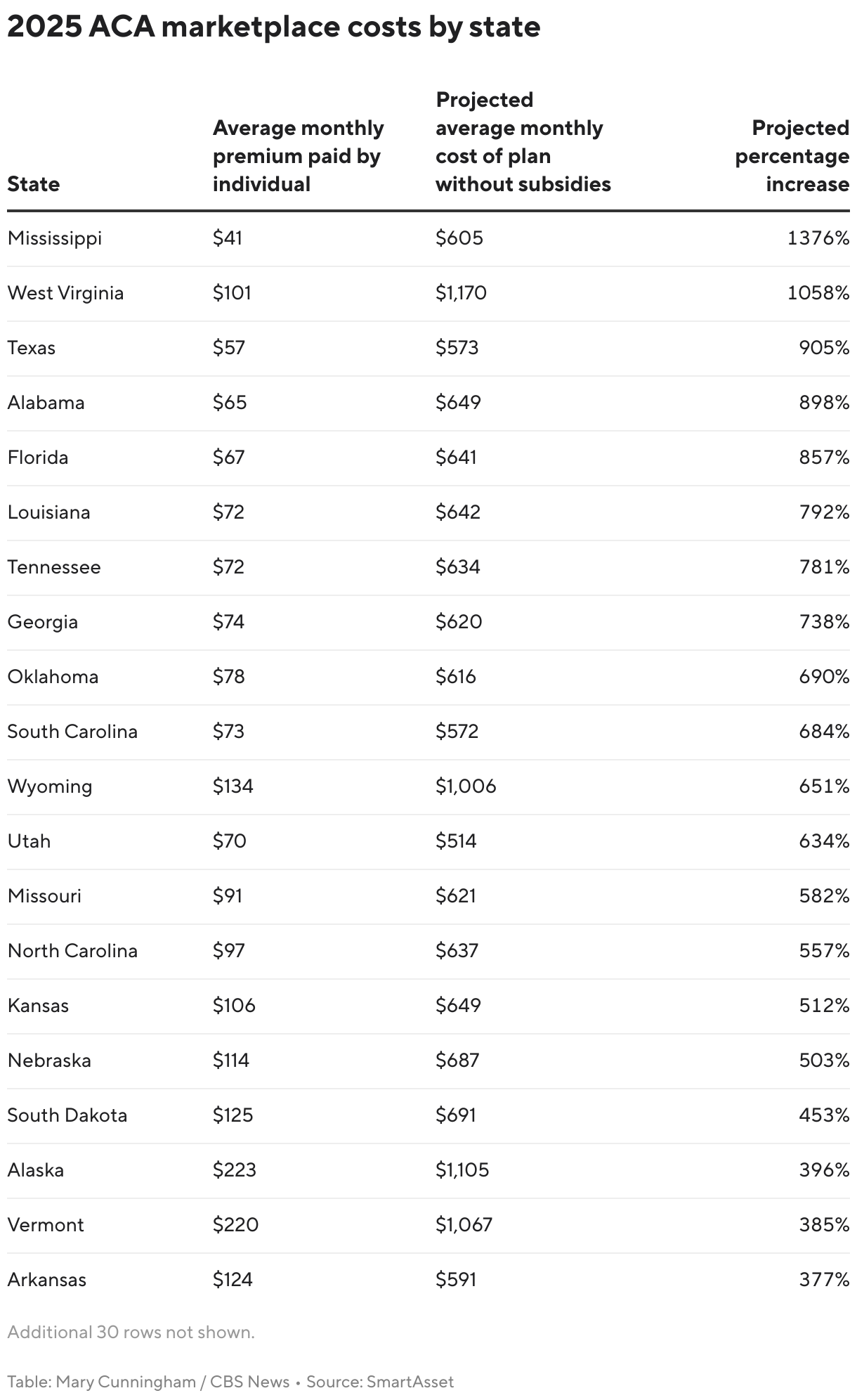
New data from investment adviser SmartAsset projects how much people around the U.S. with an ACA plan would have paid on average for coverage in 2025 if they hadn't received the enhanced subsidies. As the analysis shows, monthly premiums for the government health insurance would've been hundreds of dollars higher.
In Mississippi, where around 11% of residents are enrolled in an ACA plan, participants would have seen their average monthly premiums jump from $41 to $605, a 1,376% increase, SmartAsset found. In West Virginia, enrollees' premiums would have risen an average of 1,058%.
A spokesperson for SmartAsset said the analysis captures 2025 costs, but noted the data amounts to a "close approximation" of how much more people with ACA coverage could expect to pay next year without the tax credits.
SmartAsset used public records from the Centers for Medicare and Medicaid Services' 2025 Marketplace Open Enrollment Period to calculate the average cost of ACA plans.
The exact price hikes people could see next will depend on a range of factors, including their insurance plan, age, household income, health status and where they live, according to a spokesperson from KFF. The health policy group estimates that annual out-of-pocket premium costs will increase 114% on average for the 22 million ACA enrollees who rely on the subsidies.
What is the status of the ACA tax credits?
The tax credits are set to lapse at the end of the year. Democratic lawmakers have pushed for an extension but lack enough support in the Republican-led Congress. And while the House passed a health care bill this week that includes several policies favored by Republicans, it excludes an extension of the tax credits and faces hurdles in the Senate.
Both chambers of Congress have left Washington until early next year, making it all but certain that the tax credits will expire on December 31. But four GOP members this week signed a Democratic measure to force a vote on extending the subsidies for three years, teeing up a final vote early next year.
If Congress fails to solve the tax credit issue, some enrollees will qualify for a smaller subsidy, while others could lose eligibility completely, according to KFF.
With sharply higher ACA costs on the horizon, the Congressional Budget Office estimates that about 4 million people could drop their health insurance altogether. Experts say that could lead to higher costs for people with other types of health insurance because hospitals will have to provide more uncompensated care for those lacking coverage.
"Hospitals can only reconcile that by raising their prices for everybody," Emma Wager, a senior policy analyst at KFF, told CBS News last week.