60 Minutes boards a rescue ship with 301 migrants
This week on 60 Minutes, correspondent Clarissa Ward reports on the migration crisis in the Mediterranean, which she calls "an unprecedented season of death." In a conversation with 60 Minutes Overtime (in the player above), Ward explains how she managed to board an Italian coast guard cutter to accompany sailors on a 2-day search-and-rescue mission to save a small fishing boat from Libya, packed with desperate migrants -- including babies, children, and pregnant women -- who had put out an S.O.S call for help.
Just after Ward and producer Randall Joyce had returned to London to write their 60 Minutes story, writing became reality when another boat, carrying migrants from Libya, capsized in the Mediterranean Sea.
At the time the tragedy occurred, she and Joyce were working on a line of the script that described the dangers of rescuing refugees, who are often jam-packed on rickety boats. "The most dangerous part of a rescue is when the Coast Guard first arrives," Ward explains to 60 Minutes Overtime. This is the moment when hundreds of hungry and scared migrants "surge forward towards their rescuers," which can cause the boat to capsize.
In the case of Tuesday's tragedy, that is exactly what eyewitnesses say happened, and an estimated 800 migrants perished in the accident.
For a more in-depth look at Clarissa's time at sea, living aboard a coast guard cutter with 301 rescued migrants, take a look at the video in the player above or read the script below:
60 MINUTES OVERTIME'S ANN SILVIO: Clarissa, you reported on the migration crisis in the Mediterranean this week on 60 Minutes, and you got the story that no one else has. And that's from the perspective of the rescuers. Tell me how you got on that Coast Guard ship.
CORRESPONDENT CLARISSA WARD: We talked and badgered and harassed, and then we just decided-- you know what? I'm gonna fly to Sicily and wait for the boat to come into port. And then be like, "Hi, why don't you take me on, too, when you go back out?"
SILVIO: How long were you on the boat for?
WARD: I was on the boat for two nights. We had been at sea, I would say, roughly 18 hours, when the captain received word that a boat had put out an S.O.S signal.
SILVIO: Tell me what you see as you approach this boat.
WARD: So we knew that we were getting close to the boat, because we could see this large merchant ship, which was next to it essentially, keeping an eye on it. It looks like a speck. You get closer and closer, and it starts to become clear that it's some kind of a wooden fishing boat and that there are people on it. The cameraman, Massimo Mariani, and myself were discussing, "How many people do you think are on it?" And we guessed-- it looks about 50 people.
WARD: And then they begin the process of basically ferrying them back to the ship. And--
SILVIO: And how long does that take?
WARD: Well, it takes hours because the little boat goes back. It goes forth. It comes back and back and I'm like, "Where are all these people coming from?" This endless flow of migrants who seem to still be coming out of this small fishing boat. So it started at dusk, this operation, and iit lasted into the night. Turns out there were 301 people on this fishing boat, not more than 40-feet long.
SILVIO: Just crammed on this boat?
WARD: Just crammed and rammed in ways that you-- I can't even imagine. Many babies, dozens of women, small children. And as they sort of managed to stagger onto the deck, it's extraordinary to see: Their energy has been sapped. They're hungry. They're thirsty. Everyone kept saying to me, "Please, can you get me some food?" [And I respond] "'I'm a journalist. I can't actually help you. I don't work on this boat." But they were just wiped out.
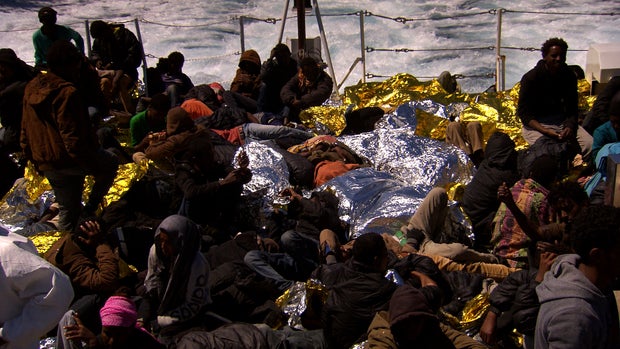
There's nowhere for them to sleep, obviously. They essentially can only go on the deck. And they're given these emergency Mylar blankets to try to keep them warm because during the night, it gets very chilly on that deck, especially when you're going at a rapid speed and there's wind.
SILVIO: You speak English, Arabic, and Italian. And I understand you were pressed into service as a translator.
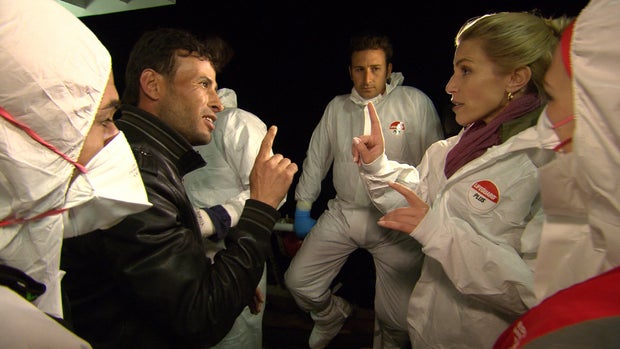
WARD: Yeah, essentially what happened is that the Coast Guard had been made aware that one Tunisian man was driving the fishing boat that they rescued.
SILVIO: So he became a suspect.
WARD: So he became a suspect. So I essentially became roped-- I got roped into acting essentially, as a translator for the Italian Coast Guard as they attempted to interrogate this man. He was adamant that the only reason he was driving the boat is because he was the only person on the boat who could drive a boat.
SILVIO: We see footage of you sitting cross-legged on the deck, talking with men, talking with children...
WARD: It was funny to watch the children on the boat, because they're just having a blast. They have no idea that they have just escaped the clutches of death. And-- that they are entering an uncertain future. For them, this was a big adventure. Seeing them enjoying themselves, playing the blankets. Because, of course, they're gold and fluttery and pretty.
Looking around, you saw such-- a variety of emotions. And I think there's also a little bit of boredom. Some people had a card game going at one stage. Some people read the Quran. I saw another person reading the Bible. One woman was having her hair braided by some friends of hers. And everybody that we spoke to was so cognizant of the very real fact that they could have died.And it did not deter them in their pursuit, in their determination to make this-- this journey.
SILVIO: It occurs to me that you're meeting these people at the moment that they finally caught a break. Did you get a sense of relief?
WARD: Definitely relief. Definitely a sense of optimism. Which I honestly found a little bit heartbreaking sometimes. Because there's a naiveté-- perhaps not a full understanding or recognition of all the challenges awaiting them in Europe.
But one moment that really stood out to me: I was watching from the deck, I saw all these people suddenly gathered at the front of the boat, and people started pointing and-- and smiling. And I-- "What-- what's happening? What's going on?" And there was a small school of dolphins who were riding along the water, swimming along. And they were so beautiful. Everybody, regardless of whether they were from Eritrea or Tunisia or Syria, shared in this moment of wonder.
SILVIO: Must have felt, after what they'd been through, like almost-- a blessing?
WARD: It did.