Why does the price in your online shopping cart fluctuate? How retailers use dynamic pricing

Consumers trying to score the best deals online may be facing a moving target as retailers increasingly use dynamic pricing. It's a strategy that adjusts prices based on factors including demand, inventory and consumer behavior.
CBS California Investigates reviewed online shopping carts at three major retailers selected randomly. We found prices fluctuated significantly over a period of weeks, making it difficult to determine when the best price is.
Dynamic pricing allows retailers to adjust prices in real time using data about supply, demand and consumer purchasing habits, according to Anthony Dukes, a marketing professor at the USC Marshall School of Business.
Dukes says dynamic pricing takes into account factors like shopping habits, demographics and other consumer characteristics because it knows consumers have different price sensitivities and willingness to pay.
Dukes says retailers may charge higher prices to consumers with a history of paying more while offering lower prices to shoppers who are more price-conscious.
"Companies use this a lot, and it's been accelerated by virtue of algorithms and data," he said.
Retailers may also consider factors such as gender, time of day, day of the week and even the type of device a consumer is using, Dukes said.
Kat Wilson, an online shopper, says she "price shops," which means she waits for things to go on sale, but she says that strategy has become complicated.
"Even if I put it in one day and then a couple of days later, I check it and then the price has gone up, so then I wait until it goes back down," Wilson said.
She adds that online shopping has become a guessing game.
CBS California Investigates monitored three online shopping carts at Old Navy, Target and Amazon. Items were added to each cart and left untouched while prices were checked regularly over several weeks.
Old Navy showed the greatest variation. Between April 29 and May 26, the total cost of items in the cart reached a high of $225 and dropped to a low of $143, a swing of roughly 36% in either direction. Prices changed almost daily, with the total falling from $201.46 on May 14 to $184.96 the following day.
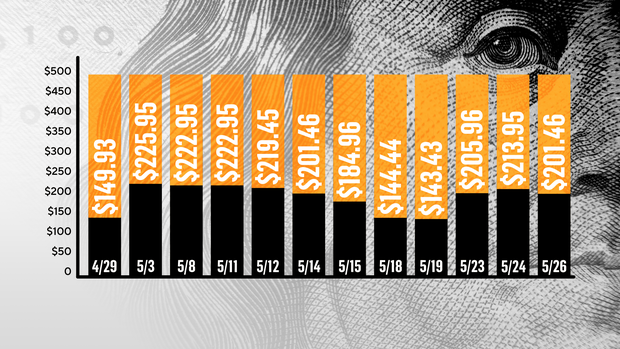
"They might, for instance, randomize their prices so it's not predictable," Dukes said. "Because if it were predictable, then customers would know when the better price is coming and just simply wait for it."
At Target, a cart containing six clothing and shoe items fluctuated between $170.11 and $135.54 over a two-week period, a difference of more than 20%.
An Amazon cart containing seven food, clothing and shoe items experienced smaller fluctuations, rising from $269.08 to a high of $274.57 during the same period.
For consumers, the frequent changes can create uncertainty.
"When prices are so up and down, how do you know if you're getting a good deal?" Wilson said. "You don't. It's a catch-22. You just have to wing it, basically, and just hope for the best."
Research by Competition Policy International says online price fluctuations differ from brick-and-mortar stores since they update continuously, sometimes several times per day, using algorithms based on competitor data and demand. Brick-and-mortar stores are more likely to update their prices based on a logistical strategy like manual tag replacements and infrequent sale cycles.
CBS California Investigates reached out to the three companies for a comment, but Old Navy did not respond to three email inquiries.
In a statement, Amazon said in part that it keeps prices low and that prices often change to match competitors, provide deals for customers, or reflect updates made by independent sellers. The company added that it does not change prices based on a consumer's shopping habits or behaviors.
"We work hard to provide everyday low prices across the widest selection of products and, according to third-party analytics and research firm Profitero, Amazon has been the lowest-priced U.S. retailer every year since 2017—with online prices an average 14% less expensive than all major U.S. retailers in 2025," the statement said. "We keep our prices low, which means our prices often change as we match competitors' low prices, offer deals to save customers money, or as independent sellers choose to update their own prices."
Target said several promotions occurred during the monitoring period, including a 30% discount on dresses and a promotion offering customers $10 off a $50 purchase.
Some shoppers said they would prefer more consistent pricing over fluctuating sales and discounts.
"How are we supposed to save money with all this inflation and everything, and these stores are just going up and down with all the internet and pricing," an online shopper said.
Consumers who notice a price drop after making a purchase may be able to request a price adjustment, depending on the retailer's policy. Target and Old Navy allow price adjustments within 14 days for both in-store and online purchases. Amazon does not offer price adjustments.