Jack Smith defends handling of Trump probes at heated Senate hearing
What to know about the Jack Smith hearing today:
- Jack Smith, the former special counsel who led two prosecutions of President Trump, defended his handling of those probes during a Senate hearing that grew contentious at several points on Tuesday.
- Republican senators on the Senate Judiciary Committee expressed outrage at Smith over his investigative methods, including his team's efforts to obtain toll records from some GOP lawmakers as part of his probe into Mr. Trump's actions after the 2020 election. Sen. Chuck Grassley, the Judiciary Committee's chairman, accused Smith of taking "partisanship to a new level."
- Smith said he followed standard protocol and dismissed accusations that he was driven by politics. "I personally find it very hard to understand how our investigation can be viewed as partisan when the strongest witnesses, the people who were the difference between the rule of law standing and not in our case, were Republicans," he said.
- Mr. Trump pleaded not guilty to charges in both the 2020 election case and one involving his retention of sensitive government documents. The two prosecutions ended after he was elected to a second term in November 2024.
See highlights from the hearing below.
Hearing ends after roughly 4 hours
Grassley delivered closing remarks about Smith's investigations into Mr. Trump and said his own probe showed the cases were infected with "defects, failures and political motives."
"His own words and that of his staff have told the tale of rampant wrongdoing and political conduct," he said.
Grassley said his investigation will continue.
Smith says he regrets limited public statements during investigations
When asked by GOP Sen. Thom Tillis of North Carolina if he wishes he did anything differently during his time as special counsel, Smith said that his limited public statements allowed others to misrepresent his investigations without a public rebuttal.
Smith said he began his career operating under the presumption that "you only do your talking in the courtroom, and that you don't talk on the courthouse steps." But, he added, "if you stick to that and that alone, people can unfairly malign your team, and unfairly malign you and your case in a way, and you really can't respond."
"You don't want to interfere with someone's right to a fair trial, and you don't want to get down in the gutter and start calling people names. But at the same time, there are things being put out daily that are patently untrue, and you know they're untrue," Smith said.
"I'm not advocating that prosecutors in the future start going on the internet every day responding to comments, but I do think that the school of prosecution I came from, where you only speak in the courtroom — I do agree that prosecutors in the future need to learn to be able to communicate to the outside world, because I believe strongly we did our investigation the right way, but I limited myself in who I talked to about that," Smith said, pointing to the two short announcements he did in his time as special counsel.
Smith says his team had "strong reason" to think Trump would destroy evidence
Sen. Ted Cruz, a Republican from Texas, questioned Smith about nondisclosure orders issued by a court that prevented phone carriers from disclosing that they had received subpoenas for toll records from senators' phones.
When asked why he sought the nondisclosure orders, Smith said his team had "strong reason to believe that Donald Trump would destroy evidence."
"We do not have to wait for someone to be injured for an investigation to be obstructed," he said. "We had strong reason to believe that Donald Trump would obstruct our investigation, given the obstruction alleged in the Florida indictment, given the attempts to intimidate witnesses in the election case, given the threats that were later made to witnesses in the election case."
Prosecutors alleged in the indictment in the classified documents case that the president attempted to obstruct the FBI and grand jury probe and hide documents. They said the president directed an aide, Walt Nauta, to move boxes of records to hide them from a lawyer and the FBI, and suggested his lawyer should hide or destroy documents sought by a grand jury subpoena.
Smith's team also said in court papers that the president attempted to delete security camera footage at Mar-a-Lago to hide information from the FBI.
In the elections case, Smith wrote in his final report that Mr. Trump made threatening public statements targeting likely witnesses and resorted to intimidation.
"Disclosure of that subpoena could result in Donald Trump attempting to intimidate witnesses as he had before and after," the former special counsel said.
Smith said his office sought to follow Justice Department policy and federal law when pursuing the nondisclosure orders.
"We submitted these nondisclosure orders consistent with the law and department policy," he said.
When asked whether he had any regrets about his work as special counsel, Smith said he did.
"I regret that the people I worked with have been unfairly fired and vilified," he said.
Smith says Lindsey Graham likely would have been a witness in 2020 election case
Sen. Darline Graham, who replaced her brother Sen. Lindsey Graham in the Senate after his death, alleged that Smith accused him of potentially attempting to destroy evidence, intimidate witnesses or cause harm to his investigation. Smith pushed back, saying that Lindsey Graham "likely" would have been a witness if the 2020 election case had gone to trial.
Lindsey Graham, a four-term senator who was seeking reelection, died suddenly in July, and Darline Graham, his younger sister, was appointed to the seat. She won a special primary in August to replace him on the ballot in November.
"I believe your brother was a patriotic public servant. He was not a target of our investigation, and in fact, he likely would have been a witness in our case," Smith said. "Your brother investigated the claims that Donald Trump was making. He found them to be false."
Last year, GOP senators said that the FBI analyzed phone records of more than half a dozen Republican lawmakers, including Lindsey Graham, during Smith's investigation. Smith has repeatedly said Tuesday that he only got toll records showing the duration of the senators phone calls and who they were talking to, and not the contents of the calls themselves.
Darline Graham responded that she believes Smith was "just trying to bully my brother and other allies of President Trump."
"You caused my brother and a lot of other senators a lot of stress, and that makes me sick," Graham continued. "You should be ashamed of yourself. It's also a damn shame that you weaponized our legal system to do this. To go after a political opponent and his allies, including Lindsey, what a disgrace to our justice system and the Constitution that you would stoop this low. Shame on you!"
Schmitt appears to confuse University of Iowa Hawkeyes with the Atlanta Hawks while accusing Smith of perjury
Smith was pressed by Sen. Eric Schmitt, a Republican from Missouri, about whether he attended a NBA game between the Atlanta Hawks and Golden State Warriors in Atlanta in early February 2024.
Schmitt said Smith's alleged attendance at the game would be significant because the game occurred around the time that Fulton County District Attorney Fani Willis revealed she had a romantic relationship with Nathan Wade, whom she hired as a special prosecutor to work on an investigation into alleged efforts to overturn the results of the 2020 election in Georgia.
Smith said he did not attend that game, but may have flown through Atlanta on the way to Florida. Still, he told senators he "definitely did not go" to an Atlanta Hawks game.
The former special counsel also said he never met Wade or Willis while he was special counsel.
Schmitt then displayed a poster board with text messages from members of Smith's team, including one asking if "109 Row 1" was reserved for Smith. Schmitt said the messages showed Smith was in Atlanta and attended the NBA game on Feb. 3, 2024.
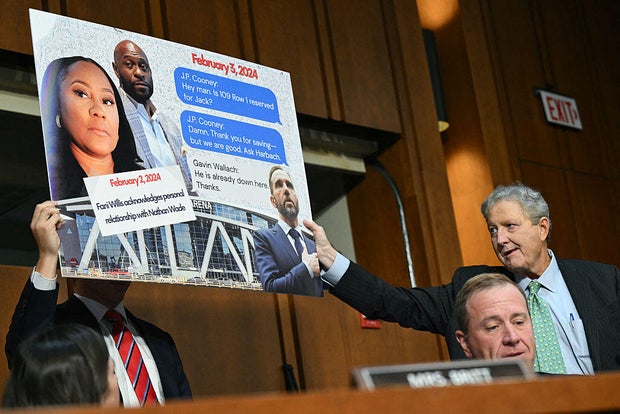
"I don't think you know that we have this stuff, so I'll give you a second to process it so you don't, you know, perjure yourself," Schmitt told Smith.
But the poster board on display was quickly taken down by Schmitt's staff and Smith asked to see it again.
Schmitt said he would put the information "in a follow-up."
"I think you've already perjured yourself," the senator said, calling Smith a "total dirtbag."
Sen. Amy Klobuchar, a Democrat from Minnesota, continued to push for a copy of the text messages referenced by Schmitt and said Smith should be given the opportunity to see them.
When the poster with the texts was displayed again, Smith said he did attend a women's college basketball game in early February 2024 between the University of Maryland Terrapins and the University of Iowa Hawkeyes to see Hawkeyes star Caitlin Clark play.
That game took place in College Park, Maryland. Klobuchar suggested that Schmitt was mistaking the Hawkeyes for the Atlanta Hawks.
"For a U.S. senator to have false information and imply, based on a confusion about the name of a team, which I knew, knowing my Midwestern sports, and imply that you were in another city, that you were somehow involved that day in what was happening in Georgia, and then call you a dirtbag is something that deserves an apology," Klobuchar said.
Smith says Republicans would have been the strongest witnesses in election case
Smith told Sen. Chris Coons, a Democrat from Delaware, that if his election case had gone to trial, the strongest witnesses would have been Republicans.
"I personally find it very hard to understand how our investigation can be viewed as partisan when the strongest witnesses, the people who were the difference between the rule of law standing and not in our case, were Republicans," he said.
Smith specifically cited Rusty Bowers, the former speaker of the Arizona House, who resisted a scheme to replace a slate of presidential electors who supported Biden with a fake slate that backed Mr. Trump. Biden won Arizona in 2020.
The former special counsel also cited former Vice President Mike Pence, who refused to go along with a plan to overturn the results of the 2020 election by rejecting the electoral votes of battleground states that Biden won.
Pence testified before a grand jury as part of Smith's probe.
Kennedy questions Smith about his wife's political views
Sen. John Kennedy, a Republican from Louisiana, questioned Smith about his wife's views on Mr. Trump and what he said were favorable comments she has made about former President Barack Obama and former first lady Michelle Obama.
Smith noted that he worked in the Trump administration as acting U.S. attorney in Tennessee and then as a war crimes prosecutor at The Hague.
"I'm not going to talk about my family here today," he said. "I'm here to talk about my work as special counsel."
Smith reiterated that he took the job as special counsel because of his career as a nonpartisan prosecutor.
"I knew that I would do it independently, and I would conduct it the same way whether I were a Republican or a Democrat," he said.
Smith said he told then-Attorney General Merrick Garland twice that he was going to prosecute Mr. Trump. The former special counsel brought two criminal cases against the president.
After asking Smith about the toll records from senators' phones that he received, Kennedy told Smith, "you make me want to throw up in my mouth."
Durbin presses Smith on obtaining phone records of Republican lawmakers
Durbin pressed Smith on last year's revelation that investigators looking into Mr. Trump's actions after the 2020 election obtained several Republican lawmakers' phone records.
Smith said that obtaining the records was crucial to his investigation, specifically to prove the criminal intent of Mr. Trump and his unindicted co-conspirators in the 2020 election case.
"They show who a call was to, who a call was from and the length of that call," Smith said, adding that his team consulted with the Justice Department's Public Integrity Section to make sure his subpoenas of the records were appropriate.
"Those records corroborated evidence that we had that the president, President Donald Trump, and his co-conspirators were seeking to exploit the violence on Jan. 6 in furtherance of their criminal scheme," Smith said. "They were taking the fact that law enforcement officers had been brutally assaulted at this institution and using that to seek to delay the proceedings further in violation of the law. It was an important part of our investigation."
Durbin then pressed Smith on whether or not his team "initiate[d] any wiretaps relative to members of Congress of either party."
"No. The records that we're talking about are non-content records," Smith said, adding that it was "unclear" how many phones were being used to make the calls and that there were "incomplete" records from the White House switchboard, necessitating the need for the subpoenas.
Grassley says Smith obtained more than 4,700 donor checks as part of election probe
Smith said that in the course of his investigation, his team obtained financial information but could not recite each subpoena his office issued.
"I can tell you why we issued subpoenas, and it was to conduct a criminal investigation of one of the most serious crimes that's ever happened in our nation's history. I had a duty to collect facts," he said.
Grassley had asked Smith whether his team of investigators obtained donor data, including financial information. The senator said that his own investigation found that Smith obtained more than 4,700 donor checks, many of which he said was for small dollar amounts.
Grassley said the Justice Department and FBI will now "forever" possess the addresses, phone numbers, bank account information and signatures for "thousands" of people.
As part of his investigation into Mr. Trump's alleged efforts to overturn the results of the 2020 election, Smith examined the president's Jan. 6, 2021, speech at the Ellipse outside the White House. After the president's remarks, members of the rally crowd descended on the U.S. Capitol and breached the building, where lawmakers had gathered to reaffirm the results of the 2020 election.
The rally outside the White House was planned by Mr. Trump's political supporters.
Smith said in his report that the president repeatedly told his supporters that the 2020 election had been stolen and was rigged against him.
Smith says Trump administration targeting his team is an "outrage"
In response to a question from Grassley that suggested Smith's team abused their authority, Smith defended the work of his investigative team and criticized the Justice Department's mass purge of his former colleagues after his departure.
"The members of my team that you just mentioned, I'm extremely proud to have worked with them, and the fact that they have been targeted illegally, lost their jobs illegally, and had their lives turned upside down by this Department of Justice is an outrage," Smith said.
According to CBS News reporting since Smith departed the Justice Department after Mr. Trump won re-election, dozens of investigators and career law enforcement at the Justice Department and FBI have been fired simply for working with Smith.
Smith sworn in, says evidence showed Trump "engaged in serious crimes against our nation"
Smith was sworn in by Grassley and delivered his own opening statement.
The former special counsel rejected claims that he is a partisan and said he has served Republicans and Democrats over the course of his career.
"I am not a politician, and I have no partisan loyalty," he said. "My career has been dedicated to serving our country by upholding the rule of law and the core principles on which our country was founded. I believe that there is no role for politics in the proper administration of justice."
Smith said prosecutors must base their decisions on the facts and the law, and a subject's "status, power, prominence, or political affiliation" should not come into play.
The special counsel defended his decision to seek indictments of Mr. Trump and said it was made without regard to his candidacy in the 2024 election.
"Our investigation developed proof beyond a reasonable doubt that President Trump engaged in serious crimes against our nation," he said. "If asked whether to prosecute a former president today based on the same facts, I would do so regardless of whether that President was a Republican or a Democrat."
Smith lamented the actions taken by the Trump administration, saying that the rule of law "faces challenges unlike any we have experienced in our lifetime." He specifically highlighted threats of criminal prosecution against people Mr. Trump's perceived enemies.
"Predetermined outcomes increasingly seem to take precedence over the Justice Department's long-standing core values and traditions," he said. "History teaches that the rule of law is rarely destroyed all at once. It's often weakened by attacks on the institutions and the public servants sworn to uphold it."
Durbin defends Smith's probes, criticizes Republicans for spreading conspiracy theories
In his opening remarks, Democratic Sen. Dick Durbin, the ranking member of the Senate Judiciary Committee, defended Smith's investigations, and criticized his Republican colleagues for "baseless conspiracy theories" about the former special counsel.
"House Republicans called Mr. Smith to testify in January, but Senate Republicans refused his offer to testify. Instead, they held eight hearings on his supposed wrongdoing, never calling him directly," Durbin said, adding that the witnesses the committee called earlier this year are "MAGA loyalist witnesses with no firsthand knowledge" of the probes.
"In both his theft and distribution of these classified documents, and his attempts to steal the 2020 election, President Trump demonstrated a wanton disdain for the laws of the United States, the will of the people, and our national security," Durbin said, adding that Smith and his team of investigators, most of whom have been fired, or resigned from the Justice Department, had the "necessary experience to tackle this assignment."
Durbin accused Republicans of trying to "contort themselves to support President Trump's lies" around the cases, and said document releases in recent months from Sen. Grassley are attempting to "muddle the professional nature of Mr. Smith's efforts in a manufactured controversy."
Grassley says the Justice Department and FBI have "reams" of information on "thousands" of Republicans
Grassley said that as a result of the special counsel's investigation into Mr. Trump's actions related to the 2020 presidential election, the Justice Department and the FBI have "reams" of "very personal information" on "thousands" of Republicans and are unlikely to delete that material.
"In the end, Mr. Smith indicted one person," he said. "That one person was President Trump, but in the process, [he] successfully mapped out the Republican apparatus."
Grassley said that was left out of Smith's final report.
Grassley says Smith obtained communications from reporters at multiple outlets
The Iowa Republican said in his opening statement that Smith obtained communications from members of the media.
He listed a number of news outlets, including CBS News, CNN, Fox News, the Associated Press, The Federalist, the Wall Street Journal, Bloomberg, the Washington Post and the Washington Times.
"Now, what will partisan media say about this disgraceful government overreach?" Grassley said. "I want to hear their response, and I will if they are responsible media."
The Judiciary chairman indicated that the communications were swept up in hundreds of subpoenas targeting GOP groups and individuals, as well as dozens of phones belonging to White House staffers.
Grassley first revealed last year that Smith obtained communications from media companies.
Grassley says Smith's election case was about "mapping out the Republican apparatus"
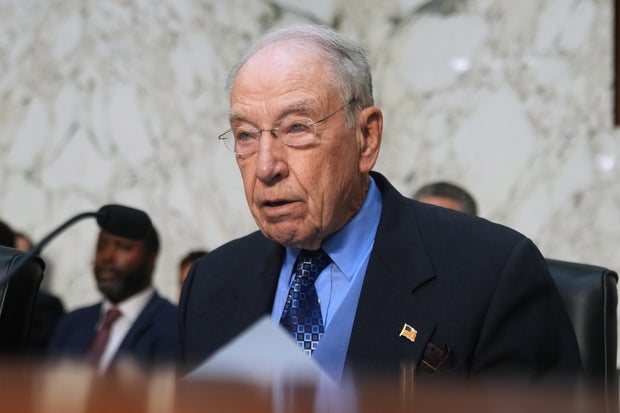
In an opening statement, Republican Sen. Chuck Grassley of Iowa, the chairman of the Judiciary Committee, detailed some of the findings from his investigation into Smith's probes, centering on actions taken by Justice Department lawyers involving members of Congress.
Grassley said Smith's election case "ultimately wasn't just about Trump. It was about partisan agents and prosecutors mapping out the Republican apparatus."
The Iowa Republican read from communications the Judiciary Committee obtained about investigations that began before Smith's appointment as special counsel in November 2022, but said the foundation for his probe into the events surrounding the 2020 election was "built by partisan agents and prosecutors."
"Jack Smith took partisanship to a new level," Grassley said, highlighting the toll records from lawmakers' phones that the special counsel received.
How to watch the Jack Smith hearing
- What: Jack Smith testifies before the Senate Judiciary Committee
- Date: Tuesday, Sept. 29, 2026
- Time: 9 a.m. ET
- Location: Capitol Hill
- Online stream: Live on CBS News
Smith expected to defend work on Trump probes in opening statement
Smith is expected to defend his work on the dual Trump investigations, according to a copy of his opening remarks obtained by CBS News.
"I stand by my decisions as Special Counsel, including my decision to bring charges against President Trump. I made these decisions without regard to President Trump's political association, activities, beliefs, or candidacy in the 2024 presidential election," Smith is expected to say in his opening remarks. "Our investigation developed proof beyond a reasonable doubt that President Trump engaged in criminal activity. If asked whether to prosecute a former President based on the same facts today, I would do so regardless of whether that President was a Republican or a Democrat."
Smith is also expected to defend himself against Mr. Trump's continued public statements calling for charges to be brought against him.
"I will not be silenced by the continued threats of prosecution from the President or others," Smith is expected to say, adding that "it is my belief that the rule of law faces challenges unlike any we have experienced in our lifetime."
"Individuals are threatened with criminal investigation because they are perceived to have opposed the President. Predetermined outcomes increasingly seem to take precedence over the Justice Department's long-standing core values, traditions, and norm," Smith's prepared opening remarks read. "History teaches that the rule of law is rarely destroyed all at once. It is often weakened by attacks on the institutions and public servants sworn to uphold it."
What Smith told Congress in 2 previous hearings
Smith has sat down to answer lawmakers' questions about the cases involving Mr. Trump twice before. In December, he testified for more than eight hours during a closed-door deposition before the House Judiciary Committee.
During that deposition, Smith was asked about subpoenas his team issued for toll records for certain members of Congress. He told the committee that he did not seek a search warrant for the content of text messages from lawmakers, only the toll records.
But Republicans have accused Smith of lying during his appearance because of information revealed by the Senate Judiciary Committee in July.
The Justice Department provided documents to the Senate committee that showed Smith's team had sought and obtained text messages from the National Archives and Records Administration, which included messages from 44 members of Congress — Republicans and Democrats.
Smith addressed his decision to analyze Republicans' phone records in January, when he appeared before the panel in a public setting.
"The conspiracy that we were investigating, it was relevant to get toll records to understand the scope of that conspiracy, who they were seeking to coerce, who they were seeking, to influence who was seeking to help them," Smith said.
He said securing the phone records, which only contained data about the calls and not their contents, is "common practice" in complex investigations.
During that hearing, Smith also defended his handling of the investigations involving Mr. Trump and told House members he pursued the unprecedented charges against the president "because the evidence established that he willfully broke the law — the very laws he took an oath to uphold."
Smith unlikely to answer questions on his report on classified documents case
One topic that Smith will be unlikely to comment on Tuesday will be his final report detailing his investigation into Mr. Trump's alleged mishandling of sensitive government documents and alleged obstruction of the ensuing federal probe.
In February, a federal judge permanently blocked the Justice Department from releasing that portion of his report, granting a request from Mr. Trump and two of his former co-defendants in the case against him, Walt Nauta and Carlos de Oliviera, to prohibit the release of the second volume of Smith's report. That order barred then-Attorney General Pam Bondi, or any of her successors, from releasing or sharing that portion of the report.
During Smith's closed-door testimony last year, Smith's legal team said their client was barred from discussing that portion of the report, or any drafts of it, unless the information was already made public through other means.
Trump has said he wants Smith prosecuted
Smith is frequently targeted by Mr. Trump, who lobs insults at the former special counsel and has said he should be criminally prosecuted.
The president has called Smith "deranged," a "thug" and a "sleazebag." Following Smith's January testimony, Mr. Trump said he should be "prosecuted for his actions." The president claimed the former special counsel "committed large scale perjury."
The Justice Department under Mr. Trump has pursued investigations into several of the president's perceived political enemies, including former FBI Director James Comey and New York Attorney General Letitia James. But criminal cases brought against the two were dismissed last year. Comey was indicted for a second time in April over a photo he posted to Instagram that showed seashells arranged on the beach to form the numbers "86 47."
Comey has denied wrongdoing and is seeking to have the indictment tossed out on numerous grounds.
Smith's final report said Trump could have been convicted in 2020 election case
Before the start of Mr. Trump's second term on Jan. 20, 2026 — and following some 11th-hour legal maneuvering — a portion of Smith's final report detailing his investigations was made public.
Smith wrote in the first volume of his report, which focused on the 2020 election case, that "[b]ut for Mr. Trump's election and imminent return to the Presidency, the Office assessed that the admissible evidence was sufficient to obtain and sustain a conviction at trial."
The former special counsel also rejected accusations his actions were influenced by the top ranks of the Justice Department under then-President Joe Biden and called the claim that the Biden administration directed his actions "laughable."
"The throughline of all of Mr. Trump's criminal efforts was deceit — knowingly false claims of election," Smith said in his report.
The president continues to claim without evidence that the 2020 presidential election was rigged against him and has said repeatedly that he won that contest against Biden in a landslide.
But dozens of lawsuits challenging the election results in key battleground states in 2020 were dismissed by federal judges appointed by Republican and Democratic presidents. And while Mr. Trump has been in office more than 18 months, his administration has yet to put forth evidence that he defeated Biden.