Jack Smith defends handling of Trump probes in first public testimony to Congress
What to know about Jack Smith's testimony:
- Jack Smith, the former special counsel who oversaw two criminal investigations into President Trump during the Biden administration, testified publicly for the first time Thursday at a hearing before the House Judiciary Committee.
- Smith's investigations dealt with Mr. Trump's retention of sensitive government documents after leaving the White House in 2021 and his attempts to reverse the outcome of the 2020 election. Both cases were brought to an end after Mr. Trump won a second term in November 2024.
- Smith told lawmakers that Mr. Trump was charged "because the evidence established that he willfully broke the law — the very laws he took an oath to uphold." He defended his handling of the investigations, saying he had no regrets about how the cases proceeded. His testimony largely focused on the 2020 election case, since there is an ongoing court fight over his report on the classified documents probe.
- GOP members portrayed his investigations as a politically motivated attempt to prevent Mr. Trump from returning to the White House. Democrats praised him and his team for their handling of the cases, accusing Republicans of trying to rewrite the history of Jan. 6 and the 2020 election.
- Smith also said he expects the Trump Justice Department will try to indict him, but he said that he "will not be intimidated."
- Here are the key moments from Smith's testimony:
Democrats push for Smith to return to testify about documents case as hearing concludes
As the hearing wrapped up, Rep. Jamie Raskin brought up the fact that a court order prevented Smith from addressing his report in the Trump documents case. He asked that the committee call Smith back to testify about that case once the judicial order expires.
"We'll take it under advisement. We're going to see what the court decides to do, frankly," Jordan said.
Raskin said every Democrat had signed a letter outlining their intention to bring Smith back "to answer all of the unanswered questions about the second half of his work."
Jordan joked, "that will certainly factor in tremendously when we make our decision."
Raskin noted that the minority has the ability to bring up a witness. Jordan expressed surprise that the minority would call Smith back again.
"We'll see, we'll see," Jordan added.
Smith addresses push for quick trial in 2020 election case
Rep. Bob Onder, a Republican from Missouri, questioned Smith about the timeline for a trial in the 2020 election case. Mr. Trump was indicted in August 2023, and Smith asked the court to schedule a trial for just five months later, in January 2024.
Onder noted that the proposed schedule would have given the president's legal team little time to sift through 13 million pages of documents and thousands of hours of video evidence.
"Why such a rush to charge and try and pursue conviction on President Trump?" Onder asked.
"I sought to move that case forward expeditiously because the public has a right to a speedy trial as well as a defendant. That is, there is Supreme Court precedent directly on point regarding that. I felt it was my duty to do that. I considered all options," Smith said.
Onder replied that he has "never heard of the idea that the prosecution has a right to speed up a trial and require the defense to review 100,000 pages a day in order to get a trial in before an election. I've never heard of such a thing."
Smith said, "The Supreme Court in at least, as I sit here now, three different cases, has stated pretty explicitly that the right to a speedy trial is the public's, as well as the defendant's."
"You were trying to get the president tried, convicted and hopefully imprisoned before Election Day," Onder said in response. "I understand."
Smith says he expects DOJ to do "everything in their power" to indict him, but "I will not be intimidated"
In an exchange with Democratic Rep. Becca Balint of Vermont, Smith was asked about Mr. Trump's repeated attacks on him, and whether he thinks he will be charged by the Justice Department.
"The statements are meant to intimidate me. I will not be intimidated. I think these statements are also made as a warning to others, what will happen if they stand up. And I am, as I say, I am not going to be intimidated," he said. "We did our work pursuant to department policy. We followed the facts and we followed the law, and that process resulted in proof beyond a reasonable doubt that he committed serious crimes. I'm not going to pretend that didn't happen because he's threatening me."
Balint asked: "Do you believe that President Trump's Department of Justice will find some way to indict you?"
"I believe that they will do everything in their power to do that because they've been ordered to by the president," Smith answered.
In his Truth Social post earlier in the hearing, Mr. Trump wrote: "Hopefully the Attorney General is looking at what he's done, including some of the crooked and corrupt witnesses that he was attempting to use in his case against me."
Smith declines to comment on Trump post calling him a "deranged animal"
Rep. Joe Neguse, a Colorado Democrat, brought up a post on Truth Social from Mr. Trump where he called the former special counsel "a deranged animal."
The president, who is on Air Force One returning from Europe, took to social media earlier in the hearing, claiming that Smith is being "DECIMATED before Congress."
"Jack Smith is a deranged animal, who shouldn't be allowed to practice Law," the president added. "If he were a Republican, his license would be taken away from him, and far worse!"
Neguse said to Smith, "if you care to respond, I'll give you an opportunity, but I will simply say, we are grateful for your service to this country."
"We appreciate your fidelity to the rule of law, and I would echo the comments that have been made by my Democratic colleagues to ignore the noise that you hear from so many of my colleagues that would debase themselves in this way," Neguse said.
Smith replied, "I don't have anything to add."
Smith says probe showed that Trump "caused what happened on Jan. 6" and "exploited that violence"
Rep. Pramila Jayapal, a Washington Democrat, asked Smith a slew of questions about his election interference case against Mr. Trump.
Jayapal asked whether the investigation found that the president attempted to manufacture fraudulent slates of electors, pressured state officials to ignore true vote counts in those states, spread lies and conspiracies to make his followers believe that the election had been illegally rigged, pressured DOJ officials to stop the certification of the election and pressured then-Vice President Mike Pence to stop the certification of the election. Smith replied in the affirmative to each question.
"And when all of this didn't work, did he, Donald Trump, motivate and inspire an angry mob to the U.S. Capitol to stop the certification?" she asked.
"Our proof showed that he caused what happened on Jan. 6, that it was foreseeable and that he exploited that voilence," Smith said.
Smith says he doesn't remember details of when he was sworn in
Rep. Lance Gooden, a Texas Republican, repeatedly questioned Smith about his swearing in and oath of office after he was appointed special counsel by then-Attorney General Merrick Garland. Smith said he did not "recall the specifics of it" or who swore him in.
"It strikes me as odd that you don't remember who swore you in, how you were sworn in," Gooden said. "It's pretty significant."
"I don't remember the details of it as I sit here today," Smith replied.
Gooden and Smith went back and forth about the date he took the oath of office and a second oath of office he later took, why he was asked to do it a second time and whether it was signed or witnessed.
"Apparently Attorney General Garland thought it was significant enough to have you do another oath 11 months later," Gooden said. "That's strange, right?"
"I don't know why they asked me to sign it again," Smith said. "I don't recall ever discussing this issue with Attorney General Garland."
Smith said he had "grave concerns" about obstruction of justice by Trump and allies
Smith said that part of the reason he sought nondisclosure orders from judges during his Jan. 6 investigation is because he had "grave concerns" that Mr. Trump and his allies would attempt to obstruct justice or intimidate witnesses.
"I had grave concerns about obstruction of justice in this investigation, specifically with regards to Donald Trump. Not only did we have the obstruction of justice that we were investigating in the classified documents case, but I was aware during the course of our investigation of targeting of witnesses during the course of the [election] conspiracy itself," Smith said. "There were election workers who had their lives turned upside down and received vile death threats because they were targeted by Donald Trump and his co-conspirators."
Smith said he "had a duty to protect witnesses in this investigation," and his concerns were reaffirmed after he secured indictments against Mr. Trump.
"That threat to witnesses was only confirmed when we went forward in this case and Donald Trump suggested that one witness should be put to death, and then also issued a statement to the effect of, 'if you come after me, I'm coming after you,'" Smith added.
Smith fields questions about nondisclosure order for subpoena on phone records
GOP Rep. Brandon Gill of Texas asked Smith about the subpoenas he issued to obtain the phone records of Republican lawmakers who were in touch with Mr. Trump after the 2020 election. Smith's office secured those subpoenas along with nondisclosure orders that prevented the targets of the seizures from knowing about them.
Gill asked about the nondisclosure order accompanying the subpoena for Kevin McCarthy's records. McCarthy became the speaker of the House two weeks before the subpoena was issued.
The nondisclosure order from the court said that there were "reasonable grounds to believe that such disclosure will result in flight from prosecution, destruction of or tampering with evidence, intimidation of potential witnesses, and serious jeopardy to the investigation."
"Was Speaker McCarthy a flight risk?" Gill asked.
"He was not," Smith replied.
"He was not. Then why does your nondisclosure order refer to him as a flight risk?" Gill said.
After some back and forth, Smith answered: "With respect to a nondisclosure order, the risks aren't necessarily associated with the subscriber to the phone. The risks are to the investigation."
Gill disagreed, and said Smith was using "clearly false information to secure a nondisclosure order to hide from Speaker McCarthy and the American people the fact that you were spying on his toll records."
Smith says investigation found Trump "was not looking for honest answers" on alleged 2020 election fraud
Smith said that his investigation into Mr. Trump's alleged actions after the 2020 election revealed he "was not looking for honest answers about whether there was fraud in the election."
"[Trump] was looking for ways to stay in power, and when people told him things that conflicted with him staying in power, he rejected them, or he chose not even to contact people like that who would know if the election was done properly in the state," Smith said. "On the other hand, when individuals would say things that would allow him to stay in power, no matter how fantastical, he would latch on to those."
Smith said that "pattern" was "powerful evidence that he, in fact, knew that the fraud claims he was making were false."
Hearing resumes after break for votes
Jordan has brought the committee back from recess after a short break so representatives could vote. Members are proceeding to 5-minute rounds of questioning.
Committee recesses for votes
Jordan said the committee would recess for House votes and would resume as soon as the votes conclude.
Smith explains why he obtained lawmakers' phone records
Smith explained why he analyzed the phone records of more than half a dozen Republican lawmakers as part of his investigation into efforts by Mr. Trump and his allies to overturn the election results in 2020.
"The conspiracy that we were investigating, it was relevant to get toll records to understand the scope of that conspiracy, who they were seeking to coerce, who they were seeking, to influence who was seeking to help them," Smith said, adding that the phone records, which did not contain the content of the calls and just the data about the calls themselves, are "common practice" in complex investigations.
Smith says Trump "willfully broke the law — the very laws he took an oath to uphold"
In his opening statement, Smith defended his investigations into Mr. Trump, and emphasized the importance of the rule of law.
"During my tenure as special counsel, we followed Justice Department policies, we observed legal requirements and took actions based on the facts and the law," Smith said. "I made my decisions without regard to President Trump's political association, activities, beliefs or candidacy in the 2024 election."
"President Trump was charged because the evidence established that he willfully broke the law — the very laws he took an oath to uphold," Smith said, adding that he stands by his decision to bring charges against the president.
"If asked whether to prosecute a former president based on the same facts today, I would do so regardless of whether that president was a Democrat or a Republican," Smith said. "No one, no one should be above the law in this country and the law required that he be held to account, so that is what I did. To have done otherwise on the facts of these cases would have been to shirk my duties as a prosecutor and as a public servant, of which I had no intention of doing."
Smith said that he is "grateful" for the members of his special counsel team who investigated Mr. Trump in the face of public pressure and criticism. Most of the career FBI agents and prosecutors who worked on the cases were fired by the Justice Department in the first months of Mr. Trump's second term.
The former special counsel said he appreciates "the opportunity to appear here today to correct false and misleading narratives about our work."
Raskin praises Smith in opening statement: "You had the audacity to do your job"
Rep. Jamie Raskin, the top Democrat on the committee, heaped praise on Smith in his opening remarks, thanking him for appearing before the committee and for his work, despite intense criticism from the GOP and the president.
"Mr. Smith, thank you for appearing before the American people. I'm glad that the committee has finally granted you the same chance to report your findings to the American people that every other special counsel investigating an American president has had," Raskin said.
The Maryland Democrat acknowledged Jordan's opening statement. He said "the good chairman started by saying, 'it's all about the politics. Well, maybe for them, but for us it's all about the rule of law — and who's going to stand by the rule of law and who's going to oppose it."
Raskin called Smith "one of America's great prosecutors," citing his background working under Republicans and Democrats in the Manhattan District Attorney's Office, the Eastern District of New York and at the Justice Department.
"While others may have devoted their lives to corrupt self-enrichment, you have devoted your life to the rule of law and to public service," Raskin added.
"But Donald Trump says you're a criminal and you belong in prison," Raskin continued. "Not because you did anything wrong, mind you, but because you did everything right. You pursued the facts, you followed the law, you stuck with extreme caution to every rule of professional responsibility. You had the audacity to do your job."
Jordan accuses Smith of weaponizing Justice Department against Trump
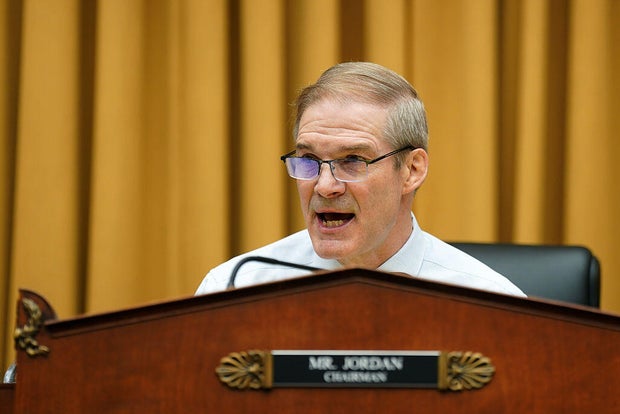
"It was always about politics and to get President Trump, they were willing to do just about anything," Jordan said in his opening statement.
Jordan portrayed Smith's probes as in line with other investigations into Mr. Trump first announced he was running for president, saying that "Democrats have been going after President Trump for 10 years."
Jordan criticized Smith's team obtaining some Republican lawmakers' phone records as part of the Trump Jan. 6 probe and a temporary gag order Smith secured against Mr. Trump. He said Smith attempted to "stop President Trump from running" in 2024.
"In spite of the left and the weaponization efforts of Jim Comey, Alvin Bragg, Fani Willis and Jack Smith, we the people saw through it all, and we elected President Trump twice," Jordan said at the end of his remarks.
Smith arrives as hearing gets underway
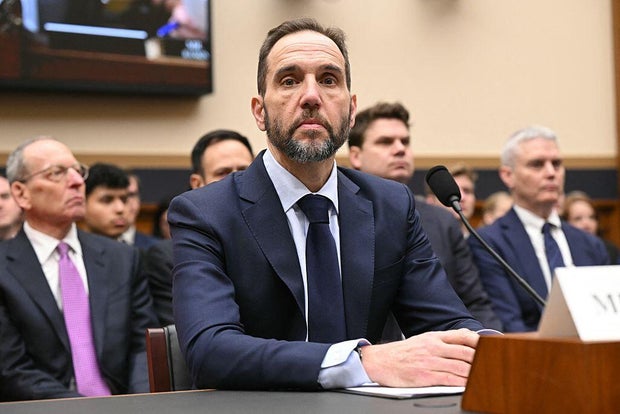
Smith entered the hearing room around 10 a.m. and sat for his first public testimony as photographers snapped photos. Chairman Jim Jordan gaveled in the hearing and began with an opening statement.
Testimony comes after months of Smith offering to appear publicly
In an October letter from his lawyers to lawmakers, Smith offered to testify before both the House and Senate Judiciary Committees. In December, the Republican chairman of the House Judiciary Committee, Jim Jordan of Ohio, subpoenaed him to appear behind closed doors instead.
Rep. Jamie Raskin, the top Democrat on the Judiciary Panel, said Smith answered every question to "the satisfaction of any reasonable-minded person in that room."
Following Smith's testimony, Rep. Daniel Goldman, a Democrat from New York, criticized Jordan for having Smith testify privately first.
"The accusations against him are completely bogus, and the American people should hear that for themselves," he said.
Following his testimony, Smith's lawyers again asked for their client to appear publicly, urging Jordan to call him to testify in an "open and public" hearing. Jordan said earlier this month that he had scheduled his public testimony for Jan. 22.
Smith is also under investigation by the Office of Special Counsel, an agency that is unrelated to Smith's former position as special counsel. His lawyers called the ethics probe by the Office of the Special Counsel "imaginary and unfounded."
What Smith can talk about, and what he likely can't
While Smith spoke at length at his deposition about his investigation into Mr. Trump related to the 2020 election, it's unlikely that he will be able to speak in detail about the classified documents case due to ongoing court proceedings.
For over a year, U.S. District Judge Aileen Cannon, who oversaw the initial stages of the documents prosecution, has blocked the release of the second volume of the final report that Smith submitted to then-Attorney General Merrick Garland. Smith left the Justice Department shortly after submitting his reports.
However, in December, after Smith's testimony, Cannon granted attorneys for Mr. Trump a 60-day window to challenge whether the report should continue to be under seal as separate legal proceedings in the case continue. On Tuesday, Mr. Trump's legal team asked Cannon to grant an order blocking "current, former and future" DOJ officials from ever releasing the report.
When pressed on whether he could talk about the second volume of the report, Smith told lawmakers that he did "not want to do anything to violate that injunction or that order," and said he has not reviewed his report since it was submitted to Garland in early 2025. Smith told lawmakers that unless something related to the handling of the case was in a public filing, he could not address it.
Smith defended his probes at deposition, said he had not made "final decisions" on charging co-conspirators
Behind closed doors in December, Smith defended himself from accusations from committee staff and Republican lawmakers that his investigations into Mr. Trump were intended to stop his presidential campaign.
"All of that is false," Smith said, adding that "the evidence here made clear that President Trump was by a large measure the most culpable and most responsible person in this conspiracy. These crimes were committed for his benefit. The attack that happened at the Capitol, part of this case, does not happen without him. The other co-conspirators were doing this for his benefit. So in terms of why we would pursue a case against him, I entirely disagree with any characterization that our work was in any way meant to hamper him in the presidential election."
Smith revealed that he and his team determined they had evidence to charge some of Mr. Trump's co-conspirators in the election-related case, but said that by the time the cases were dismissed, he had not yet made final decisions on whether to do so.
One of those co-conspirators was Rudy Giuliani, Smith said, before later saying that it's possible the former mayor of New York could have testified against Mr. Trump. Giuliani, Smith said, "disavowed a number of the claims" that he made repeatedly about the integrity of the 2020 election in an interview with the special counsel's office.
There were six unnamed co-conspirators in the indictment against Mr. Trump. Based on details and Smith's testimony, they appeared to be Giuliani, Sidney Powell, John Eastman, Kenneth Chesebro, Boris Epshteyn and Jeffrey Clark, who was a high-ranking Justice Department official at the time.