Live Updates: Iran denies plans for nuclear site inspections, says it will retain control of Strait of Hormuz
What to know about the Iran war today:
- Iran's foreign ministry spokesman said Tuesday that there were no "plans for IAEA inspections" of nuclear sites, contradicting Vice President JD Vance's optimism about United Nations nuclear inspectors returning as soon as this week.
- Iran's chief negotiator told state media Tuesday that the Strait of Hormuz will "never return to its pre-war conditions" and that Iran will maintain control of the vital waterway.
- Monday was the busiest day for transits of the Strait of Hormuz since the war began, with 35 commercial vessels crossing the waterway, according to data from the maritime tracking firm Kpler. That is still only about a third of pre-war traffic levels, but it likely does not include some ships that transited the strait with their location transponders switched off.
Israeli military says it struck Hezbollah fighters in southern Lebanon
Israel's military said Tuesday that forces operating in southern Lebanon had killed two "armed terrorists operating in close proximity" to soldiers.
"The soldiers struck the terrorists north of the Security Zone in order to remove the threat," the Israel Defense Forces said in a statement.
The "security zone" is an area that extends roughly six miles into Lebanese territory, spanning virtually all of its southern border with Israel, that Israeli forces have occupied for weeks. Israeli officials say forces will remain in Lebanon until the threat posed by Hezbollah is eliminated.
The incident came as Lebanon's civil defense rescue agency told the Qatari government-owned Al Jazeera network that two people were killed and one was injured by Israeli troops firing on a group of people.
"The IDF will continue to operate to remove immediate threats and will not allow the Hezbollah terrorist organization to harm Israeli civilians and IDF soldiers," the Israeli military said in a statement.
The conflict between Israel and Iran-backed Hezbollah has threatened to derail the agreement struck between the U.S. and Iran, which calls for an end to military operations on all fronts, including, explicitly, Lebanon.
Iran's foreign minister said Monday that a "de-conflicting cell" agreed to during Sunday's first round of U.S.-Iran negotiations, aimed at avoiding escalations in Lebanon, would be the "first test" of the memorandum of understanding signed by President Trump and his Iranian counterpart last week.
Nuclear talks dependent on implementation of other points agreed with U.S.
Iran's foreign ministry spokesman said Tuesday that the start of talks on the future of Iran's nuclear program will be dependent on the implementation of the other points in the memorandum of understanding with the U.S.
"The text of the memorandum clearly states that the start of negotiations on these two issues [nuclear program and sanction relief] is conditional upon the implementation of specific clauses of the memorandum," spokesman Esmail Baqaei said during a regular briefing to reporters in Tehran aired on state television.
"We are currently working to ensure that all these clauses are fulfilled as prerequisites for the start of negotiations," he said.
Iran has long stressed the point in the memorandum that calls for a halt to hostilities on all fronts, including in Lebanon, where Israeli forces continue to occupy a wide swath of the country in their fight with the Iranian-backed group Hezbollah.
Iran says it intends to retain control of Strait of Hormuz
Iran's chief negotiator insisted Tuesday that Tehran intends to retain control of the Strait of Hormuz following talks with the U.S.
"The Strait of Hormuz will never return to its pre-war conditions and will be administered by the Islamic Republic of Iran, in accordance with international law," Iran's chief negotiator Mohammad Bagher Ghalibaf said according to Iranian state media.
Qalibaf, who is also the speaker of Iran's parliament, echoed his own statements from Monday on his way back from Switzerland.
"Hopefully we can activate the strait again, in terms of passage, and bring prosperity back to [the] regional and global economy," he said.
Monday ship traffic through Strait of Hormuz highest since start of war, data shows
At least 35 commodity carriers transited the Strait of Hormuz on Monday, a record level since the start of the Middle East war in late February, according to data from the maritime tracking firm Kpler.
The 35 passages represent nearly a third of normal peacetime traffic, which was around 120 per day through the strait, which normally sees around a fifth of the world's oil and gas exports.
The total count for Monday crossings is expected to rise further as ships are detected later by maritime trackers. Vessels will sometimes switch off their location transponders to transit the strait.
Iran denies plans for nuclear inspection of sites damaged in war
Iran's foreign ministry spokesman said Tuesday that there is no plan yet to allow inspectors from the United Nations' International Atomic Energy Agency to return to Iranian nuclear sites that were severely damaged by U.S. and Israeli strikes a year ago, casting doubt on a remark made Monday by Vice President JD Vance.
"We have not had a meeting with the director general of the International Atomic Energy Agency, nor do we have any plans for the agency to inspect Iran's nuclear facilities damaged by the U.S. and Zionist military aggression," Esmaeil Baqaei said at a press conference.
Vance said Monday that Iran had agreed to let IAEA inspectors visit the nuclear sites as soon as this week following talks with Tehran's negotiators.
It is not clear whether Iran might allow inspections of other nuclear sites in the country, but the one of most interest is likely Isfahan, which was among those struck last year.

Isfahan is where IAEA officials believe Iran's stockpile of roughly 900 pounds of highly enriched uranium is buried under rubble. The material is enriched to 60% purity, a short technological step away from the 90% required to make a nuclear weapon.
Vance says Iranians can be "extremely confusing as negotiators"
Vice President Vance said he did not feel snubbed by Iran's Foreign Minister Abbas Araghchi when he appeared to skip out on a photo op with him on Sunday.
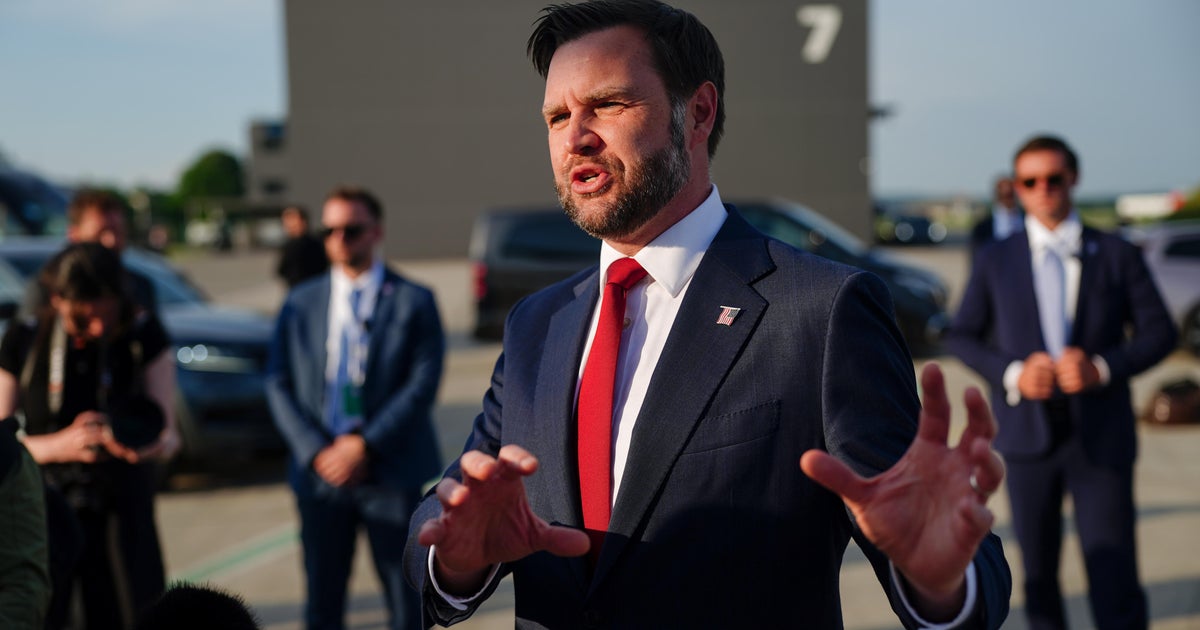
"Trust me, I've spent a lot of time dealing with the Iranians over the last few months. Sometimes I find them extremely confusing as negotiators," he told reporters Monday following hours of meetings with Iranian negotiators and mediators in Switzerland.
Vance said there was a "sort of social media firestorm" suggesting the Iranians were going to leave the talks.
"And then we proceeded to talk to them for like the next nine hours. So I would just encourage the media, mistrust a little bit what you see coming out of Iranian social media. They can be confusing negotiators, but we feel like we're making progress," he said.
Iran says technical talks with U.S. in Switzerland have concluded
Technical talks between Iran and the United States in Switzerland have wrapped up, with negotiating groups to be set up on nuclear issues and sanctions on Tehran, Iran's state media reported Tuesday.
The negotiators "decided that four working groups would be established: (Iran) Sanctions Termination, Nuclear Affairs, (Iran) Reconstruction and Economic Development, and Monitoring and Implementation (of agreements reached)," said the IRNA state news agency, quoting Deputy Foreign Minister Kazem Gharibabadi.