Millions of Americans face higher utility bills as dozens of rate hikes take effect
Tens of millions of Americans are facing higher utility bills after regulators approved dozens of rate hikes last year.
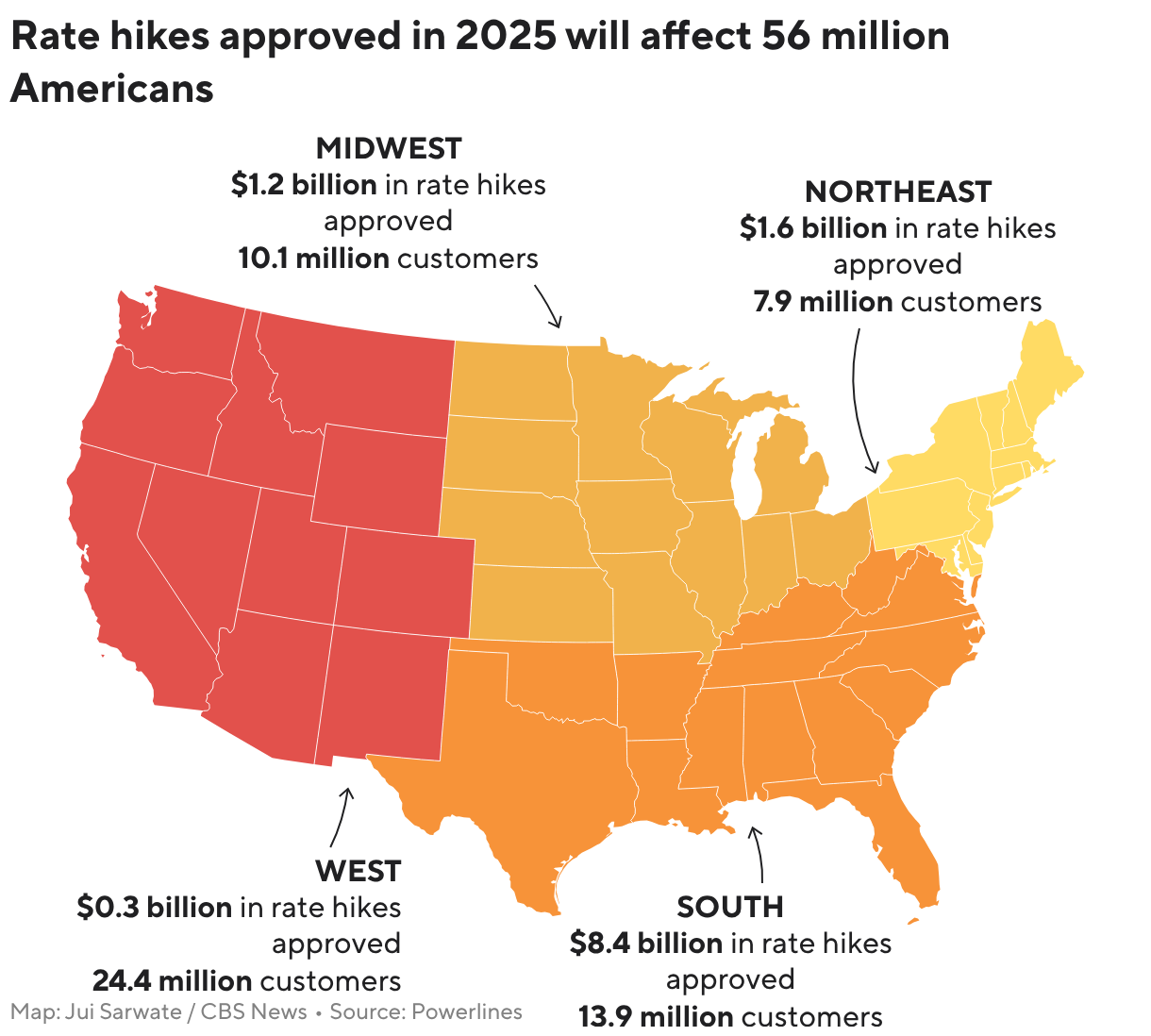
Regulators green-lit 43 rate hikes across the country in 2025, totaling $11.6 billion in increases, according to an analysis by PowerLines. The nonprofit, which is focused on lowering utility costs, said the vast majority of hikes have already gone into effect, while eight are slated to go live in the coming months.
All told, 56 million Americans will see higher utility bills, according to PowerLines, adding fresh financial pressure on consumers at a time when energy costs are already a major headache. Utilities are hiking their rates to pay for repairing and replacing ailing infrastructure, costs linked to extreme weather events, volatile fuel prices and the increase in electricity demand, driven largely by data centers.
Consumers absorb the cost of rate hikes, as well as utilities' operational and capital infrastructure costs, in their monthly utility bills, according to PowerLines.
"We're calling this the new politics of electricity, where electricity is the new eggs," said Charles Hua, the executive director of PowerLines, during a media briefing last Wednesday, referring to the soaring price of eggs in 2024 and 2025 that became a focal point of consumer frustration over grocery costs.
Where are rates rising?
While the impact of the rate hikes will be felt around the U.S., residents of southern states are bearing the brunt, data from PowerLines shows. Utilities in the region requested 13 rate hikes, with regulators approving increases totaling $8.4 billion.
That includes a highly contested rate hike by the utility company Florida Power & Light, which is asking Floridians to pay billions of dollars in additional utility costs in the coming years.
PowerLines tabulated a total of 83 rate requests in 2025, 38 of which are still pending and two of which were rejected. If the pending requests are approved, more than 80 million Americans could be facing higher utility bills, the analysis found.
Sky-high costs
The new round of rate hikes comes as Americans are already grappling with soaring energy costs. Around one in three Americans said they had to forgo paying a basic expense in 2024 to afford their energy bills, according to a LendingTree analysis of U.S. Census Bureau Household Pulse Survey data.
As of July 2025, Americans paid about $250 a month on average for their utilities, data released last year from The Century Foundation, a progressive think tank, and advocacy group Protect Borrowers shows.
The reason for a rate hike will likely depend on where you live, Hua said.
"In California, wildfires have been by far the biggest driver," Hua said last week. "In Georgia, things like extreme weather events, or the Vogtle nuclear plant, have been the biggest driver of the utility bill increases that people ultimately have felt."
Power-hungry data centers are another culprit, although how much these facilities will impact a given customer's utility bill is nuanced, according to Hua.
"It differs a lot based on the geography, electricity market structure, as well as the state utility regulatory paradigm, and what actions the [public utility commission] is or isn't taking in that jurisdiction," he said.
To assuage consumer concerns, the White House and Congress have called on big tech companies to foot the bill for new artificial intelligence plants, with some, like Meta and Google, committing to absorb the costs.
State of natural gas and electricity prices
Higher utility bills may continue to be a pain point for Americans, especially as electricity prices are expected to continue rising this year.
The U.S. Energy Information Administration forecasts residential electricity prices to rise nearly 4% in 2026. Because electricity rates vary by state, prices vary depending on where you live.
Americans spent $1,833 on average on their electricity bills in 2024, according to PowerLines. The nonprofit said wholesale electricity prices have surged in recent years due to rising demand from electrification, manufacturing and data centers.
Residential natural gas prices are expected to dip in the coming years, an EIA projection shows, potentially offering some relief.
While the price of natural gas overall is expected to fall in the next several years, it will likely remain volatile, experts told CBS News. Take the recent winter storm blitz, when global natural gas prices rose due to a surge in demand. Natural gas futures settled at nearly $7 per MMBtu (British thermal unit) on Jan. 27, the highest level since December 2022.
"Heating demand was significantly higher, and electricity demand increased significantly, which increased natural gas-fired generation to a very high level for this time of year," Matthew Palmer, executive director and head of Americas gas research at S&P Global Energy, told CBS News in an email.
Weather events can push up natural gas demand, but they aren't likely to impact utility bills in the near term, experts said.
"Short-term spikes are unlikely to impact individuals' utility bills since much of what they consume is hedged out months ahead of time by utilities," Eric McGuire, director of research at Wood Mackenzie, an energy research company, told CBS News. "That being said, if prices remain high or we see continued volatility, it could impact the prices they pay in the future."