Detroit man exonerated after more than 12 years with help of Michigan Innocence Clinic
At 20 years old, Quinton Jones-Whitaker was sentenced to 12 and a half to 22 years in prison for a crime he did not commit.
On Tuesday, 12 and a half years later, his convictions for carjacking, armed robbery, and felony firearm possession were vacated by the Third Circuit Court of Michigan with the help of the Michigan Innocence Clinic and the Wayne County Conviction Integrity Unit (CIU).
"It was an emotional rollercoaster because it was like finally somebody trying to help me," said Jones-Whitaker, who is now 33.
The Michigan Innocence Clinic is a non-DNA innocence clinic run out of the University of Michigan Law School, where students lead all cases. The clinic and CIU were able to present new evidence to the court, which identified the three men who actually committed the crime.
In 2013, a man was carjacked and robbed at gunpoint in Detroit after receiving text messages from someone pretending to be his ex-girlfriend and asking to meet.
The victim told Detroit police that his two perpetrators were 5 feet 10 inches tall and 160 pounds, and 6 feet 10 inches and 200 pounds, and he only got a good look at one of them.
Police suggested the victim look on social media to identify the perpetrators. The ex-girlfriend in question was now dating Jones-Whitaker. After seeing a photo of him on his ex-girlfriend's Twitter page, the victim identified Jones-Whitaker — who was 5 feet 5 inches and 125 pounds — as one of the perpetrators.
Police then arrested Jones-Whitaker, and in a lineup where Jones-Whitaker was wearing the same distinctive shirt he was wearing in the Twitter photo, the victim identified him.
Olivia Vigiletti, clinical fellow in the Michigan Innocence Clinic, was the supervising attorney on the case.
"It reveals a huge problem that one eyewitness — no matter how faulty their memory might be — is enough to convict," Vigiletti said. "Once he saw that photo of Quinton on Twitter, that's the picture that was going to stick in his mind."
The Michigan Innocence Clinic began investigating the case in 2019 after Jones-Whitaker's mom reached out.
"We investigated the case for about a year and realized that we probably had enough to move forward, and that's when we reached out to the Wayne County Conviction Integrity Unit and conducted an additional joint investigation," Vigiletti said.
However, once someone is convicted, "you need a lot of really compelling new stuff to get it back in court," Vigiletti said. The clinic and CIU successfully found new evidence implicating other people.
Jones-Whitaker's girlfriend at the time had secretly recorded a phone call where one of the perpetrators confessed to driving the car that brought the two men to the crime scene.
"Our task was to corroborate that phone call," Vigiletti said. "We tracked down some other witnesses who had heard similar confessions to the crime, and we were able to tie three men much more strongly than Quinton was ever tied to the crime."
In the call, he said the two men he drove were cousins. The CIU then tested a fingerprint from the carjacked vehicle that defense counsel previously didn't know about, and the results revealed it belonged to one of the identified perpetrators' cousins.
"The (third fingerprint) allowed us to identify that third perpetrator," Vigiletti said. "It closed the window for someone to say 'Well, maybe it was Quinton and these two other men who have confessed to the crime,' which wouldn't have made sense, but it was something that we thought people would probably say, because we had only identified two of the actual perpetrators."
Jones-Whitaker learned he was being exonerated the same day he was released on parole.
"It's just been a crazy good feeling and just been living," Jones-Whitaker said. "I didn't celebrate too hard. I was just with family, and that's all."
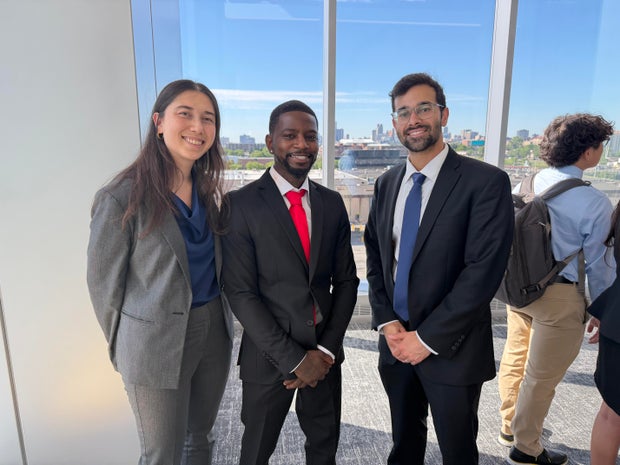
Maxime Legros and Riley Segal, both rising third-years at the University of Michigan Law School, were Jones-Whitaker's student attorneys.
Jones-Whitaker was incarcerated in the Upper Peninsula, so the student attorneys spoke with him by phone and mail.
"Our communication line was always open," Jones-Whitaker said. "As long as I called at the times that was available, I was always able to get through. There was no waiting; they were always there for me."
Jones-Whitaker said that after more than 12 years of incarceration, he is excited to take it one day at a time.
"I'm just ready to live," Jones-Whitaker said. "I'm ready to build a career, be with my family… I'm not trying to catch up. I'm just trying to just live. Just one step foot forward, that's all I'm trying to do."


