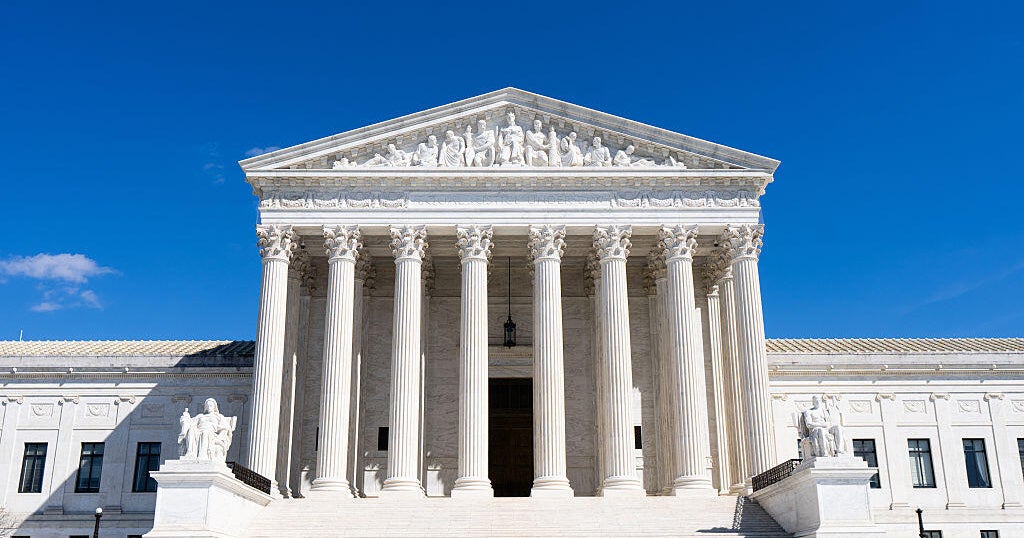
Supreme Court seems likely to uphold transgender athlete bans in West Virginia and Idaho
Washington — The Supreme Court on Tuesday appeared likely to uphold state laws that ban transgender athletes from participating in girls' and women's sports, wading for the first time into the contentious issue.
The justices heard more than three hours of arguments in a pair of cases challenging laws from West Virginia and Idaho that require public school and collegiate sports teams to be designated based on biological sex at birth and restrict transgender girls and women from competing on teams that correspond with their gender identity.
Across the arguments, the justices debated the level of scientific evidence behind whether transgender athletes who have received gender-transition treatments hold any athletic advantage over female competitors, as well as whether the laws discriminate based on sex and transgender status, as two transgender athletes who challenged their states' measures argue.
A decision from the Supreme Court could have ramifications for more than half the country: Idaho and West Virginia are among the 27 states that have enacted laws in recent years that forbid participation by transgender athletes in girls' and women's sports.
The two transgender athletes who brought the cases, Lindsay Hecox of Idaho and Becky Pepper-Jackson of West Virginia, filed lawsuits challenging the laws in their respective states several years ago, arguing that they violate the Constitution's guarantee of equal protection and Title IX, the landmark law that prohibits sex discrimination in education programs. The bans, the athletes said, categorically exclude all transgender girls and women from school sports altogether, and treat them worse than their peers. Lower courts ruled in favor of Hecox and Pepper-Jackson.
But Idaho and West Virginia officials asserted that their bans do not discriminate based on transgender status and draw permissible distinctions between the sexes. They said that the laws' sex-based classifications are allowed because they are substantially related to their interest in fair and safe athletic opportunities for women and girls.
Justice Brett Kavanaugh said that the growth of girls' and women's sports since Title IX was enacted 50 years ago is one of the "successes in America," and he warned that allowing transgender athletes to compete on girls' and women's sports teams threatened to "undermine or reverse" that success. He said sports are typically a "zero-sum game," and transgender athletes can displace girls and women if they are selected for a team or take their place on a podium.
"For the individual girl who does not make the team or doesn't get on the stand for the medal or doesn't make all-league, there's a harm there, and I think we can't sweep that aside," Kavanaugh said. He later sought to clarify that a ruling from the Supreme Court on Title IX grounds would be specific to sports and unlikely to open the door to policies that separate males and females in the classroom or other activities.
Kavanaugh also said that when Congress enacted Title IX decades ago, it understood "sex" to mean biological sex at birth, and it would be up to lawmakers today to adjust the definition in the law.
Some of the justices sought to test the lines of when it would be permissible under Title IX for girls and boys to be treated differently. Justice Neil Gorsuch posed the hypothetical scenario of boys having separate high school remedial programs, while Justices Elena Kagan and Amy Coney Barrett raised examples of proficiency in chess or calculus.
Barrett and Justice Clarence Thomas also questioned whether boys who are less athletically skilled than their male peers could try out for girls' teams if the laws were wiped away.
But some of the liberal justices said that Pepper-Jackson and Hecox, as well as other transgender athletes like them, are seeking an exception to the state bans. Lawyers for the athletes told the court they received medical interventions that do not give them an unfair edge over girls and women competing against them.
"I would think the state would just have to make exceptions where people can demonstrate that the justification that makes the state's conduct constitutional doesn't apply to them," Justice Ketanji Brown Jackson said.
Joshua Block, a lawyer with the ACLU who argued on behalf of Pepper-Jackson, told the justices that she and Hecox are categorically excluded from all sports, and said some states are using the definition of "sex" to deny athletic opportunity. He urged the Supreme Court not to issue a broad ruling, but to instead allow the district court to evaluate the facts and evidence related to athletic advantage.
A decision from the Supreme Court is expected by the end of June or early July.
Little v. Hecox
Idaho was the first state in the nation to enact a law barring transgender athletes from competing on girls' and women's athletic teams. Called the Fairness in Women's Sports Act, the measure requires public school and collegiate sports teams to be designated "based on biological sex." Under the law, athletic teams designated for females, women or girls "shall not be open to students of the male sex."
If a student's sex is disputed, the law requires the athlete to provide a health examination and consent form that verifies their biological sex at birth.
Hecox, a transgender woman who wanted to compete on the women's track and cross-country teams at Boise State University, filed a lawsuit challenging Idaho's law and argued it is unconstitutional and a violation of Title IX. Hecox, who takes hormone therapy, tried out for the university's track and cross-country teams but did not make them. She instead participated in women's club soccer and running.
Idaho's attorney general and two athletes, Madison Kenyon and Mary Kate Marshall, are defending the law. Kenyon and Marshall competed on the women's track and cross-country teams at Idaho State University and placed behind a transgender student-athlete in various events in 2019 and early 2020.
"If women don't have their own competitions, they won't be able to compete," Alan Hurst, Idaho's solicitor general, told the high court. "Gender identity does not matter in sports, and that's why Idaho's law does not classify on the basis of gender identity. It treats all males equally and all females equally, regardless of identity."
In an interview with CBS News, Kenyon and Marshall explained why they were defending the law.
"I know it's not fair, because I stepped on the line and was beat by a male, and saw hundreds of other women be beat by a male," Kenyon told CBS News.
"I mean, to wake up at 7 a.m. every single day, putting in workouts, running, going to the gym, and then, to go to the race, already knowing the outcome, it's absolutely deflating," Marshall said.
U.S. District Judge David C. Nye ruled in favor of Hecox in 2020, and blocked enforcement of the ban, finding that it "discriminates between cisgender athletes, who may compete on athletic teams consistent with their gender identity, and transgender women athletes, who may not compete on athletic teams consistent with their gender identity." The U.S. Court of Appeals for the 9th Circuit affirmed that decision and concluded that Idaho's ban is likely unconstitutional.
The Supreme Court agreed in July to take up the challenge to the Idaho and West Virginia laws. But since then, Hecox, now 25, has sought to have the case dismissed as moot. She decided to refrain from playing any women's sports at Boise State University or in Idaho, and would not participate in any school-sponsored athletics covered by Idaho's ban.
West Virginia v. B.P.J.
West Virginia lawmakers enacted its ban, called the Save Women's Sports Act, in 2021. Like Idaho's measure, the law requires athletic teams to be designated "based on biological sex." The law states that athletic teams or sports designated for females "shall not be open to students of the male sex where selection for such teams is based upon competitive skill or the activity involved is a contact sport."
Before the law took effect, Pepper-Jackson wanted to compete on the girls' cross-country and track teams, and sued to block enforcement of the ban against her, arguing it violated Title IX and the 14th Amendment's Equal Protection Clause. Pepper-Jackson, a 15-year-old transgender girl, began socially transitioning in third grade and has taken puberty-delaying medication and hormone therapy. She is now a sophomore in high school.

In 2023, a U.S. district court upheld the law on both equal protection and Title IX grounds, finding West Virginia's classification based on biological sex is substantially related to its interest in providing equal athletic opportunities for females.
The U.S. Court of Appeals for the 4th Circuit and the Supreme Court blocked West Virginia officials from enforcing the ban against Pepper-Jackson while proceedings continued, with Justices Samuel Alito and Clarence Thomas in dissent. The 4th Circuit then divided 2-1 in finding that the law violates Title IX because it discriminates based on gender identity, which it said is discrimination on the basis of sex.
The debate over transgender athletes
It's unclear how many transgender athletes are covered by bans in the 27 states that restrict participation in girls' and women's sports. The Williams Institute at UCLA Law School estimates that up to 122,000 transgender athletes could be participating in high school athletics.
Pepper-Jackson is the only openly transgender student-athlete in West Virginia, her lawyers say, and they argue that neither she nor Hecox have any athletic advantage over their female competitors because they've received gender-transition treatments.
But West Virginia officials argue that as a result of Pepper-Jackson's participation in girls' sports, she displaced at least 400 female athletes in standings in track-and-field events in the spring 2025 season.
West Virginia Solicitor General Michael Williams and state officials warned that the 4th Circuit's decision requires states to treat sex and gender identity as synonymous when it comes to sports.
"Maintaining separate boys and girls sports teams ensures that girls can safely and fairly compete in school sports. The question today is whether this enduring structure can continue," Williams told the justices. "It can. Title IX permits sex-separated teams. It does so because biological sex matters in athletics in ways both obvious and undeniable."
In filings with the Supreme Court, Idaho officials assert that sex is biological and immutable, and causes the differences between males and females. They say their law is motivated by those physical and physiological differences, and classify based on sex to account for those distinctions.
The Trump administration is backing West Virginia and Idaho in the cases. In a friend-of-the-court brief, Solicitor General D. John Sauer said the practice of sex-separated sports is justified for transgender athletes, because physiological differences between males and females are unrelated to gender identity and not eliminated by medical treatments like puberty blockers or hormones.
"In short, the laws of West Virginia and Idaho place trans-identifying athletes on sports teams on the same valid, biology-based terms as everyone else," Sauer wrote. "That is the definition of equal treatment. It is not gender-identity discrimination at all, much less sex discrimination."
On the other side, Hecox's lawyers first argue her case should be dismissed because she has stopped playing any sports covered by the ban. But the legal teams for both transgender athletes also refute that Idaho and West Virginia's laws are substantially related to their interests in promoting equality and safety in female athletics.
"The statutory text, history, and purpose lead to the inescapable conclusion that the Act intentionally treats transgender women and girls differently — and worse — by categorically barring them from playing women's and girls' sports," Hecox's lawyers wrote in a filing.
In Pepper-Jackson's challenge to West Virginia's law, her legal team says in court papers that Title IX does not authorize the "wholesale exclusion" of transgender girls from athletics. They argue the state's restriction subjects Pepper-Jackson to discrimination because it denies her equal access to athletics.
The legal battles over the state bans for transgender athletes are the latest involving LGBTQ rights to land before the Supreme Court.
In 2020, the court divided 6-3 in finding that protections from workplace discrimination under Title VII extend to transgender and gay employees, with Justice Neil Gorsuch authoring the majority opinion. Chief Justice John Roberts joined Gorsuch and the three liberal justices in the majority, though he suggested when debating the sports-participation bans that the reasoning in that earlier case may not extend to these legal battles.
"The question here is whether or not a sex-based classification is necessarily a transgender classification," he said.
In its last term, the Supreme Court upheld a Tennessee law barring medical interventions for minors experiencing gender dysphoria. The high court found that the law does not rely on sex-based classifications, but instead draws lines based on medical use and age.
The Supreme Court has also allowed Mr. Trump to temporarily enforce policies banning transgender people from serving in the military and requiring passports to reflect the holder's biological sex at birth. Both cases landed before the high court in their early stages, and the Supreme Court has not yet been asked to decide the legal merits.