Spain to put containment fence around Ceuta after deadly border rush from Morocco
Spain said Saturday it will install a 1,600-foot containment fence on the aquatic border between the tiny territory of Ceuta and neighboring Morocco after tens of thousands of migrants breached the enclave earlier this week. At least 67 people died in the border rush, Spain's Minister of the Interior said, including some who drowned and others killed in a stampede.
Between 50,000 and 60,000 people crossed into Ceuta since Thursday morning. But Spanish Interior Minister Fernando Grande-Marlaska told reporters on Saturday that most of the migrants who arrived in Ceuta have already been sent back to Morocco.
"Almost all of them have already left Ceuta," the minister said when asked about the tens of thousands of migrants who had crossed into the enclave. "The situation has been almost entirely reversed."
Most who tried to cross the border are Moroccans. Seawalls and fences separate Morocco from Ceuta, a Spanish enclave that sits on Morocco's Mediterranean coast. Ceuta and Melilla, another Spanish enclave farther east, have the only land borders the European Union shares with Africa.
Local officials have blamed the sharp increase in crossings on a recent Spanish Supreme Court ruling, which makes it harder to turn away migrants arriving from Morocco by sea. Vivas called the ongoing situation "absolutely unsustainable." He also criticized the government's response, saying that "action was taken too late and insufficiently."
Prime Minister Pedro Sánchez said in a Friday news conference that "all of Spain stands" with Ceuta, and called the increase in migrants "an attack" and "a violation of Spain's territorial integrity." He was expected to visit the city Friday.
"Ceuta is a Spanish city, and what happened yesterday deserves our full reproach, our condemnation at the strongest possible level of rejection, condemnation and consideration as deplorable," he said.
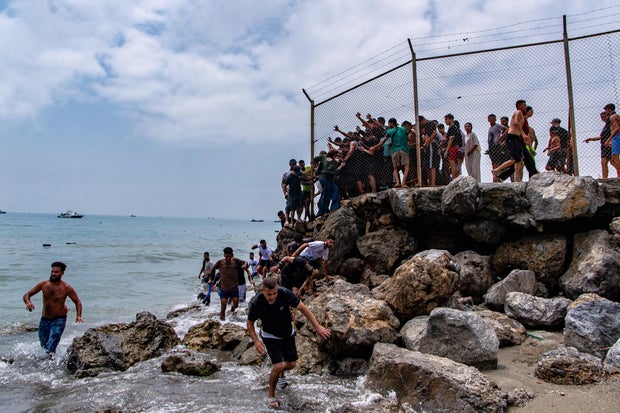
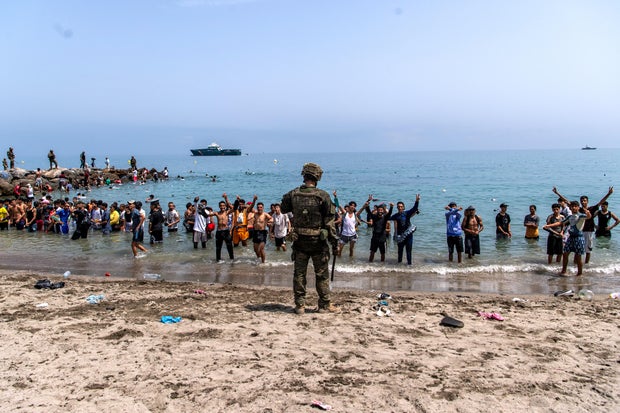
Some people who spoke to CBS News described rushing and overwhelming Moroccan police who tried to stop them. Videos and images from Ceuta showed crowds of people, mainly Moroccans, walking around the breakwaters at an urban beach near a border checkpoint with Morocco onto local roads. The majority looked to be young men, though there were also families with women and children.
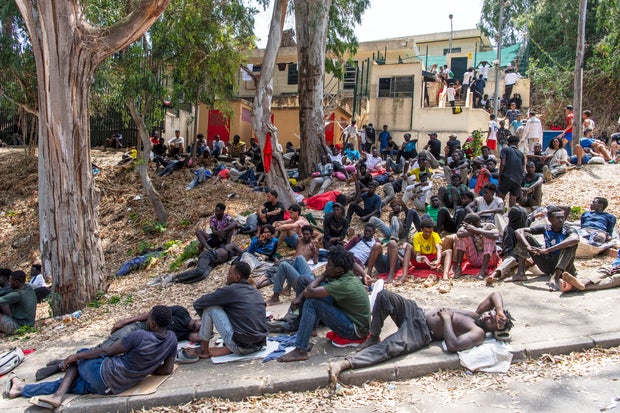
Local workers association leader Rachid Sbihi called the situation a "serious humanitarian crisis." He said thousands of migrants, including unaccompanied children, slept in parks and on sidewalks.
"It's chaotic," said Sbihi, whose union represents Spanish Civil Guard officers, adding that some of the deceased had been trampled trying to cross a breakwater fence.
Sánchez said he asked that buoys be deployed to create a "physical barrier," and said troop numbers have been increased. Spain's government has also deployed its army and sent extra forces, including diver teams and Maritime Service vessels, to Ceuta.
Sánchez said the Legislature is finalizing a system to "facilitate the repatriation of migrants who entered our country irregularly." He said if necessary, the government may "modify certain aspects of the laws to guarantee those border repatriations as efficiently as possible." He added that Morocco's government is cooperating with Spain's.
Sánchez accused "human trafficking mafias" of exploiting the Spanish Supreme Court's ruling.
"This demands one of the strongest condemnations, particularly of the human trafficking mafias that deceive many young people, many of whom find death, whether in the ocean or at this border," he said.
Why are Moroccans fleeing to Ceuta?
Some Moroccan migrants told CBS News they saw social media posts stating, "Spain is an open door," along with videos of people swimming from Morocco to Ceuta. One young man said the posts referenced the recent Spanish Supreme Court ruling.
The average demographic appeared to be young Moroccan men ages 14 to 25. Most said they were there for better jobs or money. One told CBS News he hoped to play soccer in Europe. Another said he wanted to see what Europe was like for the day, but understood why he now had to return to Morocco.
The people who spoke to CBS News did not have premeditated plans to come to Spain, but instead made the spontaneous decision to swim when they saw others doing it.
While Sánchez and others have linked the border crossings to the Supreme Court ruling, it was not immediately clear if that was specifically what prompted so many people to flock to Ceuta in recent days.
Moroccan resident Fatima Zahra told the AFP news agency that she joined the crowd attempting to enter Ceuta after hearing about others who had crossed the border successfully. She said she wanted to go to Europe because she works "under appalling conditions" in Morocco. Zahra was ultimately turned away at the Moroccan border town of Fnideq and did not enter Ceuta.
"I was in Tangier, where I was working. I woke up in the morning and heard that Ceuta had opened," Zahra told AFP. "At that point, I told the people with me, 'Let's go there for work... let's try our luck too.'"
Ceuta is often seen as a destination for those trying to reach Spain from Africa, but crossing the border from Morocco into Ceuta does not immediately grant migrants free movement across Europe.
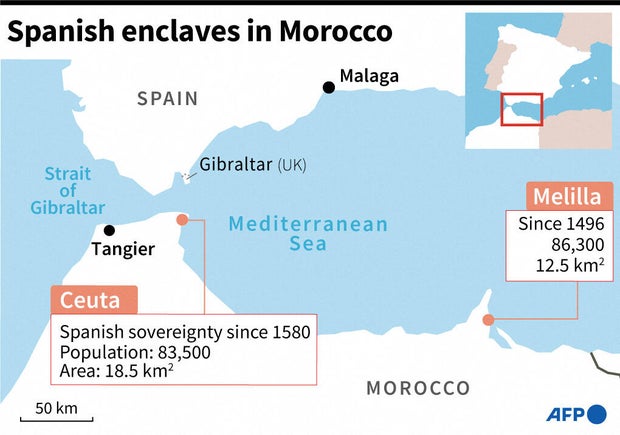
To cross the channel separating northern Africa and mainland Europe, migrants would have to pass additional border controls. Ceuta's isolation from mainland Europe, with limited transportation to the rest of the EU, also makes such travel unlikely.
Both Ceuta and Melilla are heavily fortified, and many migrants who arrive in the enclaves are immediately turned back. Others are held in migrant shelters until they are processed, at which point they can apply for asylum in Spain.
Migrant arrivals to the two enclaves are generally much lower than in other Spanish areas, like the Canary and Balearic Islands.
Ceuta is home to both Spanish and Moroccan residents and day workers. Morocco does not officially recognize Ceuta and Melilla as Spanish territory, and often refers to them as occupied lands.
This is not the first time Ceuta has seen a sudden influx of Moroccan migrants. In 2021, Moroccan authorities relaxed border enforcement amid a diplomatic dispute with Spain, allowing 6,000 migrants to enter Ceuta in a single day.
Morocco's ambassador to Spain said the current situation had unfolded against the Moroccan government's wishes. "We have always prioritized legal, orderly and safe migration for all," Karima Benyaich said.
What were the dynamics between the military and the migrants?
CBS News witnessed local police making arrests of people trying to run away from the border, but the dynamic between police and migrants appeared more playful than hostile.
Throughout the day, teenagers would dash onto the beach, dodging officers before diving back into the water.
However, deeper inside the city of Ceuta, some migrants attempted to open the doors of locked shops and searched for places to get food, water and shelter. One woman described to CBS News people jumping on her parents' house and stealing clothes that were hanging outside.
The Spanish military and local police presence was still large late Friday night, with authorities present on most residential streets in the city.
European Union leaders react
The crossings drew quick condemnation from conservative leaders across Europe.
Italian Prime Minister Giorgia Meloni called on the European Union to suspend the Schengen agreement, which allows freedom of movement within member states.
Meloni said her nation was prepared to "intervene with extraordinary measures to defend the borders and safety of citizens."
Finland's minister of the interior, Mari Rantanen, said: "All European countries must support Meloni's proposal."
European Commission President Ursula von der Leyen said the "images coming from Ceuta are unacceptable," and said that officials "cannot allow anyone to come to our Union without abiding by our rules."
French Interior Minister Laurent Nunez said that he had given instructions to "immediately strengthen" controls at the border the nation shares with Spain.