A Santa's Christmas passion was nearly ended by a severe stroke. The desire to spread holiday cheer fueled his recovery.
When Brent Rasmussen lost his balance early one morning in December 2023, he knew something was seriously wrong.
"All that went through my mind was 'Oh, this is gonna be bad," Rasmussen, now 79, told CBS News. "Everything started to spin. I grabbed the wall and my face slid down the wall. I could see the floor coming."
Rasmussen hit his face hard on the floor. Blood was pouring out of his nose, but he couldn't stand or call for help. It took about an hour for his dog to find him and start barking, alerting his wife. Tenesa Rasmussen called 911 and paramedics brought him to an area hospital. His condition was misdiagnosed at first. Only 19 hours later did doctors realize he was having a massive cerebellar stroke.
Cerebellar strokes affect the cerebellum, which controls a person's movement and balance, according to the Cleveland Clinic's website. The left side of Rasmussen's cerebellum was blocked by a clot. The delay in diagnosis meant he couldn't receive clot-busting medication. He needed brain surgery to remove half his cerebellum. When Rasmussen woke, he couldn't swallow, walk or talk.
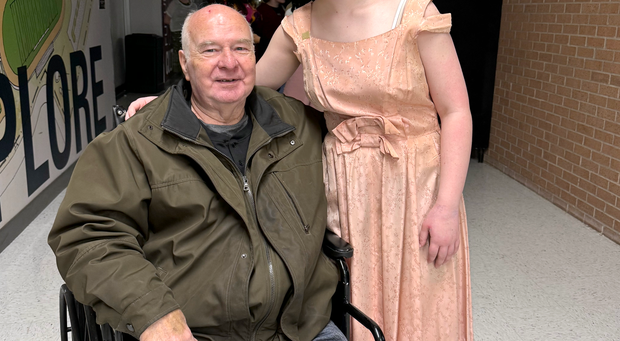
Rasmussen began physical therapy as soon as he was able, but was frustrated by his progress. In March 2024, he sought care at UT Southwestern Medical Center's Department of Physical Medicine and Rehabilitation. They asked him to set a goal. He had a surprising answer.
"I said 'I want to get my ho ho ho back,'" Rasmussen said. "I said, 'I have to be Santa Claus again.'"
Becoming Santa Claus
In 1998, Rasmussen's Dallas company asked him to dress up as Santa for their holiday party. He agreed and found a surprising new passion. The next year, people asked if he could appear at other events. Soon, Rasmussen was booking multiple appearances a year as Santa Claus. After a few years, Tenesa made them elaborate costumes, complete with handmade embroidery and custom buttons.
Even after the couple retired, appearances as Santa and Mrs. Claus continued to dominate their holiday season. In 2023, the couple was celebrating 25 years of bringing holiday cheer.
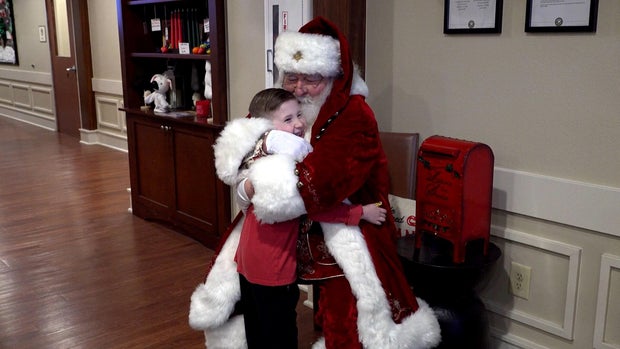
"The joy that comes from visiting with the kids, it's just, you can't explain it," Rasmussen said.
After Rasmussen's stroke, he feared he might never be Santa again. His recovery was slow. After three months, he was still dependent on a walker and a feeding tube. He had lost 45 pounds and didn't have his Santa belly. He needed help with everyday tasks and struggled with vertigo. He could barely speak, let alone do his deep Santa voice. Meeting with kids was out of the question.
"I was upset that this had happened to me," Rasmussen said. "I wanted to be able to do all the things I had always done. I worked hard my whole life, and now I couldn't even go out and do the simplest project. If I got down on the floor, my head would start to spin and I couldn't remember even why I was on the floor."
"The culmination of all our efforts"
After Rasmussen came to UT Southwestern and declared his goal to become Santa again, staff physical therapist Dr. Egle Richards and the facility's rehabilitative team made a plan. He would receive physical therapy to help with his strength and balance issues. Occupational therapy would target his fine motor skills and dexterity. A speech therapist would help him learn how to talk and swallow again.
The progress was slow. At times, Rasmusse's wife said he would grow frustrated.
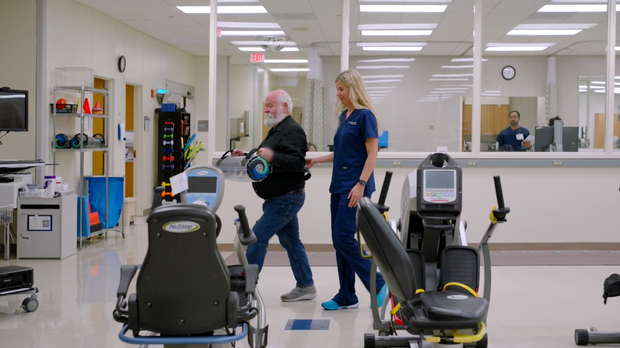
"He would say, 'Why does everything have to be so hard?' Just getting up, just getting dressed, was just indescribably difficult, but he kept at it because he wanted to be Santa," Tenesa recalled. "That is what pushed him to do the hard work, to do the exercises, to keep trying."
After seven months of working with Richards and the rest of the rehabilitative team, Rasmussen's progress was obvious. By late October 2024, he was able to get off the feeding tube and could walk on his own. He regrew his beard. He learned how to project his voice again. His endurance grew.
While he wasn't able to do a full slate of Santa events that December, he was able to make a surprise in-character appearance at UT Southwestern's holiday party.
"It was such a wonderful surprise and just really kind of the culmination of all our efforts here," Richards said.
"The days get longer"
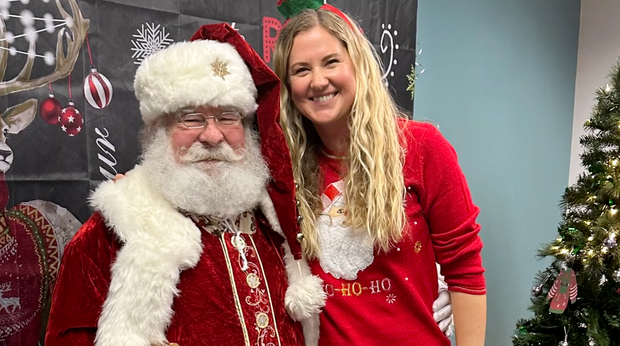
This holiday season, the Rasmussens were able to book a full slate of events — even multiple events a day, something that would have been unthinkable last year. Getting dressed and traveling to events takes a little longer, but once kids start lining up, "the adrenaline kicks in," Rasmussen said.
He's sure to ask what each child wants for Christmas and let them know they're on the nice list. His top priority is making sure each child has a "magical moment" with Santa. If his voice wobbles, he remembers his vocal therapy lessons.
"It's a delicate balance, but it's absolutely wonderful," Rasmussen said.
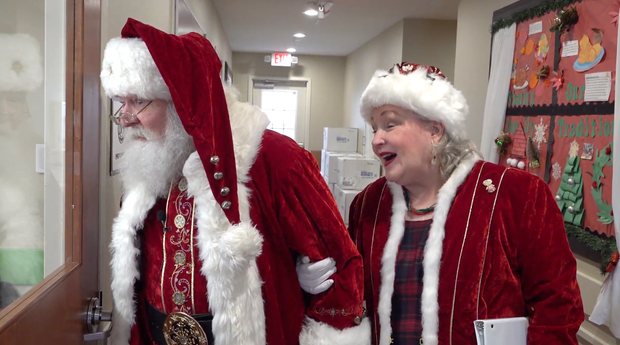
Rasmussen hopes his journey can help provide hope to other stroke survivors.
"If you don't have a goal, you get up and get dressed every day and you're so exhausted by the end of that, all you want to do is just fall back on the bed and snuggle back into the warmth under the blanket and call it a day. But it gets better," Rasmussen said. "Slowly, the days get longer and you're doing more, and you're feeling so happy with yourself for the progress. These are just the experiences you have. You embrace them and move forward and grab it, because life is not over."