Plan for big increase in size of reservoir in Colorado appears to sink

A plan for big increases in the size of Bear Creek Lake in Lakewood's Bear Creek Lake Park looks like it's not going to happen -- at least for the foreseeable future.
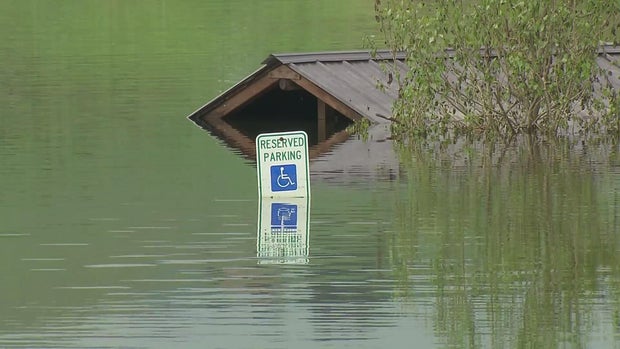
For several years, the U.S. Army Corps of Engineers and the Colorado Water Conservation Board have been looking at the idea of adding to the capacity of the big reservoir deep in the park. That means a change in the original purpose of the lake, which was created behind a big dam for flood control at about the same time as Cherry Creek Reservoir and Chatfield Reservoir. It's also approved for recreational use. Changing the purpose of the lake would mean a so-called reallocation.
But the idea has been just about dropped with the USACE telling the state it is not getting any additional funding for the project beyond the money currently budgeted to study the idea.
"So the volumes that we had before, no longer necessarily in play," said Erik Skeie, a staffer with the Colorado Water Conservation Board during a recent meeting of the board.
Those volumes under consideration were as much as 20,000 acre-feet of water, which would raise the water level 64 feet and flood about 500 acres of the park, covering trails and other facilities.
In addition to a lack of money, community opposition also came into play, Skeie said.
It's good news to Katie Gill, director of Save Bear Creek Lake Park, an opposition group that attended meetings and sent an email to the state and USACE.
"This is what gets preserved. Almost all of this," said Gill as she walked along a trail near Bear Creek that flows through the park.
The Corps owns nearly all of the park land, which is leased to the city of Lakewood under a 50-year lease.
Gill notes that hundreds of thousands of people use the park every year. Many of those utilize the Soda Lakes for boating and swimming. The two lakes are close to C-470. But Bear Creek Lake sits behind a high dam. Several local water utilities are interested in partnering for water storage to meet potential future shortages, including the city of Brighton, Evergreen Metropolitan District, Foothills Parks and Rec, Hidden Valley and, additionally, a potential environmental pool of others, the state said.
If the larger of the potential expansion options was chosen, Gill and others worries the reallocation would effectively terminate uses of areas for running, biking, picnicking and other land uses.
"Most of the trees would be removed," Gill explained. "Mud flats, loss of habitat, loss of trails, loss of trees -- for the every now and then intermittent ability to store more water."
Gill noted there are differences between the ability to store the water and the actual yield of what could be expected, which would be lower in dry years like the current one.
"There's the cost per acre-foot of storage," Gill said. "Then, there's the cost per acre-foot of yield. So, if you pay for the infrastructure and the mitigation necessary for a large reallocation, but the yield isn't there for that volume, then, the partners would be paying a lot for water that's not always there."
Skeie said in a response to emailed questions, "Note that no formal decision has yet been made. At this time, we understand that the federal portion of funding will only cover studying feasibility of 300 acre-feet of additional storage."
An acre-foot is the equivalent of an acre (about the size of a football field) of water 1-foot deep. A cost estimate of that increase would be about $3.5 million. But other estimates rose quickly. A document lists up to a 6,000-acre-feet increase with a price tag of $148 million. That too would flood large areas of the park.
"The Corps' scope is determining whether or not storing additional volumes of water is feasible," Skeie wrote. "At this point, that does not mean additional storage is assured."
During the water conservation board meeting Skeie said, "Due to Corps' funding issues … only alternative one can be completed."
That alternative is the 300-acre-feet alternative. That increase would raise the water level 3 feet and flood only an additional 6 acres around the lake.
"We are fortunate that the costs were in our favor," Gill said. But the Corps did take into account public opinion, and the opposition made a difference. Gill was happy that Skeie contacted her and came out to the park to listen.
"And genuinely understood our concerns, took the time to understand our concerns and helped us navigate the process for making our concerns known," Gill said. "I'm glad that we participated in the process."
There is still a feasibility study going on that was funded by Colorado and USACE. The results of that could mean another look. But at this point the focus is only on pursuing the 300-acre-feet increase. Even that would need to be funded.
Gill recognizes the need for additional water, but also notes there is a balance to be struck.
"This isn't the only way," Gill said. "We need to have better conservation and smarter, more sustainable water storage, and this isn't it."