Chicago winter weather outlook 2026-2027: Strong El Niño favors warmer temperatures, less snow


As we move deeper into fall, a clearer picture is emerging of what the upcoming winter could look like across Chicago and the Great Lakes.
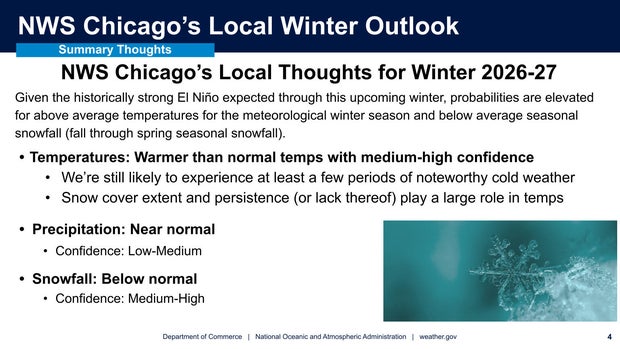
NOAA released its official winter outlook Thursday, October 15, and the forecast continues to favor above-average temperatures for the Chicago area. A very strong to potentially historically strong El Niño is expected to play a major role in our weather patterns this winter.
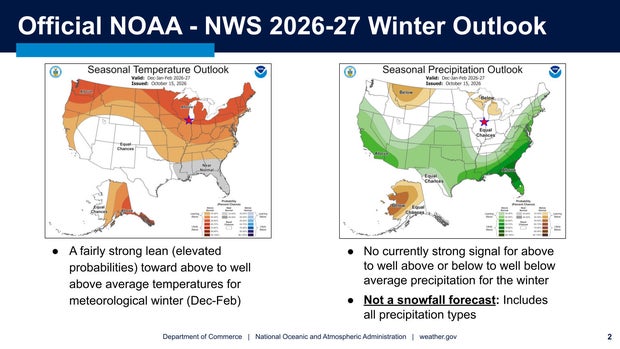
For meteorological winter, which runs from December through February, the Climate Prediction Center favors warmer-than-average conditions across the Great Lakes.
The precipitation outlook is less certain. Forecasters at the National Weather Service in Chicago say their current thinking is for roughly average precipitation across the region this winter.
However, that doesn't necessarily mean average snowfall.
Looking at past strong to very strong El Niño events dating back to 1950, the historical data favors below-average seasonal snowfall across the Chicago area and surrounding region.
One of the biggest factors to watch will be El Niño.
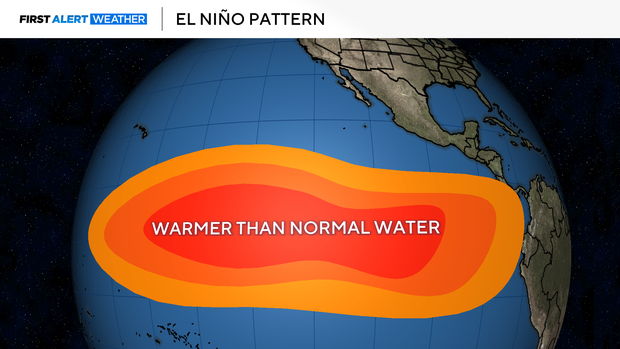
El Niño occurs when warmer-than-average sea surface temperatures develop in the central and eastern equatorial Pacific Ocean. This can shift weather patterns around the world, including across the United States.
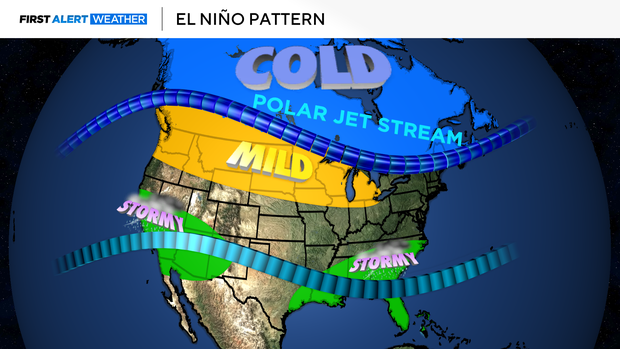
For Chicago and the Great Lakes, El Niño winters tend to favor a jet stream positioned farther south, which can reduce the frequency of storm systems moving through the region and favor milder conditions.
According to the nonprofit Climate Central, winter is already the fastest warming season.
"What we are seeing is that the El Niños are even more extreme because of climate change and because we are seeing an overall warming pattern already," said Kristen Maleck with the University of Illinois Chicago's Center for Extreme Conditions and Health Excellence. "The extremes from climate are making the El Niños more dramatic."
Meleck's group researches the impact of extreme cold on health, both physical and mental. But with the winter expected to be warmer than normal, they're looking past snow and ice.
"We've been focusing a lot on flooding and I think we want to think about what does winter time flooding look like? Because we are not used massive amounts of wetness that may come during a winter like this," she said.
With a warmer overall weather pattern, some precipitation may also fall as rain or a wintry mix rather than snow, depending on temperatures and the track of individual storm systems.
However, even a very strong El Niño does not guarantee a warm or snowless winter in Chicago.
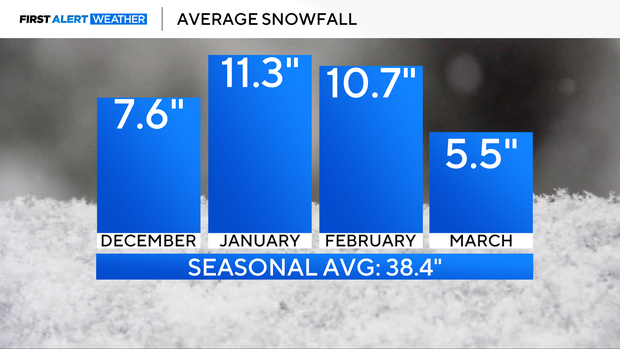
On average, Chicago receives around 38 inches of snow each season, with January typically the coldest and snowiest month.
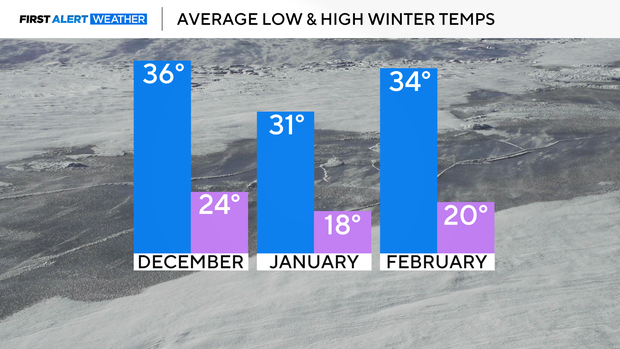
High temperatures in January generally stay in the low to mid-30s, while lows often fall into the teens and 20s.
For now, the overall signal favors a warmer-than-average winter with the potential for below-average snowfall. But seasonal outlooks describe the general pattern over several months, rather than the weather on any particular day.
As always in Chicago, a milder winter can still bring stretches of bitter cold and significant winter storms.


