University of Chicago researchers lead effort to map mass in universe using data from South Pole Telescope

An effort led by University of Chicago researchers has led to the development of the sharpest and clearest map ever of mass in the universe.
The scientists, representing 30 institutions, developed the map by measuring how gravity bent the earliest light in the universe as it moved through space.
They used data from the South Pole Telescope, which has the benefit of the incredibly clear skies of Antarctica as it records the cosmic microwave background. The telescope is located the National Science Foundation Amundsen-Scott South Pole Staton, and is run by a collaboration led by UChicago.
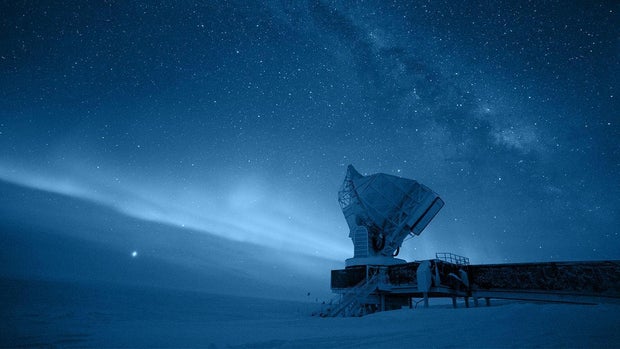
"This is the deepest map of the universe we have so far—it's like taking a photograph with very low background noise exposure," said Yuuki Omori, research scientist at UChicago and lead author of the paper on the study, said in a news release. The paper was released Sept. 1 on arXiv.
The ancient cosmic microwave background, sometimes known as the afterglow of the Big Bang, has been around as long as the universe itself. But it is useful for more than information on the beginning of the universe.
As UChicago explained, the light of the cosmic microwave background travels steadily unless it is bent by the gravitational pull of a cluster of galaxies — in what is called gravitational lensing. Scientists observing this effect can reconstruct a map of all the matter between observers on Earth and where the light was emitted, the university said.
The new map from the South Pole Telescope data is the most sensitive of measurement of gravitational lensing of the cosmic microwave background ever.
Through the mapping effort, scientists can look into a number of questions, including where and how matter is lumped together in the universe.
"What an amazing thing to be able to see all the mass in the universe," John Carlstrom, the Subramanyan Chandrasekhar Distinguished Service Professor of Astronomy and Astrophysics at UChicago and the South Pole Telescope project director, said in the release. "We are entering the new era of cosmology promised by these instruments."
Observing the mass in the universe in turn allows scientists to find out how the universe grew over time.
"Scientists want to tell a coherent story that can explain everything about the universe," Omori said in the release. "We have a pretty good story about the beginning of the universe and a pretty good one about today, but less about the middle years."
Those middle years where when stars and galaxies really started to form.
Scientists also hope the cosmic microwave background data collected from the telescope could someday reveal information about neutrinos. Neutrinos are the most abundant particles with mass in the universe, albeit mass so minuscule that it was long thought to be zero. The mysterious particles are zipping around the universe all the time, but usually don't do anything to warrant notice.
But they might hold answers about the development of the universe.
"By weighing all of the mass in the universe and studying the structure, we can probe the effects neutrinos had on the growth of structure," Wu said in the release. "It's a unique probe of neutrinos, and could even give us a way to measure the mass of neutrinos very precisely."
Scientists also say the data represent progress toward detection of the ripples of gravity from the Big Bang. These are known as "primordial gravitational waves," and date from the first nanoseconds that the universe existed, UChicago said.
Among other things, information about these waves could point a way toward reconciling the laws of gravity and quantum physics, which has long eluded scientists.
To find these waves, the South Pole Telescope data will be used to clean earlier data from another cosmic microwave background measurement effort called the BICEP experiment.
"Essentially, our map can be used to reduce the noise they see and locate the true signal," Omori said in the release.
The UChicago-led collaboration is also working on analyzing a larger set of six years of data from the South Pole Telescope.


