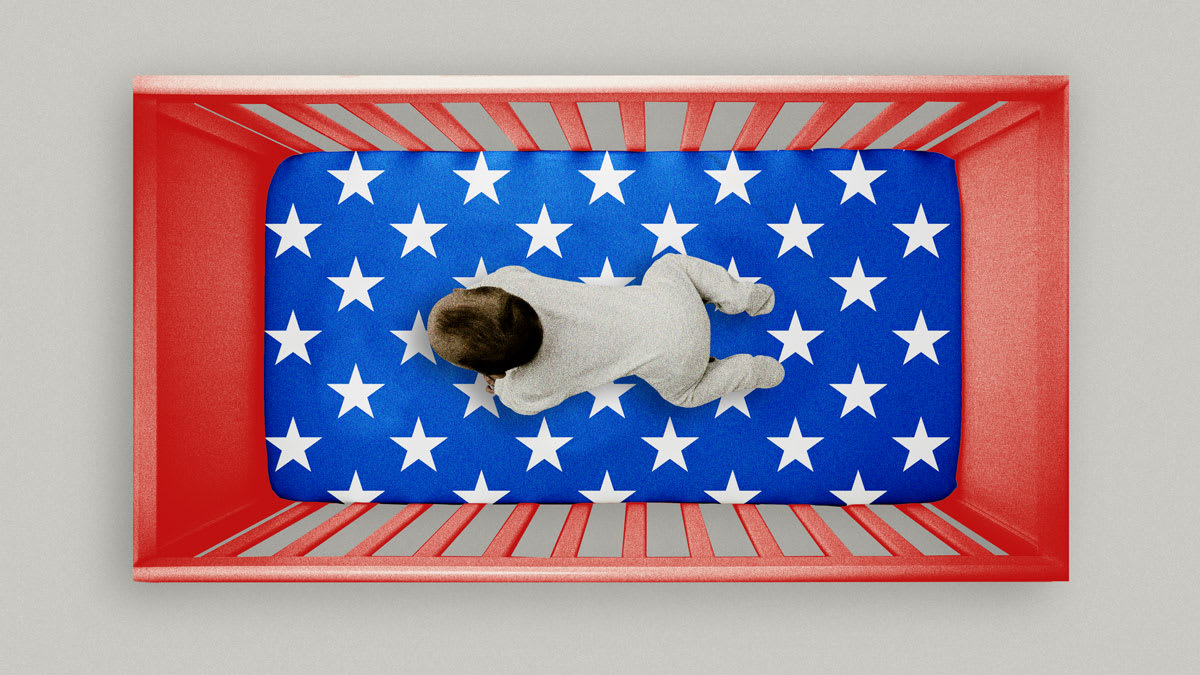
Supreme Court upholds birthright citizenship, striking down Trump's order
Washington — The Supreme Court on Tuesday struck down President Trump's executive order seeking to end birthright citizenship, reaffirming the more than 100-year-old understanding that nearly all of those born in the United States are citizens.
In a divided decision in the case Trump v. Barbara, the Supreme Court split 6-3 in finding that Mr. Trump's policy is unlawful. Five of the justices — Chief Justice John Roberts and Justices Sonia Sotomayor, Elena Kagan, Amy Coney Barrett and Ketanji Brown Jackson — agreed that Mr. Trump's executive order violates the 14th Amendment of the Constitution. Justice Brett Kavanaugh wrote separately to say he believes the order violates federal law.
Justices Clarence Thomas, Samuel Alito and Neil Gorsuch dissented.
With the decision, the Supreme Court has now invalidated a second of Mr. Trump's signature initiatives from his second term, joining its ruling striking down many of his tariffs in February. The president signed his directive aiming to restrict birthright citizenship on his first day back in the White House as part of a sweeping crackdown on immigration.
"Citizenship, then and now, was the right to have rights — to freely participate in our political community. The Framers of the Fourteenth Amendment extended that promise to 'every free-born person in this land,'" Roberts wrote in the majority opinion. "We keep that promise today."
Thomas, joined by Gorsuch, argued that the majority's account of the history of the rule for American citizenship "is not historically accurate."
"The Court today takes the extraordinary step of holding facially unconstitutional the President's Order excluding from citizenship the children of foreign temporary visitors and illegal aliens," he wrote. "In doing so, the Court adds to the sad history of the Fourteenth Amendment, which was designed and understood to secure equal rights for the freed blacks but has instead been repurposed for political projects that the Reconstruction Congress did not support."
Trump's order
A cornerstone of Mr. Trump's immigration agenda, his executive order sought to deny automatic American citizenship to babies born to parents in the country illegally or temporarily. The order would have upended the long-held interpretation of the Constitution's Citizenship Clause as granting citizenship to almost all people born in the U.S.
But the directive never took effect, since it was blocked by every federal court that examined it.
In response to the Supreme Court's decision, Mr. Trump urged Congress to take action to restrict birthright citizenship. But given the conclusion from the five-justice majority that the 14th Amendment guarantees birthright citizenship, a constitutional amendment would likely be needed to restrict it.
"The Supreme Court upheld Birthright Citizenship, which is too bad for our Country, but we can easily make it up in Congress through Legislation, with the support of the President, that has now been determined during this process," he wrote on Truth Social. "No long and unwieldy Constitutional Amendment is necessary! Congress should start TODAY to work on ending expensive and unfair to our Country, Birthright Citizenship. They will have my Complete and Total Support!"
The Citizenship Clause of the 14th Amendment states that "all persons born or naturalized in the United States and subject to the jurisdiction thereof, are citizens of the United States." Congress codified that language in federal immigration law, first in 1940 through the Nationality Act, and again in 1952 in the Immigration and Nationality Act.
The Supreme Court considered the meaning of the clause in a landmark case in 1898 and affirmed the rule of citizenship by birth, with rare exceptions for the children of foreign diplomats, occupying armies and members of Native American tribes. Congress in 1924 enacted legislation conferring citizenship on all Native Americans born in the U.S.
Still, Mr. Trump's executive order sought to change the long-held definition of who is an American. The president and his administration argued that unrestricted birthright citizenship has served as a powerful incentive for illegal immigration and birth tourism. They said the Citizenship Clause has been misread since the mid-20th century.
While the administration said Mr. Trump's measure would have applied only prospectively, the effects would have been far-reaching. An estimated 250,000 babies born in the U.S. would be denied citizenship each year under the executive order, according to the Migration Policy Institute and Penn State's Population Research Institute.
In a sign of the case's importance to Mr. Trump, he attended the oral arguments in April, becoming the first sitting president in modern history to view such proceedings at the high court. Still, the president indicated in social media posts across the past few months that he believed he may not prevail before the Supreme Court.
Mr. Trump's executive order was met almost immediately with legal challenges in courts across the country. Judges in New Hampshire, Washington, Massachusetts and Maryland quickly blocked enforcement of the policy nationwide.
The Trump administration pursued emergency appeals of those decisions, eventually landing the issue before the Supreme Court last year. But those cases involved the scope of the lower court orders, known as nationwide injunctions, and not the legality of Mr. Trump's effort to limit birthright citizenship.
After the high court curbed lower courts' ability to issue nationwide injunctions, another challenge was filed in New Hampshire on behalf of all children who would be covered by the birthright citizenship policy. It was that case that landed before the high court, though in this instance, the justices weighed whether it violated federal law or the Constitution.
Writing for the majority, Roberts, in reference to the 1898 case called United States v. Wong Kim Ark,
said the Supreme Court's holding then "was simple: the Citizenship Clause incorporated the common law and granted citizenship to nearly all children born in the United States. Not surprisingly, then, in the 128 years since, we have repeatedly understood the rule of Wong Kim Ark to guarantee citizenship to all children born in the United States and subject to its power. We see no reason to depart from that view today."
In separate opinions, both Kavanaugh and Justice Samuel Alito suggested that if there was an appetite to limit birthright citizenship, as Mr. Trump attempted to do unilaterally, Congress could enact legislation doing so.
"Congress could — consistent with the Fourteenth Amendment — amend [the Immigration and Nationality Act] or otherwise enact new legislation establishing exceptions to birthright citizenship for children born to foreign citizens unlawfully or temporarily in the country. But Congress has not yet done so," Kavanaugh wrote.