Scientists from UChicago, other institutions discover bizarre lemon-shaped planet orbiting neutron star

Space is full of mysteries that can't be easily explained by the layman, and this latest one from a isn't likely to sour anyone on their fascination with space.
Scientists from several institutions, including the University of Chicago, discovered a lemon-shaped planet with an atmosphere never observed before, orbiting a rapidly rotating neutron star.
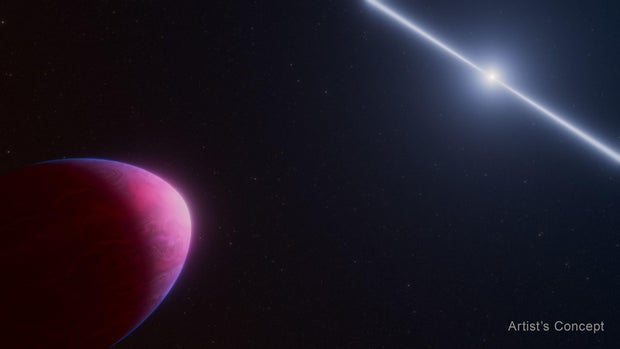
As UChicago and the Space Telescope Science Institute explained in a news release, the scientists were using NASA's James Webb Space Telescope when they discovered the exoplanet — that is, a planet beyond our solar system. The description almost sounds psychedelic — the planet is shaped like a lemon, might have diamonds at its core, and blurs the line between what defines planets and stars, the release said.
The planet — officially called PSR J2322-2650b — also has an atmosphere unlike anything seen before. Scientists were expecting to find the typical molecules — water, carbon dioxide, methane — on the exoplanet, but instead they found it dominated by helium and molecular carbon (C2 and C3), the release said.
The mass of the planet is about that of Jupiter, but carbon soot clouds floating through the air can condense and turn into diamonds, the release explained.
"This was an absolute surprise," team member Peter Gao of the Carnegie Earth and Planets Laboratory in Washington, D.C., said in the news release. "I remember after we got the data down, our collective reaction was 'What the heck is this?'"
The star the planet orbits is no less curious. It's a rapidly spinning neutron star, or pulsar.
What is a neutron star, or pulsar? It's what remains after a massive star runs out of fuel and collapses, slamming all the protons and electrons together and turning them into neutrons.
If the star keeps collapsing, a black hole is the result. But if the mass of the collapsing star is between 1 and 3 solar masses, the neutrons can stop the star from collapsing further, and a neutron star remains, as explained by NASA.
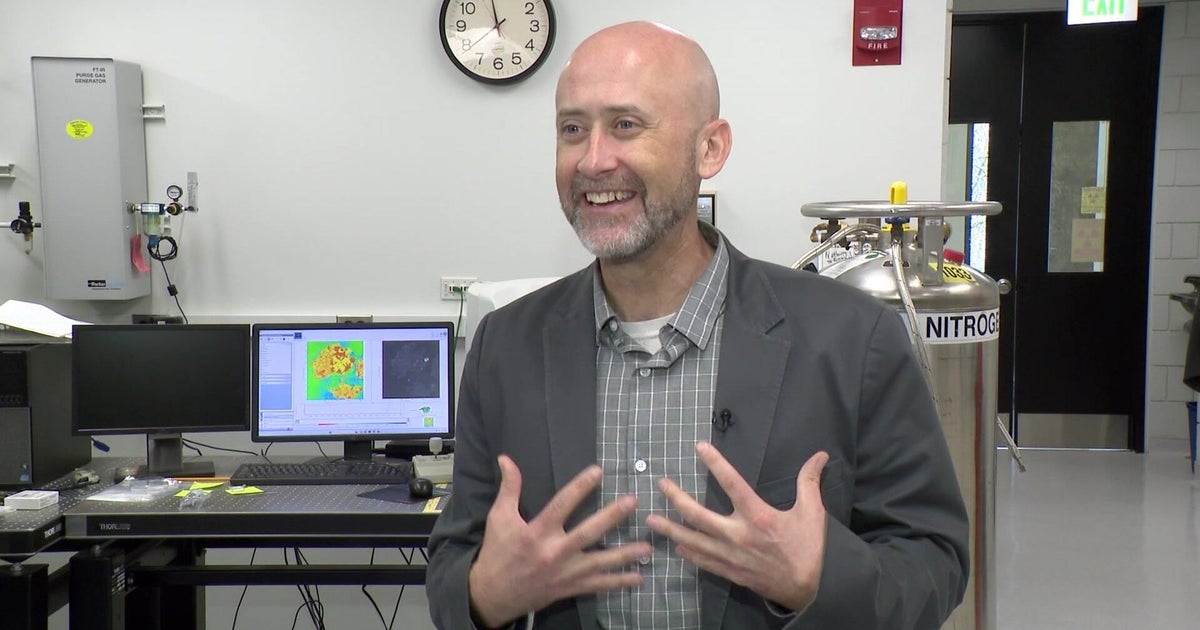
This particular neutron star — as described in the news release by the University of Chicago's Michael Zhang, the principal investigator in the study — has "the mass of the Sun, but the size of a city."
Usually, stars shine so brightly as to obscure their planets. But this neutron star doesn't shine — it emits electromagnetic radiation beams from its magnetic poles, but mostly emits gamma rays and other high-energy particles that the Webb Telescope can't detect, the release explained.
The result is that scientists could see the lemon planet that the star illuminates, but not the star itself — which means they could observe the star in detail around its whole orbit, Stanford University graduate student Maya Beleznay, who worked on modeling the shape of the planet and its orbit, said in the release.
Scientists are also baffled by how the planet could have formed at all.
"It's very hard to imagine how you get this extremely carbon-enriched composition," Zhang said in the release. "It seems to rule out every known formation mechanism."
Because of its tight orbit around the dense star, a "year" for the lemon planet — the time required for it to complete a trip around the star — is a mere 7.8 hours, the release said.
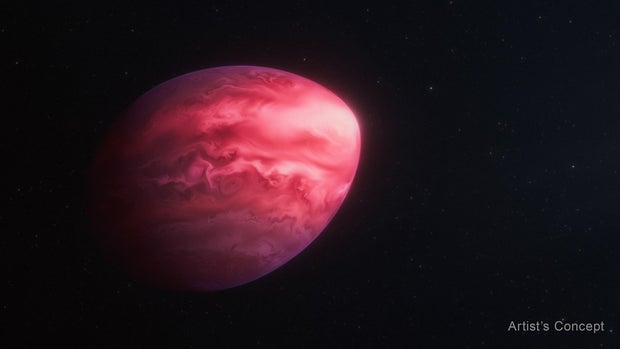
The team also found that the strong gravitational forces from the super-heavy neutron star have pulled the planet so it is shaped like a lemon, the release said.
The planet and the neutron star are part of a "black widow" system, the U of C explained — though such systems typically involve two stars rather than a star and a planet. In such a system, a rapidly spinning pulsar is joined by a smaller companion star, which would have once streamed material onto the pulsar and caused the pulsar to spin faster and power a strong wind, the release said.
The wind and radiation end up destroying the smaller star — hence the name "black widow" system, a reference to how female black widow spiders can, though don't always, eat their male partners after mating.
But again, these systems usually involve two stars. The International Astronomical Union considers the lemon planet an exoplanet.
But Zhang explained in the release that it didn't form like most planets — which develop from dust around stars that contain elements such as carbon and iron.
Study co-author Roger Romani, of Stanford University and the Kavli Institute for Particle Astrophysics and Cosmology, suggested that as a companion in the "black-widow system," the lemon planet cooled down and the mixture of carbon and oxygen in its crystallized. Pure carbon crystals may have floated to the top and got mixed with helium, which would explain the strange atmosphere, Romani said in the release.
How oxygen and nitrogen were kept away from that system remains a mystery. But Romani said in the release that it's "nice not to know everything."