Domestic violence comprises one-quarter of Chicago violent crime as federal funds for services dry up


President Donald Trump has threatened for weeks to send National Guard troops to Chicago, claiming crime has transformed the city into a "killing field." However, Chicago Police data shows violent crime is trending down as the city experiences one of its least violent summers in decades.
Trump said on Monday that "We're going to be doing Chicago probably next," after signing a presidential memorandum mobilizing federal law enforcement agents to join the Tennessee National Guard in Memphis.
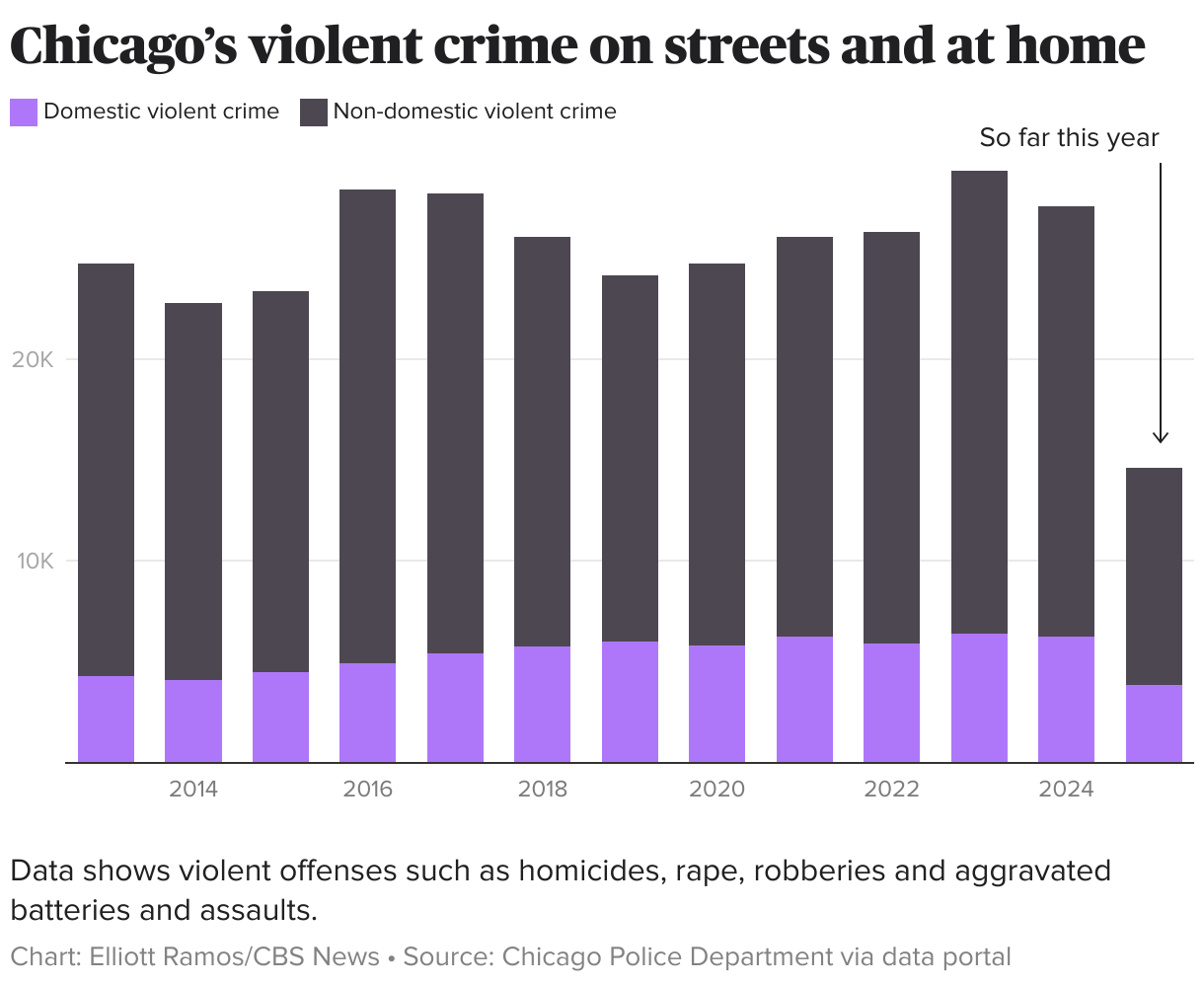
Chicago's violent crime is down double-digit percentage points so far in 2025 compared to 2024, according to a CBS News analysis of Chicago Police Department data. Domestic violence is down 5%, but it now is making up a bigger slice of Chicago's overall violent crime, accounting for 26% of the city's violent crime so far this year.
What's more, the president appeared to minimize domestic violence in a speech last week, referring to it as a "lesser" crime when talking about how his National Guard deployment has dramatically cut the violent crime rate in Washington D.C.
Reducing domestic violence requires different tactics than those used to fight other forms of violent crime. This is especially true of funding for local law enforcement and local programs designed to help survivors — the kinds of funds local government officials and victim advocates say have been cut this year, undercutting efforts to address the problem.
"If Donald Trump was actually serious about fighting crime in cities like Chicago, he… would not be cutting over $800 million in public safety and crime prevention grants nationally, including cutting $158 million in funding to Illinois for violence crime-prevention programs," Illinois Gov. JB Pritzker said in a press conference in August.
Pritzker and other politicians have repeatedly pointed to the data showing Chicago's declining crime rate and noted that other cities have higher rates of violent crime. But what was not mentioned by either Pritzker or Trump was what proportion of those crimes were domestic violence incidents.
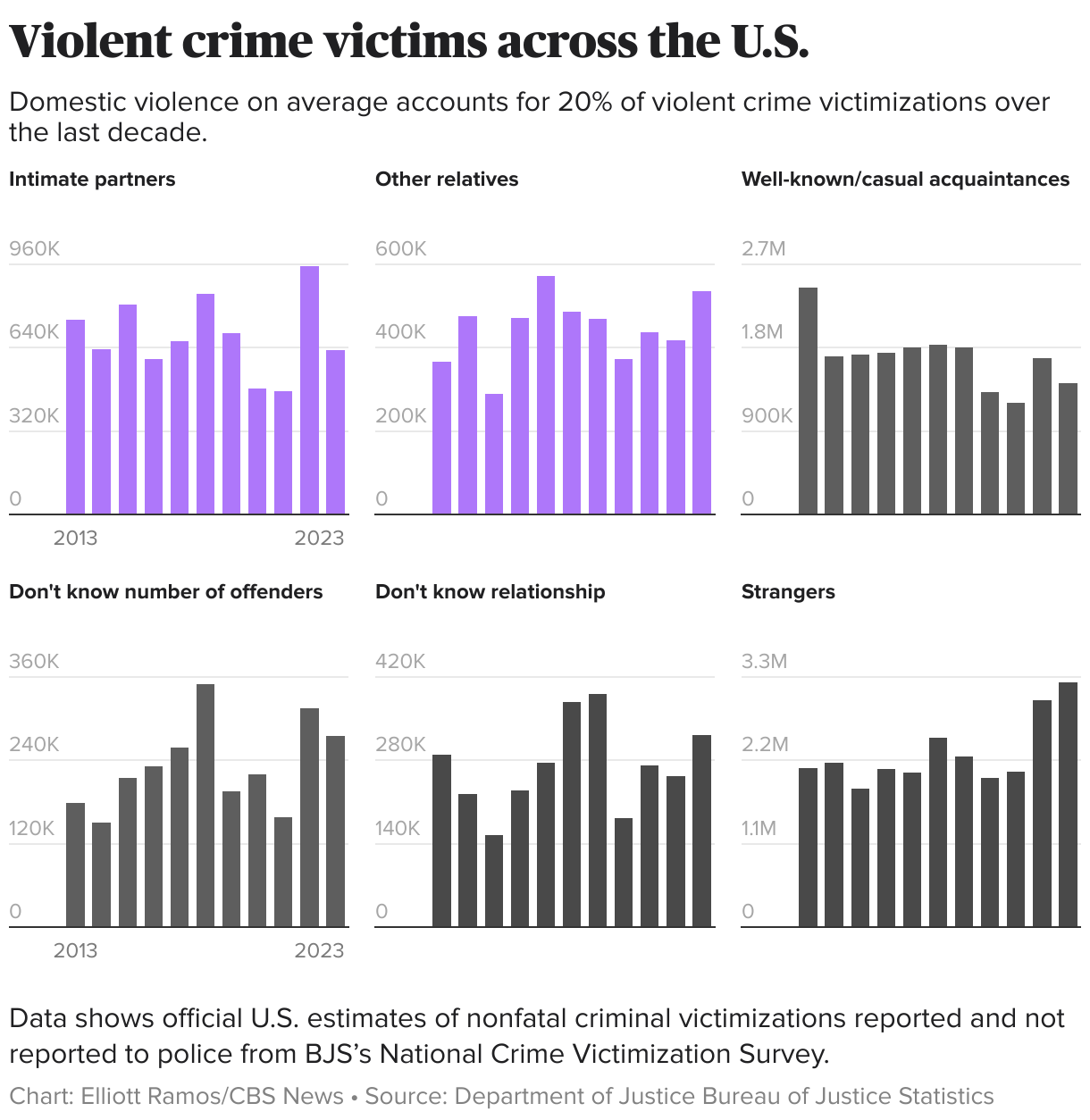
Domestic violence is not unique to Chicago. A CBS News analysis of FBI victimization data found that 24% of the country's nearly 4 million violent crimes last year were domestic. Chicago's proportion is slightly higher at 26%.
Domestic violence in the U.S. has historically been a smaller slice of violent crime, averaging about 20% annually, according to an analysis of Department of Justice data. Prior to 2019, that was true in Chicago, too. Domestic crimes also averaged 20% of violent offenses across the city, but then the share rose during the pandemic, in Chicago and nationwide.
Chicago's homicides have dropped this year by about 30%, from roughly 400 at this time last year to about 280 so far this year, according to a CBS News data analysis of Chicago Police data through August. But, the proportion of homicides that are domestic has risen this year to about 13% with 37 compared with the same time last year, it was about 7%, even though overall domestic violence started to ebb.
What gets counted as a violent crime?
During a speech at the Museum of the Bible last week, Mr. Trump tried to minimize some kinds of violent crime in Washington, D.C., where National Guard troops and additional federal law enforcement agents have been deployed since August.
The president told the crowd that crime had gone down in the D.C. since sending in the National Guard, adding that if domestic violence wasn't counted as a violent crime, the rate in the city would be even lower.
"Much lesser things, things that take place in the home, they call crime. You know, they'll do anything they can to find something," the president said. "If a man has a little fight with the wife, they say, 'This was a crime, see?' So now I can't claim 100%."
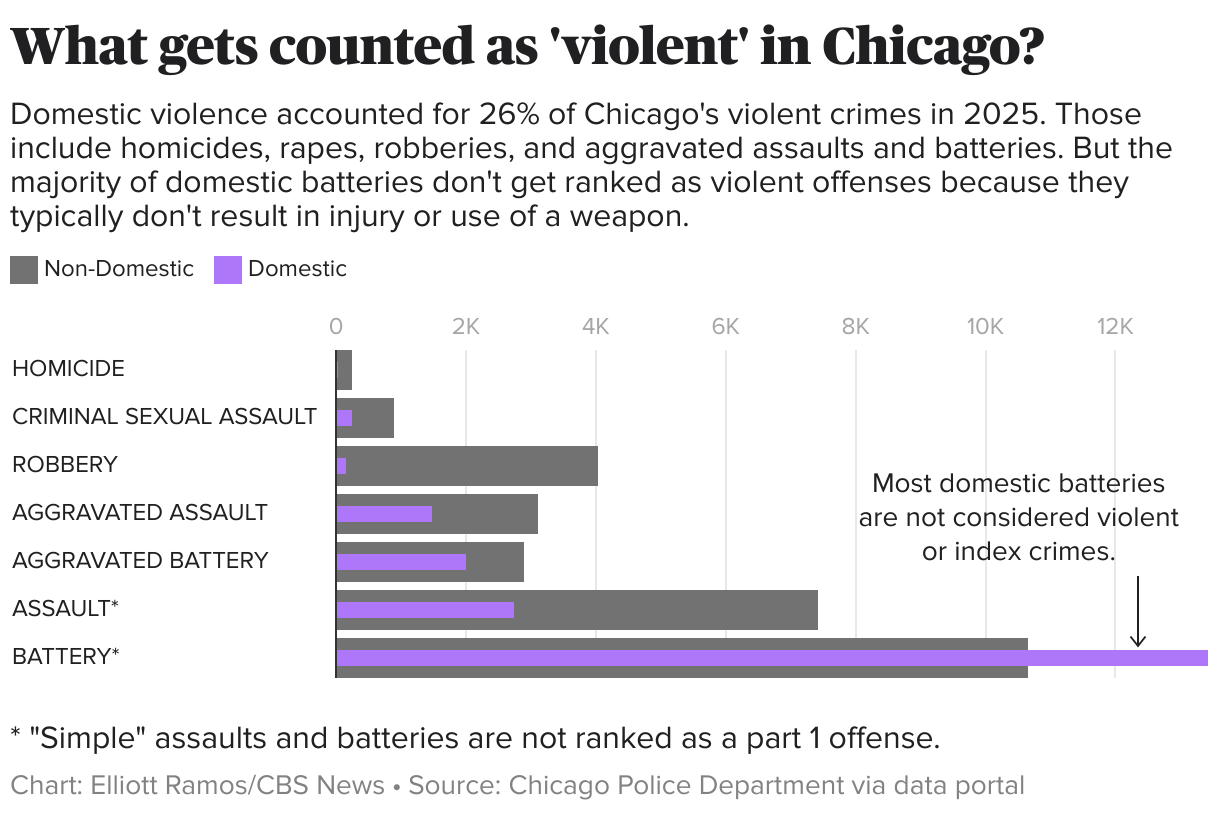
The CBS News analysis of Chicago violent crime data shows that large numbers of domestic violent offenses in Chicago were more than little fights or skirmishes. There were roughly 1,400 aggravated assaults and 1,900 aggravated batteries, 320 sexual assaults and 37 homicides that were classified as domestic so far this year.
There is a substantial difference between an assault (a physical altercation involving little to no injury) and an aggravated assault, which at its worst can be a stabbing, a shooting or some other kind of attack resulting in serious injuries.
"The president's words minimize the experiences of survivors of domestic violence, and further shame survivors from reaching out and getting the support they deserve. We know domestic violence is underreported, and these statements perpetuate a harmful stigma of shame," said a spokesperson for Chicago Mayor Brandon Johson in an emailed statement.
Most of Chicago's non-aggravated batteries and assaults do not get counted as violent crimes. The Chicago Police Department classifies them as "simple" domestic batteries, of which there were 13,400 reported so far this year. Violating orders of protection, stalking and making online threats are also not categorized as violent offenses.
And that's only counting reported crime. So far this year, there were nearly 57,000 calls to 911 for domestic disturbances, almost 17,200 for domestic batteries, and about 13,000 related to violating orders of protection, according to data from the Chicago Inspector General's public safety dashboard.
"I think comments like [the president's]this minimizes the impact that unhealthy relationships could generate," said Ji-Hye Kim, the executive director of KAN-WIN, an advocacy group that serves victims of gender-based violence in the Asian-American community in the Chicagoland area.
Kim said her organization is losing more than $400,000 in funding from the Federal Office of Family Violence and Prevention. She said the funds have paid for advocates who work one-on-one with survivors, as well as therapy and other resources.
"In terms of not investing or minimizing or not treating it like it's not a big problem, it's just gonna worsen the situation," she said.
CBS News Chicago and the CBS News Data Team have delved into the human toll of Chicago's domestic violence problem and breakdowns in the justice system's response over the last year, uncovering how too few orders of protection get served in the city and the impact domestic violence has on children.
How we got here
To better understand who is impacted by domestic violence, CBS News obtained Chicago Police Department data that shows the offender's relationship to the victim. The data covers every domestic crime incident from 2013 through the end of 2023. Recent data is not readily available.
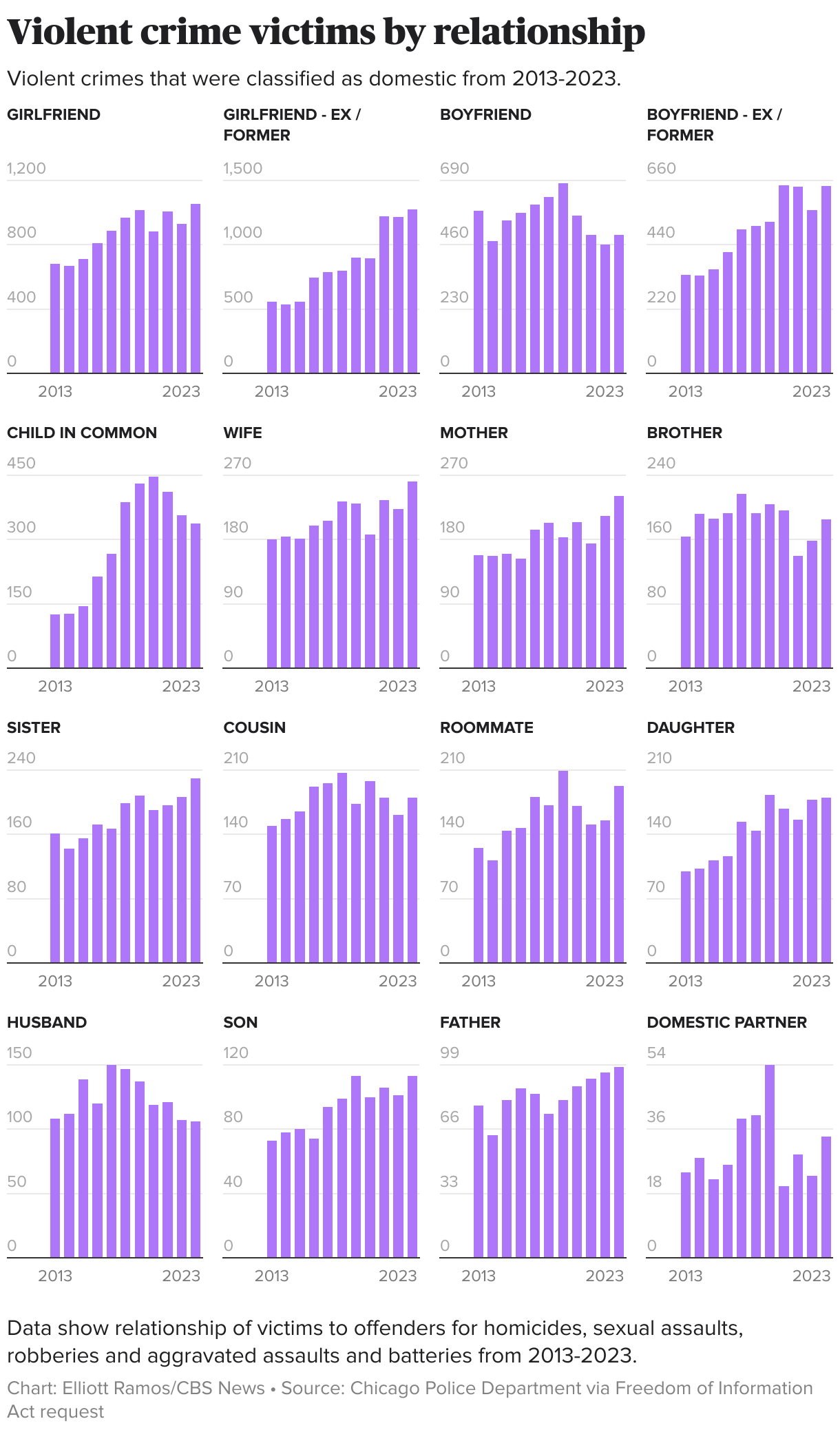
Violent offenses against girlfriends increased in Chicago by 55% from 681 in 2013 to 1054 in 2023. Offenses against ex-girlfriends rose 128% from 558 to 1,277 during that same time period. Violence against men also rose, with ex-boyfriends, fathers and sons all experiencing higher rates of crime.
The 2023 data also show that violence against acquaintances, neighbors, coworkers, and roommates went up since the pandemic, accounting for an additional 10% of violence victims that year.
Domestic violence funding imperiled
Mayor Johnson's office said the Trump administration withdrew grant support for organizations that combat gender-based violence and proposed a 29% budget cut for the federal government's Office of Violence Against Women.
"These cuts, which will impact our partner nonprofits, are especially harmful at a time when domestic violence has been on the rise," the mayor's office said in an emailed statement.
The proposed cuts are part of Trump's 2026 budget proposal, which, if approved by Congress, would reduce Justice Department grants by $850 million and reduce staff by consolidating the Office on Violence Against Women with two other agencies, according to a report by the Council of Criminal Justice, a criminal justice policy think tank.
Both Johnson and Gov. Pritzker have worries about reduced federal funding.
"We remain concerned about the possibility of future cuts by the Trump Administration that would impact and hurt our already ongoing efforts to protect victims," the governor's office said in an emailed statement. "Programs and organizations in Illinois that assist domestic violence victims and help interrupt violence before it happens are critical in ensuring the public safety of our residents and ultimately, reducing crime."
Kim, the executive director of KAN-WIN said the reduced funding could have a negative impact on their ability to provide services to survivors.
"It had been such a wonderful grant allowing us to do such innovative things, but that we're unable to do that for the next two years was very disappointing," she said. "If the messaging from the public and from the government is that these services are not worth investing in, then what are they saying to the survivors?"
KAN-WIN is one of 35 organizations across the country that received the same federal grant money and would lose it as well, documents show.
Health and Human Services funded the grants through its Office of Family Violence and Prevention (OFVP). The organizations contend that the HHS money had been earmarked for them for the next two years.
"In FY25, Congress did not appropriate funds for this grant program and the Department of Health and Human Services is not authorized to award or continue grants in the absence of an appropriation," according to an emailed statement from a spokesperson for the Administration for Children and Families, which oversees the program.
"If Congress provides authorization and appropriation of funding for this grant program as a requirement in FY 2026, the expectation is that we will obligate the funds as directed by Congress. Previously terminated recipients would have to recompete for new funding unless Congress directed us otherwise."
However, the Trump administration has previously tried to claw back previously approved funds.
In May, the Trump administration had also sought to impose restrictions on Violence Against Women grants for domestic violence programs that would promote diversity, equity and inclusion or transgender rights. A federal judge temporarily blocked the administration last month from defunding those programs after a coalition of 17 domestic violence groups filed suit with Democracy Forward, a legal advocacy organization.
Meanwhile, Kim said survivors could lose access to critical services at a time when data shows domestic violence is a substantial portion of violent crime, but insisted even with less funding, grassroots work would continue.
"We'll continue doing our work no matter what. Even if all of our funding gets taken away."
About the data
CBS News analyzed violent crime data from Chicago's public data portal for this story. The story looked at changes this year from Jan 1. through Aug. 31. Violent crime categories were determined using the FBI's Uniform Crime Report codes for violent offenses, including homicides, criminal sexual assaults, robberies, aggravated assaults and aggravated batteries.
Chicago domestic cases were determined using the domestic flag within CPD data, which indicates the report was classified as a domestic offense.
Domestic cases for the U.S. in 2024 were determined using the FBI's Crime Data Explorer, which collects data from police agencies across the country. Utilizing the NIBRS relationship tables, we determined what percentage of crimes in the country were domestic last year.
Historical domestic violence in the country was studied using a Bureau of Justice Statistics survey from 2023. That data showed the relationships of violent victimization to the offender, if known. That survey did not include homicide victims.
Historical domestic violence in Chicago was measured utilizing data obtained via a Freedom of Information Act request to the Chicago Police Department, which showed aggregate offense counts based on victim-offender relationships from 2013 to 2023. Those offenses were categorized based on FBI UCR offense definitions as well.
Editor's note: An earlier broadcast version of the story that aired Sept. 16 had an error about domestic crime spiking. It has grown as a percentage of violent crime and has been corrected on the video.