Dinosaur tracks showing "herds moving in synchrony" found in Italian region that will host Winter Olympics
Hundreds of yards of dinosaur tracks with toes and claws have been found in the Italian Alps in a region that will host the 2026 Winter Olympics, authorities said Tuesday.
"This set of dinosaur footprints is one of the largest collections in all of Europe, in the whole world," Attilio Fontana, head of the Lombardy region in northern Italy, said during a news conference.
The tracks, which are over 200 million years old, were discovered in the Stelvio National Park, in an area between the towns of Bormio and Livigno, which host part of the Games.
Nature photographer Elio Della Ferrera first spotted the imprints in September in an almost vertical rocky slope.
Some measured up to 16 inches in diameter.
The collection "extends for hundreds of meters and also represents a series of animal behaviors, because in addition to seeing animals walking together, there are also places where these animals meet," Fontana said.
Della Ferrera called in paleontologist Cristiano Dal Sasso from Milan's Natural History Museum, who assembled a team of Italian experts to study the site.
The museum released multiple images of the footprints uncovered in the so-called valley of dinosaurs on social media.
"It's an immense scientific heritage," Dal Sasso said in the region's press release.
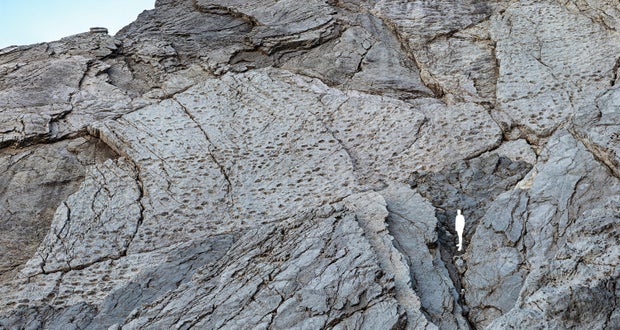
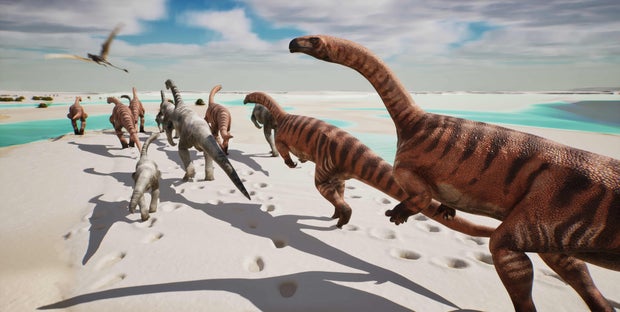
"The parallel walks are clear evidence of herds moving in synchrony, and there are also traces of more complex behaviors, such as groups of animals gathered in a circle, perhaps for defense."
"Impressions of the toes and even the claws"
The tracks, currently covered by snow and off the beaten track, are preserved in Upper Triassic dolomitic rocks, dating back approximately 210 million years.
Most of the footprints are elongated and made by bipeds. The best-preserved ones bear traces of at least four toes.
That suggests they belong to prosauropods, herbivorous dinosaurs with long necks and small heads, which are considered the ancestors of the large sauropods of the Jurassic period like the Brontosaurus, the experts said.
Prosauropods had sharp claws, and adults could reach up to 33 feet in length.
There may also be tracks of predatory dinosaurs and archosaurs, the ancestors of crocodiles, the press release said.
The prints are on an almost-vertical slope due to the formation of the Alpine chain.
But when the dinosaurs walked through the area, it was formed of tidal flats that stretched for hundreds of miles, and the environment was tropical.
"The tracks were made when the sediments were still soft and saturated with water, on the broad tidal flats surrounding the Tethys Ocean," ichnologist Fabio Massimo Petti said, referring to a prehistoric ocean.
"The plasticity of those very fine calcareous muds, now transformed into rock, has in areas preserved truly remarkable anatomical details, such as impressions of the toes and even the claws," he said.
The footprints were then covered by sediments which protected them, but with the uplift of the Alps and the erosion of the mountainside, they have been brought back into view.
"As the layers containing the tracks are diverse and overlapping, we have a unique opportunity to study the evolution of animals and their environment over time," geologist Fabrizio Berra said. "Like reading the pages of a stone book."
Other recent dinosaur track discoveries
Researchers have unearthed other dinosaur footprints recently.
Earlier this month, paleontologists in Bolivia said they found and meticulously documented 16,600 footprints left by theropods, the dinosaur group that includes the Tyrannosaurus rex.
In March, scientists in England discovered a 650-foot trail of dinosaur footprints made 160 million years ago by massive sauropod dinosaurs.
In January, British researchers unearthed some 200 dinosaur footprints dating back 166 million years in a find believed to be the biggest in the United Kingdom.
That discovery was announced just a few months after a team of paleontologists found matching dinosaur footprints on what are now two different continents, separated by thousands of miles of ocean.
In October 2023, engineers in the U.K. made a "dramatic discovery" of dinosaur footprints that experts believe could be from a mantellisaurus, a type of dinosaur that had just three toes on each foot and traveled on its hind legs.