Chicago records wettest summer in 8 years

With the end of August came the end of meteorological summer, the hottest three months of the year, encompassing June, July and August.
While temperatures at Chicago O'Hare were rather unremarkable this summer, coming in at a half-degree above the 30-year average and a bit cooler than last summer, precipitation was another story.
Frequent rounds of thunderstorms and numerous bouts of severe weather brought Chicago its wettest meteorological summer since 2018, with a rain total of 15.38 inches.
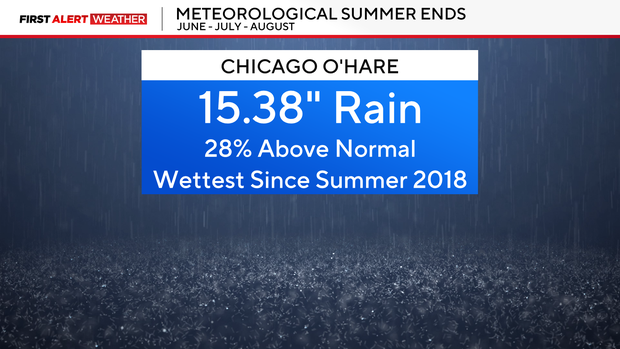
O'Hare averages just 12.06 inches of rain from June 1 through August 31, so this was 28% above normal.
Chicago recorded 5.00" of rain in June, 5.36" in July and 5.02" in August. The normal amounts for those months range from 3.71" in July to 4.25" in August. O'Hare has tallied 30.97 inches of rain so far in 2026, the 11th-wettest year on record to date.
While official climate records for Chicago are kept at O'Hare, Midway has tallied even higher rain totals so far in 2026 with 32.14 inches and counting. 2026 is Midway's fifth-wettest year on record to date.
The summer of 2018, which matched this summer's rain total exactly, was also a year that brought a developing El Niño pattern with warmer-than-normal ocean temperatures in the Equatorial Pacific. While El Niño is more strongly tied to winter weather impacts, it can bring a stormier summer to the Chicago area, as it appears to have done in both of these years.
Copious amounts of rain this summer have also left soil damp and nearby crops well-watered. As this week's heat dome settles in, the soil and crops are exuding enormous amounts of water vapor, or humidity, into the atmosphere, fueling feels-like temperatures as high as 100 to 110 degrees across the area again on Wednesday. This is a phenomenon known as corn sweat.
The developing El Niño, potentially set to grow into the strongest ever recorded, is likely to keep the storm track north of our area this winter, leading to milder conditions with less snow than usual.


