Chicago Hauntings: Ghosts of a labor riot and a headless horseman at a Back of the Yards rail overpass
Visit Loomis Boulevard just off 49th Street in Chicago's Back of the Yards neighborhood today, and you'll find a mural honoring Chicago police officers and firefighters painted on a concrete embankment that once carried freight trains overhead.
The faces of police officers Alejandro Valadez, Thor Soderberg, and Thomas Wortham IV and firefighters Edward Stringer, Christopher Wheatley, and Cory Ankum flank the roadway ahead of the heavy rail overpass.
Valadez, Soderberg, and Wortham each gave the ultimate sacrifice after being shot in separate incidents — Valadez in 2009, Soderberg and Wortham in 2010. Wheatley died while fighting a fire in August 2010, Stringer and Ankum while fighting another fire months later.

But the concrete on the old railway embankment on which they are honored is crumbling and decaying. Freight trains belonging to the Grand Trunk Western Railroad used to run on the tracks overhead, but haven't in many years.
If you go back more than a century before the mural was painted, when that freight line was new, a violent riot erupted at the site of that very overpass — and legend has it that a ghost that may be connected with that riot lurks there to this day.
The 1894 Pullman strike leads to violent riots
The old Grand Trunk Western overpass is a short distance from the former site of the Union Stockyards, which the freight line once served. But the 1894 labor riot had nothing directly to do with the Stockyards; it stemmed from a strike involving another historic Chicago industrial operation several miles south.
In the spring of 1880, industrialist George M. Pullman, president of the Pullman Palace Car Company, broke ground for an industrial town between Lake Calumet and the Illinois Central railway tracks on what is now Chicago's Far South Side.
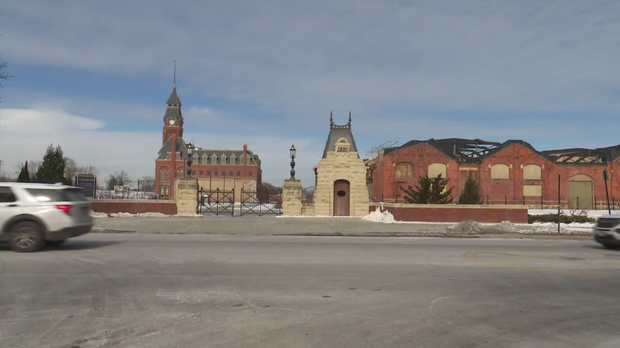
The railcar company brought in architect Solon Spencer Brenn and landscape architect Nathan Barrett to design not only factories, but also housing for workers with indoor plumbing and alley garbage collection, churches, schools, factory shops, a theater called the Arcade, and the majestic (and also reputedly haunted) Hotel Florence, the National Park Service noted.
The town of over 1,000 homes and public buildings was completed in 1884, according to the Historic Pullman Foundation.
But workers felt the Pullman company town amounted to a raw deal, as they were renting their homes from Pullman and so their wages were paid back to him in rent. There was also a sense of a surveillance state around the town, documents noted.
As Michael Hannon wrote in the 2010 publication, "The Pullman Strike of 1894," an oft-repeated quote from a Pullman employee went: "We are born in a Pullman house, fed from the Pullman shops, taught in the Pullman school, catechized in the Pullman Church, and when we die we shall go to the Pullman Hell."
In 1893, the country fell into an economic depression. The Pullman Palace Car Company was struggling, so it lowered wages as demand for train cars dropped. The company did not, however, lower the rents it charged workers.
That same year, the American Railway Association was formed in Chicago. The union soon swelled to 150,000 members under president Eugene V. Debs, according to the National Park Service.
Pullman workers formed a grievance committee to negotiate with the company, but failed to get anywhere. The union advised against going striking at the Pullman factories, the NPS said, but a strike began on May 11, 1894 nonetheless.
The Pullman company could afford to weather the work stoppage and resisted negotiations, the NPS said. So the American Railway Association went a step further and launched a nationwide boycott of the handling of Pullman railcars by union members.
This action crippled railway traffic around the country. According to an 1897 Chicago Tribune article, 75% of the railroads in the country were thrown into confusion with a matter of 10 days.
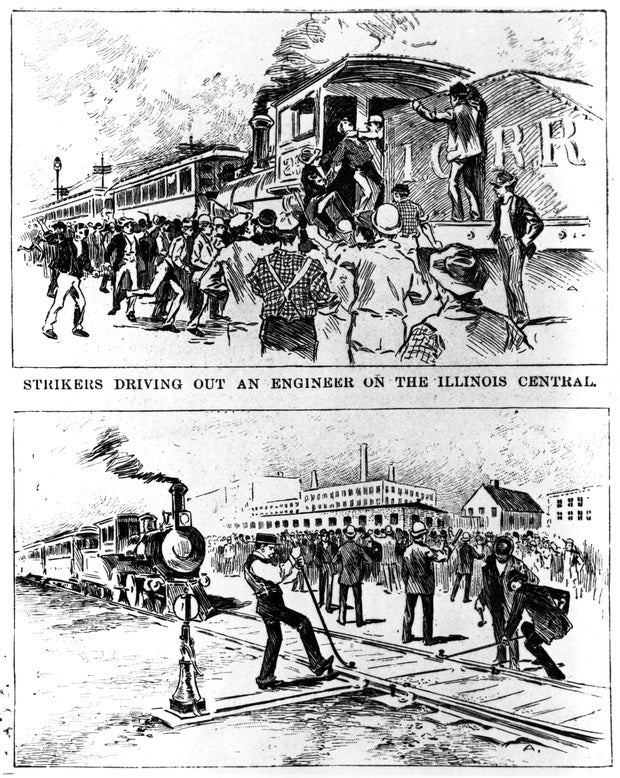
By June 30 riots began to break out near Kensington and Cottage Grove avenues in the Pullman district, which the city had annexed in 1889 but was still managed by the Pullman Land Association. Several rail cars were destroyed by strike sympathizers along the Illinois Central Railroad tracks, and the local police and 1,000 special deputies could not maintain order, the article said.
On July 2, two federal court judges issued restraining injunctions against Debs on the grounds that the strike and boycott interfered with U.S. mail or interstate commerce.
Illinois Gov. John Peter Altgeld did not order out the National Guard. The federal government instead went over his head, as President Grover Cleveland ordered U.S. Army troops to the scene from Fort Sheridan and three other bases. Altgeld complained, but President Cleveland responded that the strike was interfering with mail, that there were "conspiracies" against commerce between states, and that a federal injunction had to be enforced — and thus, the deployment of federal troops was justified.
Troops arrived on the 4th of July, and unrest only got worse. The World's Columbian Exposition had closed several months earlier, but many of the elegant Greco-Roman structures from the White City in Jackson Park remained standing. That night, rioters connected with the strike burned several of them to the ground, according to Hannon.
An exposition historical website said the Court of Honor, Machinery Hall, Electricity Building, Administration Building, Mining Building, and Manufactures and Liberal Arts Building were all destroyed in the July 5, 1894, blaze.
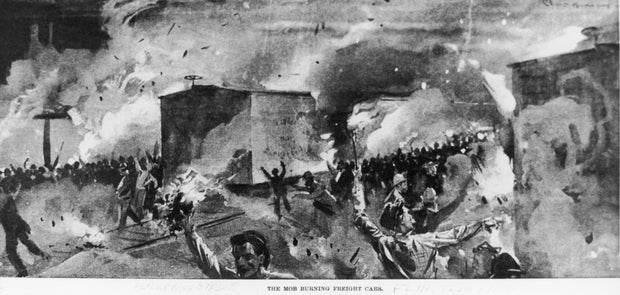
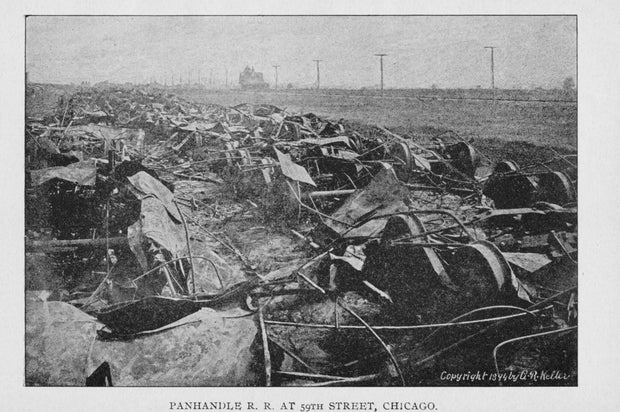
On July 6, an Illinois Central Railroad agent shot two rioters, and in turn, a mob of about 6,000 set fire to nearly 7,000 railcars in Panhandle Railroad Yards around 59th Street, Hannon wrote.
That same day, Gov. Altgeld sent 4,000 Illinois National Guard troops to Chicago at the request of Chicago Mayor John Patrick Hopkins.
As recalled in Clayton David Laurie and Ronald H. Cole's 1997 volume, "The Role of Federal Military Forces in Domestic Disorders, 1877-1945," the bloodiest clash between troops and rioters followed on July 7 at the Grand Trunk tracks at 49th Street and Loomis Boulevard.
Company H of the 2nd Regiment of the Illinois National Guard was trying to protect a utility train on the tracks, which back then were at grade level, Laurie and Cole wrote. The train stopped to raise an overturned car, and the crowd "cursed and threw stones" at the guardsmen.
The junior officer of the commanding National Guard company ordered the mob to disperse and for his troops to load their rifles, Laurie and Cole wrote. Most of the women and children in the mob left, they wrote.
"Reduced to its most militant members, the mob grew more threatening and continued throwing rocks. The officer then ordered a bayonet charge that wounded several people. When the crowd retaliated by throwing more rocks, one struck the officer on the head," Laurie and Cole wrote. "Fearing for the safety of his men and despairing of receiving reinforcements, he then ordered his command to fire at will and make every shot count. After firing 100 rounds in several volleys that killed or wounded a minimum of twenty people, the mob began to mill about in confusion until the Chicago police arrived, and using revolvers and clubs, made a series of charges that finally dispersed the crowd."
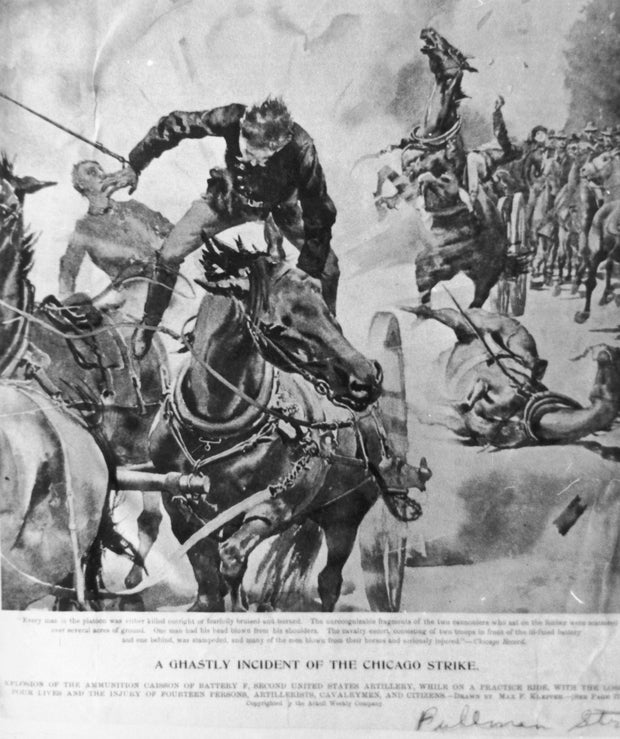
Debs tried to bring the Pullman Company into arbitration by trying to organize a general strike with other labor groups, according to the National Park Service. He failed, and the boycott ended in mid-July. The American Railway Union was defeated, and Debs and others in the union were indicted on contempt charges.
A headless horseman at the old railway overpass
So what about ghosts? The sightings surround that crumbling old Grand Trunk railway overpass that stands where that violent clash happened 131 years ago — but the specter often reported there evokes Washington Irving's "The Legend of Sleepy Hollow" rather than rioting union laborers.
Szabelski said people have long reported seeing a ghostly man riding a horse without a head, both on the decrepit tracks and under the bridge.
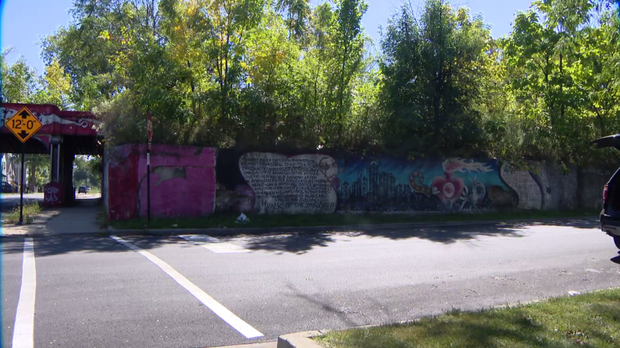
Paranormal expert Tony Szabelski of Chicago Hauntings Tours and fellow ghost hunter and historian Adam Selzer say that legend claims the headless horseman is a cavalryman who died during the 1894 riots — but there is no record of anyone being decapitated.
However, Szabelski says it's possible that such a thing did happen, and authorities tried to keep it out of the news. Selzer also notes that there were many injuries during the July 1894 riot that might not have been documented in contemporary newspapers, as reporters may have been only able to speculate about injuries.
Unrelated to the riot, there were also numerous train accidents in the area that left people's bodies torn apart, but there are no records of decapitations, Szabelski said.
Selzer specifically reports that an officer patrolling a train near what is now Damen Avenue was killed upon trying to jump off the moving train at the end of July 1894, but he was not decapitated and he was not riding a horse at the time.
Selzer also noted that the tragedy that took the life of whoever the headless horseman is might not have happened right at Loomis Boulevard. There does not seem to be a lot of historical documentation about it online, but Selzer points specifically to an accident involving a train and a streetcar at 49th and Halsted streets in 1894, in which three people were killed.
One of the people killed in that accident, Selzer wrote, was a plumber named Finn who was dismembered — though there's no reason his ghost would be riding a ghost horse.
And of course, the headless horseman more a character of folklore than a representation of any actual historical accident, act of violence, or tragedy. The Headless Horseman of "The Legend of Sleepy Hollow" was purported to be the ghost of a Hessian soldier — a German mercenary — whose head was blown off by cannon fire during the Revolutionary War and who was buried at Sleepy Hollow Cemetery in the Hudson Valley north of New York City.
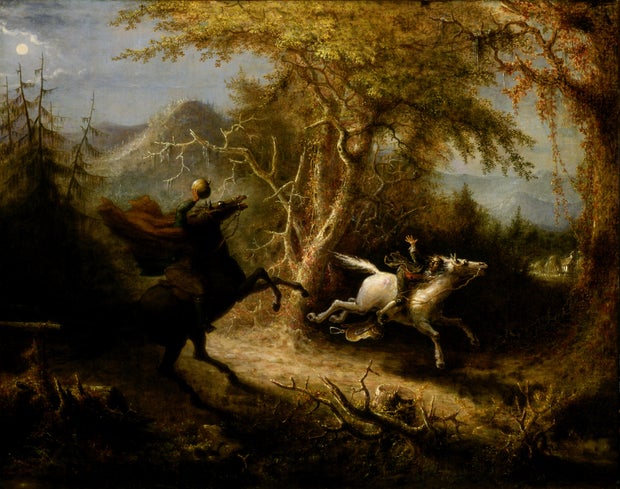
Irving described protagonist Ichabod Crane's reaction to the horrific apparition:
"On mounting a rising ground, which brought the figure of his fellow-traveler in relief against the sky, gigantic in height, and muffled in a cloak, Ichabod was horror-struck on perceiving that he was headless!–but his horror was still more increased on observing that the head, which should have rested on his shoulders, was carried before him on the pommel of his saddle!"
But Washington Irving didn't invent the Headless Horseman out of whole cloth — there are stories about headless horsemen going back to the Middle Ages in multiple countries in Europe.
In Irish folklore, the Dullahan — described by the Irish Times as a "malevolent harbinger of death" — is depicted as either the headless rider of a black horse just like Irving's character, or of a carriage pulled by six black horses which are said to have fire shooting from their nostrils and hooves.
The Dullahan wears a long, black cloak, and his severed head is "covered in rotting flesh that gives off the strong odor of rotting cheese and with the complexion of stale dough," the Irish Place notes. Anyone who is in the Dullahan's path is liable to get their eyes lashed out with a whip made from a human spine, or to have a basin of blood hurled into their eyes.
In Arthurian legend, a massive and menacing character called the Green Knight visits Camelot and challenges one of the knights of King Arthur's court to a game involving axe blows. Sir Gawain accepts the challenge and decapitates the Green Knight, only for the knight to pick up his head, rides away, and return a year later to face Gawain again.
In an American and Mexican legend, a character named El Muerto is said to be the spirit of a man named Vidal who was captured by Texas Rangers in the mid-19th century for stealing horses and beheaded. His body and severed head was said to be tied to a horse that was set free, and El Muerto is said to have been riding headless around South Texas ever since.
But just because a ghost fits a folkloric theme doesn't mean the whole thing should be dismissed. After all, ghost stories involving a vanishing hitchhiker — usually a young woman — have been heard around the country going back generations. But plenty of people in the Chicago area have reported running into the infamous Resurrection Mary for real.