Chicago DNA lawsuit used as case study in new "genetic surveillance" report, DHS motions to dismiss
The Department of Homeland Security has filed a motion to dismiss a lawsuit brought by four Chicago-area protesters who say their DNA was unlawfully collected by federal agents after they were arrested outside the Broadview ICE Detention Center.
The lawsuit, Briggs v. Mullin, was filed in May on behalf of Dana Briggs, Ian Sampson, Grace Cooper, and Jacqueline Guataquira, who were "peacefully protesting" outside the center in September and October 2025 when, their lawyers say, they were arrested without probable cause. The suit argues their First and Fourth Amendment rights were violated.
Briggs and Guataquira had their misdemeanors dismissed; Sampson and Cooper were never charged.
But their DNA was collected, their saliva swabs remain indefinitely in a government-controlled laboratory refrigerator, and their genetic profiles are uploaded into an FBI database. The case is now cited in a new Georgetown Law report on what researchers call the federal government's "rapidly expanding genetic surveillance program."
Briggs, a 71-year-old Air Force veteran who had never been arrested before, was pushed to the ground twice and detained by federal agents, caught on camera by CBS News Chicago. Hours later, he said agents handed him a buccal swab and instructed him to rub it against the inside of his cheek and give it back to the agents.
"I'm more appalled than anything else that they're going after ordinary people," Briggs told CBS News Chicago, after he was released from the Metropolitan Correctional Center in 2025.
The complaint says Briggs felt he had no choice but to comply. The DNA Act makes it a crime to refuse to provide a DNA sample after arrest by federal law enforcement.
The same narrative is shared by Cooper, Sampson, and Guataquira in the complaint.
Grace Cooper, 30, said the agents took her DNA before they even decided whether to charge her. She was standing in a "designated free speech zone taking pictures," when DHS agents arrested her, according to the lawsuit.
After her DNA was collected, agents dropped her off at a nearby gas station.
The lawsuit asks the court to find the DNA Act and its implementing regulations unconstitutional and stop the routine collection of DNA from individuals arrested for non-serious offenses, like their plaintiffs.
In the motion to dismiss, the government does not deny that their DNA was collected. Instead, it argues that the four protesters lack standing to sue and fail to state a claim, alleging that the plaintiffs are misreading the DNA Act.
CBS News Chicago reached out to DHS for a comment on the lawsuit and received the following: "Federal law requires law enforcement to collect DNA samples from individuals arrested for federal crimes under 28 CFR 28.12(b), including rioters arrested for assaulting or obstructing law enforcement."
Genetic surveillance
The plaintiff's entire genetic profile was permanently entered into the FBI's Combined DNA Index System (CODIS), a database accessible to all law enforcement agencies. CODIS was originally created to upload DNA profiles of "convicted offenders" to help solve violent crimes, but legislative acts have slowly expanded the legal criteria to be in the database.
Briggs, Cooper, Guataquira, and Sampson are not alone. Georgetown researchers describe their case as part of a "drastic expansion" of DNA collection into CODIS.
The report, "Raiding the Genome," is part of the Center on Privacy & Technology's ongoing investigation into what they say is the federal government "abusing its immigration powers to amass DNA for future policing."
CBS News Chicago brought the motion to dismiss to the Georgetown researchers.
"The response DHS gave you doesn't surprise me — it's the exact same statement our office received when reaching out for comment, too, and it doesn't answer any part of what we've reported," said Taman Mohamed, a Justice Fellow at Georgetown Law's Center on Privacy & Technology, who contributed to the report.
Mohamed and her colleagues compiled new findings into a 2026 update, and argue that their evidence reveals the U.S. government is "building a massive genetic database for policing the general population." Georgetown found that "DHS was taking DNA from vulnerable people and those outside of the scope of even the agency's own understanding of its lawful authority, including children, the elderly, and U.S. citizens."
In Chicago alone, researchers found that the local CBP office collected DNA from more than 2,854 individuals in 2025. All 20 CBP field offices are now contributing DNA to CODIS.
Georgetown also reported that CBP relied primarily on its civil, not criminal, authority to detain people and collect their DNA, meaning that 94% of the people from whom CBP took DNA were civil "detainees" rather than "arrestees" or people facing charges.
"This is something that everyone should be concerned about," said Mohamed.
Your most private information
"A sample of your DNA has a massive amount of information about you, the most personal and sensitive, and private information that the government can possibly obtain about individuals," Mohamed said.
This includes a person's race, ethnicity, disease carrier status, health conditions, and biological relatives. DNA buccal swabs can be preserved for up to six months, so researchers at Georgetown are concerned about how the DNA collected could be used beyond just CODIS.
DHS began collecting DNA through a "limited, small-scale" pilot program in 2020. According to the initial release, CBP would collect DNA from individuals, including U.S. citizens, who were arrested, facing charges, convicted, or were non-citizens who were detained in Detroit and at the Eagle Pass Port of Entry in southwestern Texas, arguing they were following the DNA Act.
But Georgetown found that by 2025, DHS had contributed over 3 million profiles to CODIS, and ICE alone added 920,000, making the agency the primary contributor to the nation's criminal DNA database.
Georgetown projects that DHS could account for over one-third of the entire CODIS database by 2030.
"DNA is inherently relational, so taking one person's DNA also implicates their genetic relatives, both in the past and in the future, for generations. And at some point, as the government continues to amass DNA, almost everyone will be implicated," Mohamed said.
That scares Briggs. He shared in a statement that having his DNA taken for "peacefully protesting" was "unsettling and deeply un-American." Now, he worries about his family being implicated.
Mohamed also voiced concerns for vulnerable populations, like the trans community.
"It can be used to figure out their sex assigned at birth," she warned. "There are so many different ways that it could be used to harm people."
The report also argues that DHS disproportionately targets communities of color, so therefore the agency is drastically increasing the proportion of profiles in CODIS who are people of color.
"The evidence that we have in this newest update is that DHS's DNA collection program is not for routine immigration enforcement purposes, as the government claims, but has been for policing the population," Mohamed said.
Through FOIA requests, researchers obtained an internal email in which an ICE attorney described the "primary purpose" of DHS's DNA-collecting authority as "build[ing] a national DNA database for solving crimes."
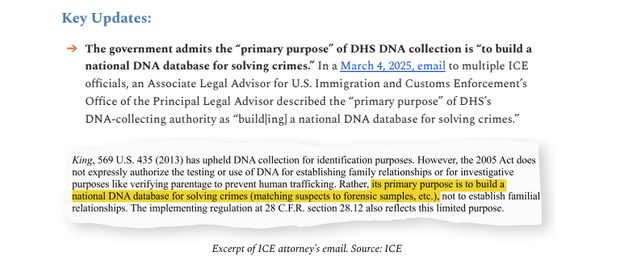
"That's actually illegal," Mohamed said, citing the Fourth Amendment. "Compulsory DNA collection entails multiple levels of search and seizures. The Fourth Amendment does not allow suspicion-less, warrantless searches for the sole purpose of crime solving, which is what this email says the program is for."
Free + Fair Litigation Group, which represents the Chicago Broadview plaintiffs, said it takes on cases involving what it calls authoritarian threats that are vulnerable to constitutional challenge. Although they declined an interview, their press release argues that the federal government is using the DNA Act to violate citizens' First and Fourth Amendment rights, specifically that DHS is conducting surveillance in retaliation for U.S. citizens exercising their rights.
The DNA Act was initially narrow but was expanded several times by Congress. In 2020, the Trump administration eliminated a provision that had previously allowed DHS to exempt certain detained immigrants from DNA collection, making collection mandatory for anyone in federal custody
"That rule change is kind of what got us here today," Mohamed said.
In Illinois, DNA collection prior to conviction is only permitted for specific "serious felonies," such as first-degree murder and predatory criminal assault of a child.
DNA expungement and legal paradox
According to the government's motion, two of the four plaintiffs, Briggs and Guataquira, are eligible to get their DNA expunged from CODIS because they have final orders dismissing the charges against them. Since Sampson and Cooper, DHS lawyers argue that they must wait until the statute of limitations expires.
However, Mohamed said it's not that easy for Sampson and Cooper, and an even higher risk for non-citizens.
"The only process that we know about is to show a copy of the court order to the FBI, showing your charges were dismissed, or that your conviction was overturned," Mohamed said.
"For non-citizens who are detained, they're not arrested, they don't have charges against them, there would be no charge to show was dismissed," she said.
Georgetown also found that refusal to submit DNA could trigger criminal charges and deportation proceedings. Their records requests uncovered documents instructing ICE officers to notify a person who is refusing to submit to DNA testing that they are subject to criminal liability, but there is no oversight of whether this is being enforced.
"This shouldn't be a partisan issue. It's about the immigration enforcement system with very little judicial oversight and very few constraints on what agencies can do once they invoke immigration authority," Mohamed said, noting the system existed before the current administration. "It will persist after this administration unless something changes."
For now, the DNA sits and the surveillance grows.


