Without clean indoor air policy, nonprofits team up to fill the gap in Chicago
A new report from the World Meteorological Organization warns that not only are extreme wildfires increasing, but the health risk from wildfire smoke may be greatly underestimated. Toxic smoke can seep inside and linger without adequate indoor air filtration.
The Illinois Department of Public Health recommends upgrading indoor air filtration, but there is no enforceable clean-air policy at the state or federal level, leaving people vulnerable to possibly dangerous conditions when wildfire smoke hits.
A new coalition of nonprofits is trying to change that.
Chi-CARN, or the Chicago Clean Air Resilience Network, is a group of four nonprofits whose mission is to help distribute clean air resources to people who need them most.
"Our project specifically is doing something immediate. It's getting tools out to keep people safer," said Jess Pohto, Executive Director of the Chicago ToolBank, one of the nonprofits in the network.
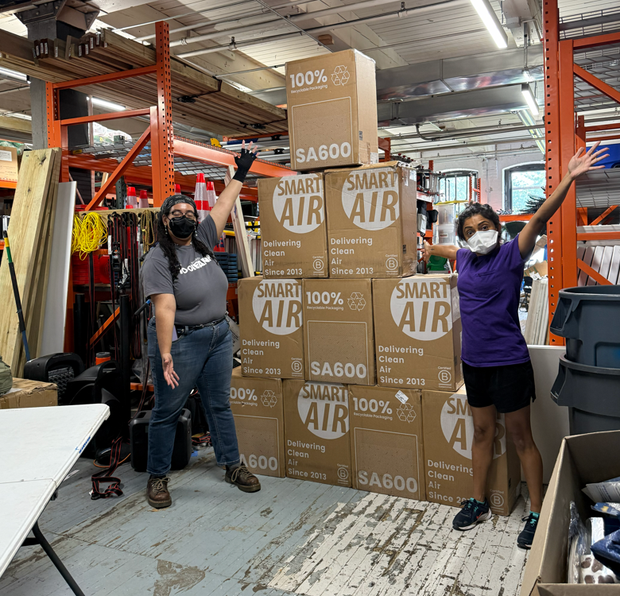
The Chicago ToolBank, located in Pilsen, is the hub for the coalition's growing supply of air purifiers, masks, testing kits, and more.
"We just got a large donation of air purifiers, and I'm already getting orders for them, and they're not even fully here yet," said Pohto.
Through their advocacy work, Chi-CARN secures surplus supplies from manufacturers like SmartAir and Wellbefore, which offload bulk inventory to the coalition, and then lends them out through the ToolBank.
The collaboration is led by the Air Support Project and also includes Public Health Action Network (PHAN) and SOS, which helps build online coordination systems for communities to share data and resources in real time.
Through a free membership service, the Chicago ToolBank has an inventory of items that mission-based organizations can borrow. It also lends equipment to ward offices, government agencies, and libraries, and helps with disaster relief by bringing generators and other equipment to areas directly impacted, like the communities hit by the rounds of severe storms and tornadoes in August.
"We have kids' masks right now, which are in demand," Pohto said, because they are hard to find in stores and usually need to be ordered online.
"One of the big gaps that we're trying to address is that people want masks and air purifiers, but when budgets are tight, and people are living paycheck to paycheck, those are the first items to get cut," said Melissa Smallwood, co-founder of the Air Support Project.
"Even if they can see the air quality is bad, there's no system to get them the resources they need," said Smallwood.
Summer wildfire smoke
In July, the worst air quality since records began descended on Chicago in part due to smoke from wildfires in Canada. The AQI, or air quality index, went over 700, surpassing the scale's technical maximum of 500; values of 301 and above are classified as "hazardous" with no real upper limit.
During that extended stretch of poor air quality, CBS News Chicago's Asal Rezai spoke with a company that found the air quality inside apartments read 340, which is still hazardous.
"During that really bad wildfire smoke event, a lot of people took shelter in public buildings, especially in low-income areas where people might not have A/C in their homes, but then they can't open their windows," Pohto said.
This summer, Chicago Park District field houses received much-needed cooling upgrades as climate change makes summers even hotter. However, the upgrades do not include high-quality air filtration.
The EPA recommends buildings have a Minimum Efficiency Reporting Value, or MERV, rating of 13 or higher to effectively filter out the fine particles found in wildfire smoke. The Chicago Park District confirmed to CBS News Chicago that its new upgrades only have a MERV rating of 7, a rating the EPA does not even test for those fine particles.
CBS News Chicago reached out to the Department of Buildings to ask what MERV standard they use but has not heard back.
"There's a new standard that's supposed to help upgrade ventilation and indoor air quality. But standards have to be adopted. Having a standard is fantastic, but if nobody uses it, what's the point?" said Tarz Ludwigsen, co-founder of PHAN.
Airborne viruses
PHAN and the Air Support Project both focus on airborne infectious disease prevention and bring that work into Chi-CARN.
Awareness of indoor air quality peaked in 2020 when COVID was declared a pandemic. The airborne virus continues to infect and disable people, according to the CDC.
Without proper ventilation and filtration, the virus can linger in the air for up to three hours, according to the National Institutes of Health.
"Public health, environmental justice, and climate change-related issues all benefit from having access to the same resources," Smallwood said.
Part of Chi-CARN's supplies also includes COVID tests and other tools like far-UVC lighting, which uses a specific wavelength of light to inactivate airborne viruses and bacteria.
The coalition said one of its goals is to help teachers access air purifiers, noting that absenteeism has increased since COVID emerged.
"You know, teachers could really use these kinds of air purifiers in their classrooms, but if we open those floodgates now, then there goes our entire inventory out for six months," Smallwood said.
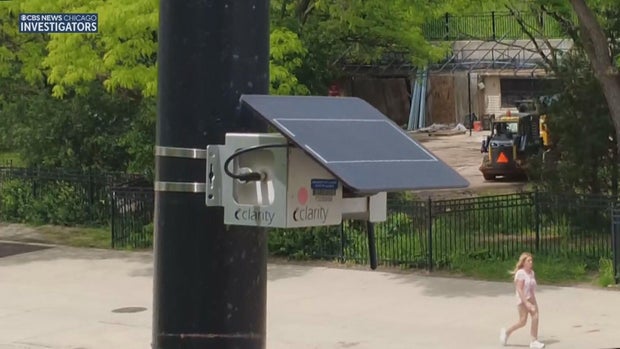
In the meantime, Chi-CARN is also using already available real-time data from Open Air Chicago, the nation's largest air-quality sensor network, to monitor real-time air pollution.
Policy change advocacy
"We can start to translate that data into something actionable, and focus on communities where we are seeing higher levels of pollution," said Sarah Masih, co-founder of the Air Support Project.
In addition to the Open Air Chicago data SOS will collect data on who, where and how their supplies are being used.
"We've got the people who need help, the partners, and the sensor data. Now we need to bring that data together, analyze it, keep it private, and use those learnings in policy discussions," said Jonathan Greenberg, co-founder of SOS.
The group will then bring that data to stakeholders and future partnerships to help grow their work, as well as donors and funding partners, which they say they are in need of.
"On the federal level, there isn't a lot of help for these air quality projects. If you've got a huge wildfire, you get federal support. But 100 miles away, where the air quality is bad, you might not," Greenberg said.
The group is launching pilots at city YMCA locations and is in discussions with the Chicago Park District and Chicago Public Library as well.
"There are just so many ways and opportunities to fall by the wayside in the places it needs most. That's why it's really important for us to make our program as free and low-cost as possible," Smallwood said.
Mission-based organizations can put a request into the ToolBank by becoming a member here.


