Air Quality Alert issued for Chicago area due to high ozone pollution during hot, stagnant weather






An Air Quality Alert is in effect for nearly the entire Chicago area for high levels of ozone pollution during enduring hot and stagnant weather.
The National Weather Service has issued the alert for McHenry, Lake, Kane, DuPage, Kendall, Grundy, Cook and Will counties in Illinois and for Lake, Porter, Newton and Jasper counties in Indiana through midnight.
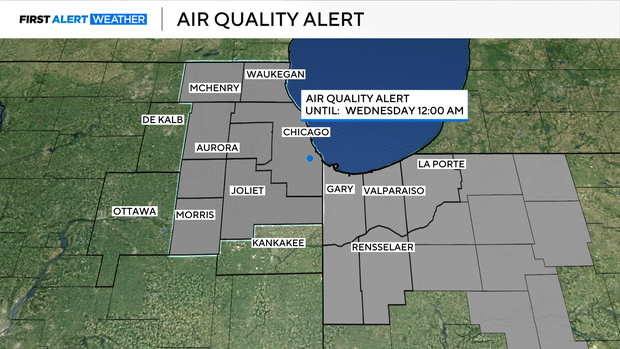
The Illinois Environmental Protection Agency has also put an Air Pollution Action Day into effect, which is declared when widespread ozone or particulate levels are expected to be at or above the level deemed unhealthy for sensitive groups for multiple days.
The primary pollutant concern Tuesday is ozone, the NWS said. People with pulmonary or respiratory diseases such as asthma, as well as senior citizens and children, should limit prolonged outdoor activity when possible.
The Chicago area is experiencing another long stretch of extreme heat this week, with highs in the 90s and humidity Tuesday and Wednesday making it feel like 100 to 105 degrees during the afternoon. There's no real relief at night, either, as overnight lows are in the 70s and humidity persists.
The heat wave is expected to last at least through Saturday, and skies will remain clear all week until a chance of rain and storms returns Friday.
Noah Kahan fans brave heat for tickets to Wrigley Field show
Amid the extreme heat, many people at Wrigley Field stood in the ticket box line for hours for American singer and songwriter Noah Kahan tickets, hoping they weren't all sold out. The first person in line had been waiting since 3 a.m.
Another hopeful, Dia Flores, said she drove five hours just to get in line.
"Just hydrate. Just literally staying hydrated. I just feel like drinking water is going to be the best bet," she said.
Hydration and relief from across the street at McDonald's is how she's surviving the heat as she waited in line since 9 a.m. outside Wrigley Field.
"We are hoping to get tickets. I've seen a lot of TikTok's of people getting last-minute tickets. My friend I came with, she's never been to Chicago. I've been multiple times, so at the very least, we're in Chicago," she said.
While a jumbotron outside of the field reminded concert goers to drink water and avoid the sun as much as possible, Chicago Fire Department crews were across the street also offering some relief, including getting drenched by a firehose.
Elsewhere in the city, in Bridgeport, at 37th and Parnell, WSP construction crews are hard at work. They were contracted through the city's water department to install a brand-new silver water main from Pershing to 35th Street. Since January, they've been working in all kinds of weather conditions, from the extreme cold to the extreme heat.
"They take hydration breaks as they need. There's water all over. They can even go into Cathy D's for breaks. So, yeah, these guys have been at it a long time and they know what they're doing," said Anthony Marzutco, WSP resident engineer.
Meanwhile, back out here at Wrigley Field, many are getting their money's worth and putting those portable fans to work.
Find a cooling center in Chicago or Cook County
Cooling centers will be available throughout the week at community service centers, libraries, Chicago Park District fieldhouses, City College of Chicago facilities, and police stations during their hours of operation.
Six cooling centers across Chicago will be available, including:
- Auburn Gresham Center – 1140 W. 79th St.
- Garfield Center – 10 S. Kedzie Ave.
- King Center – 4314 S. Cottage Grove Ave.
- North Area Center – 845 W. Wilson Ave.
- South Chicago Center – 8650 S. Commercial Ave.
- Trina Davila Center – 4312 W. North Ave.
Chicago's Office of Emergency Management and Communications also maintains a map of all cooling centers and public facilities in the city that can be used during a heat wave if you don't have reliable air conditioning. The map is interactive and lists all facilities, their locations and their hours.
Chicago Park District, Chicago Public Library, City Colleges of Chicago and Chicago Police District locations are also available to the public to cool down during the heat wave, during their hours of operation.
Cook County has dozens of cooling centers that are open and available during the summer, and also often extends their hours heat events.
Two locations are open 24 hours a day at all times: the Evanston cooing center at 1703 Orrington Avenue and the Hazel Crest Department of Fire and Rescue at 3000 W. 170th Place.
Several other cooling centers are open 24/7 during heat waves:
- Orland Park Police Department at 15100 S. Ravinia Avenue
- Bettenhausen Rec Center in Tinley Park at 8125 W. 171st Street
- Tinley Park Police Department at 7850 W. 183rd Street
- Tinley Park Public Safety Building at 17355 S. 68th Court
Wildfire smoke from Canada expected on Thursday
Another round of wildfire smoke from Canada is expected by Thursday morning, which could impact visibility and air quality.
Chief meteorologist Albert Ramon says weather models show a concentrated "wall" of smoke crossing into southern Wisconsin around midnight before drifting into northern Illinois through the pre-dawn hours.
The smoke may stall across parts of northern Illinois due to light winds by daybreak Thursday. Without much wind to push the smoke farther south, the thickest concentrations may linger along and north of the I-88 and I-90 corridors during the Thursday morning commute.
Between the heat, the air quality alert and now wildfire smoke, health experts are calling it the perfect storm.
"These are particles in the smoke stream that are so small that they can get to the deepest portion of your lungs and from there get into your bloodstream," said Brian Urbaszewski, director of environmental health programs at Respiratory Health Association Chicago.
He says those tiny fine particles have been linked to asthma and heart attacks, strokes, and other serious health problems.
Limiting time outdoors, especially strenuous activity, can reduce your exposure.
"Masks are actually designed to ... as long as they are designed to catch particles that are that size, so it will reduce your exposure somewhat," he said.
Wildfire smoke has drifted to Chicago from Canada several times in recent years, most severe in 2023. Last summer, for a brief period, Chicago ranked worst in the world for air quality
Chicago is closely monitoring the conditions through Open Air Chicago, the nation's largest urban air-quality monitoring network that is available to you with nearly 300 sensors measuring pollution levels every 10 minutes.
"I think of the perfect storm coming for those especially who are vulnerable and have respiratory issues," said Dr. Juanita Mora, allergist and immunologist with the American Lung Association.
She says symptoms can begin with a new cough, shortness of breath, or feeling winded. Children, older adults and people with underlying lung disease are at highest risk.
"If you do work outdoors, coming back, taking a shower, changing your clothes, and doing nasal saline lavages, making sure we have the HEPA filters on at home to circulate the air," she said.


