Artemis II live updates as astronauts to set distance record with moon flyby
What to know about the Artemis II moon mission today
- Artemis II astronauts are expected to make history Monday when they travel farther from Earth than any humans in history. The Orion spacecraft's four-person crew is scheduled to pass the Apollo 13 distance record of 248,655 miles from Earth, set in 1970, and continue on to 252,760 miles.
- The astronauts are conducting a lunar flyby that is set to make them the first humans to see some parts of the far side of the moon with the naked eye. The spacecraft's closest approach to the moon will be 4,070 miles.
- The crew is expected to briefly lose signal during their flyby Monday, which comes five days after the Artemis II mission lifted off from the Kennedy Space Center in Florida on a test flight setting the stage for future moon missions.
Mission's photography instructor says crew will likely take over 10,000 pictures
The Artemis II crew on Monday will spend three hours taking photos of the lunar landscape as they loop around the moon's far side and come within 4,000 miles of its surface.
Paul Reichert, the mission's photography instructor, told CBS News' Mark Strassmann that the Artemis II crew will probably take more than 10,000 pictures of the moon during the three hours that they go around it.
"You want to start at the side that the moon is disappearing first, because if you don't get that side, you're going to miss it, because you're going to travel past it," he said about capturing images.
To practice their photography, the crew sometimes used poster boards of the moon or an inflatable moon hanging from the ceiling.
The crew on Monday will have their cameras ready to go, and still shots and video will both be taken, according to NASA astronaut Randy Bresnik. He said lights inside the spacecraft will probably be dimmed and lunar maps will be out.
"It's the things that they see and choose to shoot with their camera – those are the things that will be most interesting to us when they come back," Bresnik told CBS News' Kris Van Cleave.
He said he hopes to see an image that "inspires this generation of people to great things beyond Earth."
Crew receives message from astronaut Jim Lovell that was recorded before he died
As the crew began preparing for Monday's flyby, they listened to a message that legendary astronaut Jim Lovell recorded before he died.
Lovell, who died last August at 97, orbited the moon with Apollo 8 in 1968 and commanded the ill-fated Apollo 13 mission.
"Hello, Artemis II! This is Apollo astronaut Jim Lovell. Welcome to my old neighborhood!" Lovell said in the recording, which flight controllers in Houston beamed up to Artemis II commander Reid Wiseman, Victor Glover, Christina Koch and Canadian astronaut Jeremy Hansen shortly after they woke up.
"When Frank Borman, Bill Anders, and I orbited the Moon on Apollo 8, we got humanity's first up-close look at the Moon and got a view of the home planet that inspired and united people around the world," Lovell said. "I'm proud to pass that torch on to you — as you swing around the Moon and lay the groundwork for missions to Mars … for the benefit of all."
Lovell said he knew they would be busy today but reminded them "to enjoy the view."
"So, Reid, Victor, Christina, and Jeremy, and all the great teams supporting you – good luck and Godspeed from all of us here on the good Earth," he said.
Wiseman replied, "That was an awesome message from Jim Lovell. Very cool to hear him welcoming us to the neighborhood. It's going to be a great day."
The spacecraft communicator Amy Dill in mission control said, "That gave me chills, definitely one of my heroes."
Where is Artemis II now?
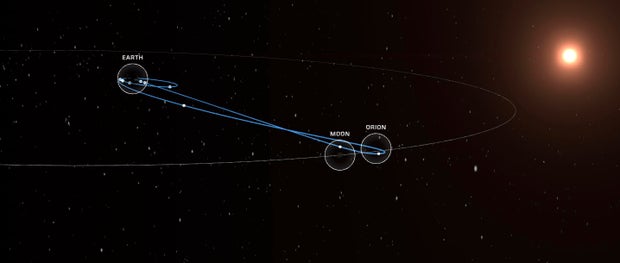
Artemis II is more than 245,400 miles from Earth, and less than 18,400 miles from the moon, NASA's real-time tracker showed late Monday morning.
The tracker's latest update shows the Orion spacecraft speeding toward the moon at a velocity of 1,147 miles per hour. At this point, Earth looks like a dark sphere hovering behind it.
NASA says crew is awake and preparing for today's lunar flyby
NASA said Monday morning that the Artemis II crew is awake and preparing for the lunar flyby.
"Morning routine: Wake up, shave, make the bed, witness something that's never before been seen by human eyes," the agency posted on X. "The Artemis II crew is preparing for today's lunar flyby, when they will see the Moon's far side."
The astronauts woke up 18,830 miles from the moon, to sounds of "Good Morning" by Mandisa and TobyMac.
NASA posted on X at 10:35 a.m. ET. The crew had been scheduled to wake up at 10:50.
Former astronaut says planned communication outages are "sometimes welcome"
NASA predicts the Artemis II will lose contact with Mission Control for about 40 minutes during the lunar flyby Monday evening. Planned communication outages like this "are sometimes welcome" for both Mission Control and astronaut crews, retired NASA astronaut and U.S. Navy SEAL Chris Cassidy told CBS News.
"Mission Control, they'll be dialed in making sure everything is perfect right before the moment of communication loss," Cassidy said, adding that once that moment comes, "those folks can take a break" while the Artemis II crew has a rare opportunity to be completely present on their flight.
"They'll know that they are the only eyes watching the safety of this vehicle, and they'll feel the onus of that responsibility all while they're looking out the window," he said. "Those are the moments where they're going to be the closest, and they can take those photos."
While communications are down, the crew is to make their closest approach to the moon, and to set a new record for the farthest distance traveled from our planet. They are also expected to see Earthset, when Earth appears to sink beneath the moon's horizon.
Artemis II commander describes crew's excitement as flyby approaches
In a radio message to Mission Control early Monday morning, Artemis II commander Reid Wiseman described the crew's excitement as he reflected on the view from the Orion spacecraft.
"The four of us have looked at this our entire lives. And the way we are responding to what we're seeing out the window, it's just like we're a bunch of little kids up here," Wiseman said. "We cannot get enough of this. It's amazing. Thank you for the privilege."
New photo shows moon out window of spacecraft
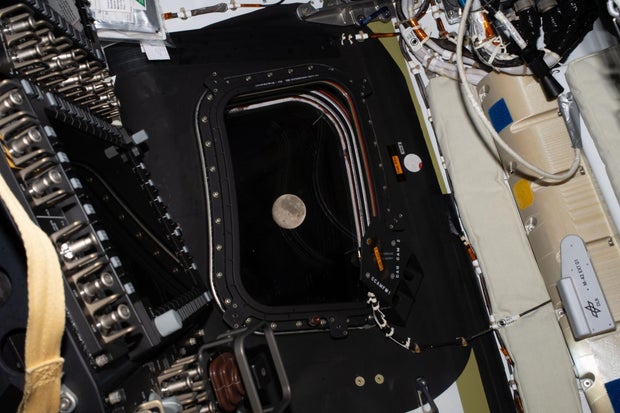
NASA released an image that was taken Monday showing the moon through the window of the Orion spacecraft as the Artemis II crew drew closer.
The image was taken by the crew before they went to sleep on the fifth day of their journey.
NASA said the crew "entered the lunar sphere of influence" at 12:37 a.m. ET Monday, marking the point at which the moon's gravity had a stronger pull on them than the Earth's.
Crew to wake up soon to break record, conduct lunar flyby
The Artemis II crew is scheduled to wake up at 10:50 a.m. ET Monday, hours before they are expected to break a distance record and conduct a lunar flyby.
After reviewing details of the flyby during a briefing with Mission Control at 1:30 pm ET, the crew is set to make history when they reach 248,655 miles from Earth 26 minutes later, and keep going. That is the record set by Jim Lovell, Fred Haise and Jack Swigert aboard Apollo 13 on April 15, 1970.
The moon flyby will then begin at 2:45 p.m. Artemis II will observe both the near and far sides of the moon, ultimately making its closest approach — at 4,070 miles from the surface — at around 7 p.m.
At that distance, NASA said the moon "will appear to the astronauts about the size of a basketball held at arm's length." They may become the first humans to see portions of the far side with an unaided eye, according to the agency.
Minutes later, the crew will reach their maximum distance from Earth: 252,760 miles.
They'll also witness "Earthrise" and try to recreate the famous Apollo 8 photo that coined that name, as well as an hour-long solar eclipse. The flyby is due to end at 9:20 p.m.
Artemis II crew capture photo of far side of the moon
NASA on Sunday released an image of the far side of the moon that the Artemis II crew captured the day before — the fourth day of the astronauts' journey.
The moon in the image is oriented upside down, with its South Pole facing upward and parts of its far side visible, according to NASA. The Orientale basin, a massive crater that's hard to see from Earth, is situated along the right edge of the moon in the picture, NASA said, adding that the Artemis II voyage marks the first time humans have ever seen the basin in full.
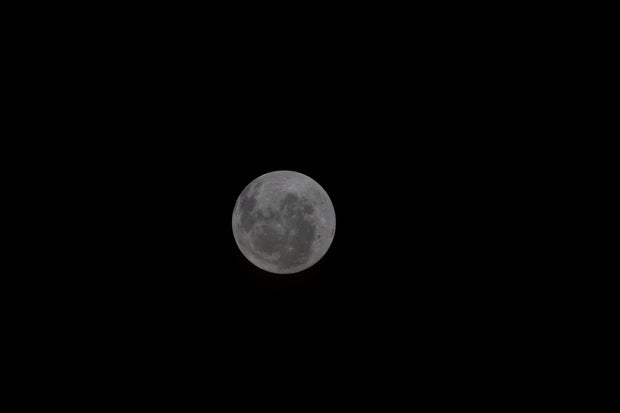
The Orientale basin will be an ongoing subject of study for members of the Orion spacecraft's four-person crew, which includes commander Reid Wiseman, pilot Victor Glover, and mission specialists Christina Koch and Jeremy Hansen.
Artemis II astronauts find hidden eggs on Easter Sunday
Artemis II astronauts took time on Sunday to send Easter greetings to Earth, and had their own version of an egg hunt.
Artemis II mission specialist Christina Koch said the crew had hidden eggs around the cabin to mark the holiday. "They were the dehydrated scrambled egg variety," she said, "but we're all pretty happy with them."
Overnight Saturday, Koch said the crew had switched from measuring their increasing distance from Earth to tracking their decreasing distance to the moon. The trip around the moon so far has yielded unexpected detail on its surface, giving scientists a taste of things to come when they pass over the lunar far side Monday.