Baltimore has a new official City Tree. Here's what to know about the Tuliptree.
Baltimore has a new official City Tree for the first time in 50 years.
Since 1974, the Chanticleer pear, or Callery pear, has represented the city. But now, it's time for the Tuliptree era.
The city launched a campaign earlier this year to select a climate-resilient species that is native to Baltimore's metro region.
The Tuliptree, or liriodendron tulipifera, was named the winner Thursday evening at TreeBaltimore's Summer Gathering at Cylburn Arboretum.
"The new official City Tree represents Baltimore's commitment to building a more diverse and resilient urban forest that can withstand a changing climate, pests, and disease," the Department of Recreation and Parks said in a news release.
"Baltimore is a city that is always growing, changing and looking toward the future, and our urban forest should be no different," said Mayor Brandon M. Scott. "Our new official City Tree represents our commitment to creating a greener, healthier and more resilient Baltimore, and I'm proud that Baltimore residents had a voice in choosing a tree that will represent our city for generations to come."
How the Tuliptree was chosen
The Rec & Parks department's tree planting program, TreeBaltimore, launched the campaign in February, asking the public to nominate tree species for consideration.
Six finalists were selected based on the following criteria:
- Regional nativity
- Resilience to climate, pests, and disease
- Potential to provide a large canopy
- Presence in Baltimore
- Ability to encourage community stewardship
Nearly 2,000 people voted, and the Tuliptree received "far more votes" than its competitors, the department said.
The other candidates up for consideration were the American Sycamore (Platanus occidentalis), Bald Cypress (Taxodium distichum), Bitternut Hickory (Carya cordiformis), Blackgum (Nyssa sylvatica), and Overcup oak (Quercus lyrata).
What to know about Tuliptrees
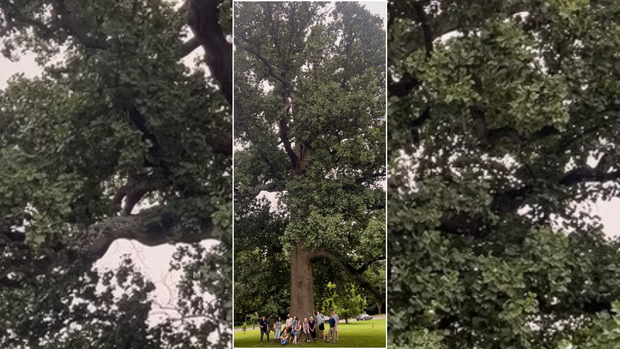
Tuliptrees belong to the magnolia family, and their scientific name translates to "lily tree bearing tulips," according to TreeBaltimore.
They can grow up to 200 feet high and live for 300 years. They are known for their "size, fast growth, useful wood, showy flowers, distinct leaf shape and cultural importance."
They are also associated with the Baltimore oriole, because their height and branch structure are ideal for orioles' unique hanging nests.
Tuliptrees have large flower blossoms that bloom in late spring and produce nectar, and their leaves resemble a tulip flower or a cat's face.
Walt Whitman once described them as, "the Apollo of the woods — tall and graceful, yet robust and sinewy, inimitable in hang of foliage and throwing-out of limb; as if the beauteous, vital, leafy creature could walk, if it only would."
To see one in person, check out the Baltimore City Champion in Druid Park — it's the tallest tree in Maryland!
A new era
The previous City Tree was chosen by Mayor William Donald Schaefer in the 1970s.
Parks officials say that while the Callery pear "has provided valuable canopy throughout Baltimore," it has "since proven invasive to the region and can outcompete native species."
"The species also requires significant branch maintenance and is vulnerable to newer challenges facing Baltimore's trees, like more severe storms," the department added.
"Today's unveiling reflects the forward-thinking work happening every day within our Forestry team," said Dr. Reginald Moore, Director of Recreation & Parks. "They are making thoughtful, science-based decisions to protect the health of Baltimore's forests, environment and communities for the next several decades."
Starting next year, the Tuliptree will officially be honored and planted throughout Baltimore streets and parks.


