Women enter skilled trades as metro Atlanta faces growing demand for workers

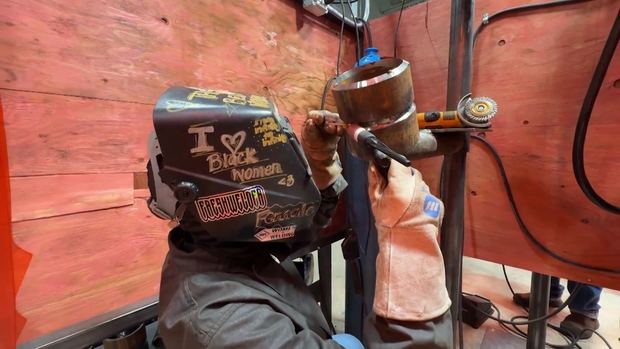
Inside a welding booth, a four-year degree can only get you so far. You can either do this expertly, or you can't. And 25-year-old JhiKayla Mathis can.
Mathis, who is from Columbus, Georgia, is at the top of her class at Tulsa Welding School's Atlanta-area campus, carrying a 4.0 grade-point average in a field she once never imagined entering.
"I always wanted to go follow in the medical field with my family, as the women in my family," Mathis said.
Instead, inspired by her grandfather, she picked up a welding torch. She is preparing to enter a job market where women remain very much the exception.
"I feel like I have to work 20 times harder, because you know, it is a male-dominated field," Mathis said. "There's not a lot of women in here. There's not a lot of Black women. So I try to go as hard as I can."
At Tulsa Welding School's Atlanta campus, President Tamekia Morris is betting on women like Mathis — a pool of talent the skilled trades have largely overlooked.
"If we really want to talk about closing this gap and the shortage in the workforce, in the skilled trades, we have to tap into the untapped market, which are women," Morris said.
Women currently make up about 16% of the student body at the Atlanta campus, according to Morris. Nationally, the gap is much larger. Women accounted for just 4.3% of construction trade workers in 2025, according to an analysis of federal Current Population Survey data by the Institute for Women's Policy Research. Women represented just 3.1% of carpenters, 3.1% of plumbers, pipe fitters and steamfitters, and 3.5% of electricians.
At the same time, metro Atlanta needs more skilled workers. More than 201,000 people work in skilled trades in the metro area, accounting for about 7% of all jobs, according to WorkSource Metro Atlanta. The Metro Atlanta Chamber's 2026 Talent Supply Report identifies skilled trades and industrial maintenance as occupations where demand consistently outpaces the available supply of workers.
That demand is being fueled by the construction of homes, roads, factories, and an extraordinary expansion of data centers. According to the latest industry report from commercial real estate firm CBRE, Atlanta has overtaken Northern Virginia to become North America's leading market for data-center capacity under construction.
All of it requires people who know how to build things.
"For so long this was not an option for us, right?" Morris said. "Our parents didn't raise us to think about welding and HVAC and electrical."
For Morris, that observation is personal. Growing up in Miami, she planned on becoming a doctor and followed the traditional educational path she had been taught to pursue.
"We just did what we were taught," Morris said. "Go to school, graduate high school, leave at 18 and go away for college. So I did that."
Morris earned a college degree and a master's degree, but medical school never happened. Instead, she found her way into education, initially helping students obtain externships in medical offices. Nearly two decades later, she is leading a school that trains students for careers she says she was never encouraged to consider herself.
If she had it to do over again, Morris said she might make a different choice.
"I probably would not have gone that route," she said. "It's just what we were taught."
Mathis is already taking a different path. When she graduates next month, she plans to go back to school to become an underwater welder. Asked why she would choose an even more specialized field, Mathis had a quick answer.
"No women in the field," she said. "Might as well go dominate that too."
Mathis says learning to weld has changed the way she sees herself and helped other women see what is possible.
"If they see me here doing this and another woman in here doing this, they're like, 'Okay, I can do it,'" she said.
The school has a saying: "The more you burn, the more you learn" — meaning the more time students spend behind a welding torch, the better they get. The welding program can be completed in seven months, putting students on a relatively quick path into a workforce that badly needs them.
In an economy hungry for people who can build, women like Mathis and Morris are demonstrating there is more than one career path — and changing ideas about who can walk it.


