SALSAtlanta teaches city to dance casino, building community along the way

On a crowded Atlanta ballroom floor in Buckhead, the instructions come quickly. Couples turn, change partners, and move around a circle as music fills the room.
For experienced dancers, it can look almost effortless. For newcomers, not so much.
"I swear, one day I'm gonna get it on the first try," one relatively new dancer joked during a recent class.
The couples are learning casino, a Cuban social dance commonly referred to in the United States as Cuban salsa. For nearly three decades, Julian Mejía has been one of the people teaching Atlantans how to do it.
Mejía moved to Atlanta from Miami in 1999. A native of Colombia, he said music had always been important to him. He learned casino while living in Miami, where the city's large Cuban population gave him access to a dance culture he discovered was far less established when he moved to Atlanta for a job.
"I couldn't dance with many people here," Mejía said.
For a while, he said, his job with Delta Air Lines allowed him to fly back to Miami on weekends to dance. Then, one night at Atlanta's Tongue & Groove nightclub, someone noticed that what Mejía was doing on the dance floor looked different.
The man asked if he was an instructor, then if Mejía would like to become one.
"I said, 'Let's try,'" Mejía recalled.
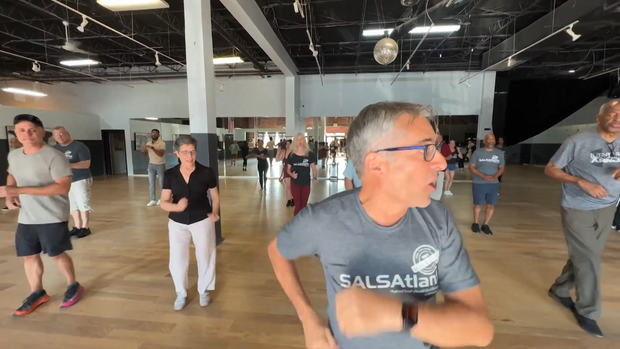
Twenty-seven years later, he continues teaching multiple times a week, with classes that can draw hundreds of dancers.
But ask Mejía what he teaches, and he makes an important distinction from the catch-all style, salsa.
"We dance casino," Mejía said. "Most people would call it Cuban salsa."
Mejía considers salsa an overly broad commercial term that came to encompass music and dance with several distinct rhythms, histories and styles.
Casino, he explains, developed in Cuba and takes its name from the social clubs where Cubans gathered and danced during the mid-20th century.
"Casino is the way Cubans dance to Cuban music, to Cuban popular music, also known as salsa," Mejía said.
Different places developed different approaches to dancing to the music, he said, including styles associated with New York, Los Angeles and Cali, Colombia.
Casino has its own vocabulary and movement.
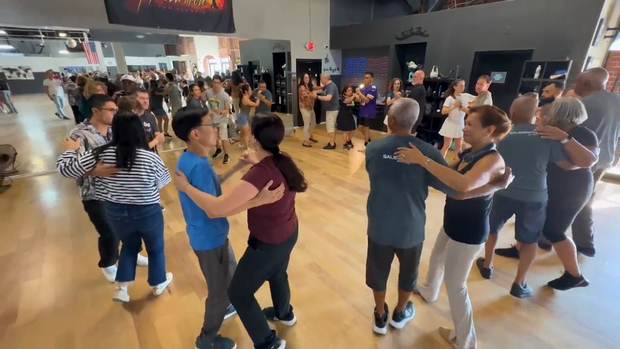
One particularly social form is Rueda de Casino — rueda meaning wheel in Spanish. Multiple couples form a circle while a caller announces moves that the dancers perform together, often changing partners along the way.
Mejía said the people who show up to learn casino rarely fit a single description.
"We have kids. We have retired people," he said. "We have all kinds of people, colors, races. It's very inclusive."
Their reasons for coming vary, too. Some have always wanted to learn to dance. Some are looking for a new hobby. Some arrive hoping to meet people. Mejía said he has even taught Cubans who grew up in Cuba but never learned the dance there.
Others arrive convinced they already know what they're doing. That, Mejía said, can sometimes make learning harder.
"You have to unlearn to be able to learn," he said, something he experienced himself when he began studying casino after growing up dancing differently in Colombia.
For some students, the dance floor also offers a social space that doesn't revolve around drinking. Mejía said that surprised him personally.
Growing up in Colombia, he recalled drinking being intertwined with parties and dancing. As he became more serious about casino, he found that alcohol made it harder to follow calls and execute increasingly complicated moves.
"When I realized I could actually dance without a drink, I stopped drinking," Mejía said. "And I stopped smoking."
One dancer in his Atlanta circle, who described herself as sober, said the dance offers something similar for her: a way to go out, participate, and connect with other people without alcohol being the center of the experience.
After 27 years, Mejía has also had the unusual experience of watching what happens after people leave his classes.
Some met romantic partners through dancing. Some married. Some started families. Now, he said, some are returning years later.
"I've had many people that actually started their family here," Mejía said. "Now their kids are old, and they met here."
That sense of connection may help explain why casino has remained such a large part of Mejía's life.
He travels to teach and attend dance festivals in other cities and countries, and said the shared language of the dance means a casino dancer can find a community almost anywhere.
But the music's effect may be the simplest explanation for why he has kept doing it.
"I can be feeling really bad, sick or something," Mejía said. "And when the music comes and if I can dance, the high that gives me lasts until the next day. It just heals," he said.
What started with four students and an accidental invitation to teach has become 27 years of music, movement, and people finding one another on Atlanta dance floors.


