Orphaned after vehicle collisions, Dozens of fawns get 2nd chance at Cherokee County rescue

Long before sunrise, while most of Cherokee County is still asleep, the day is already in full swing at a farm tucked away in Canton.
The first task is feeding time.
Volunteers gather bottles, mix formula, and prepare breakfast for some of the smallest and most vulnerable wildlife in Georgia: orphaned fawns.
At Smithwick Station, a licensed wildlife rehabilitation facility, more than 40 fawns have arrived this season alone. Most lost their mothers after vehicle collisions on Georgia roads, leaving the young deer with little chance of survival on their own.
"The end goal here that we're looking at from the beginning of the season is getting these guys back to the wild," said Sarah Paulk, a licensed wildlife rehabilitator who operates the rescue.
What began as a passion for helping animals has grown into a demanding mission supported by volunteers, donations, and a steady supply of baby bottles.
"We feed, what, 120 bottles a day?" Paulk said.
The work reflects a larger problem across Georgia.
According to State Farm, Georgia ranks 22nd in the nation for animal collisions. The insurance company estimates drivers in the state have about a 1-in-109 chance of colliding with an animal, with deer involved in the majority of those crashes.
While motorists often see the immediate aftermath of a collision, the consequences can extend beyond the roadway.
When a doe is killed, orphaned fawns are frequently left behind, creating a need for rehabilitation centers like Smithwick Station.
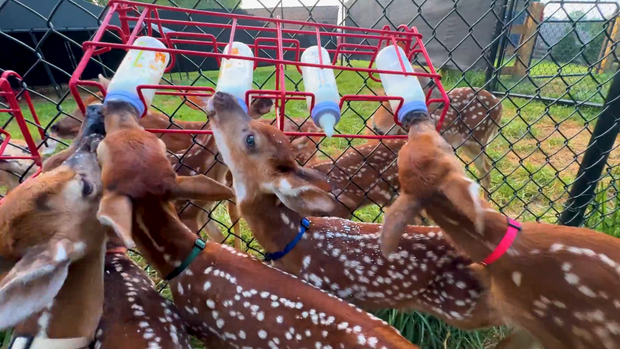
The challenge for volunteers is to raise the fawns without allowing them to become attached to people.
"We have to respect that they're not pets," volunteer Kimberly Steinberg said. "They do belong in the wild. So you have to, I think, practice some restraint."
That restraint serves an important purpose.
Wildlife experts warn that deer raised around humans can lose their natural fear of people, making them more vulnerable once released. The National Wildlife Federation notes that habituated deer face increased risks, including future vehicle collisions and hunters.
"We all want them to thrive when they're released and not necessarily be attached to humans, which could be problematic," Steinberg said.
For Steinberg, volunteering at Smithwick Station began with a fawn she encountered near her own farm.
"She was running up and down here, just screaming," Steinberg recalled.
Concerned, she contacted wildlife officials. After consulting with the Georgia Department of Natural Resources, she learned that a wandering fawn crying for extended periods, especially during the heat of the day, can be a sign that intervention is necessary.
The department referred her to Smithwick Station, and her experience inspired her to become a volunteer.
"And then I get to watch that sweet one grow up. And I'm so excited to see her be released one day," Steinberg says.
By midday, many of the volunteers have returned to work or gone home, but the care continues.
There are medications to administer, feedings to prepare, and animals to monitor.
For Paulk, the reward comes months later, when a healthy fawn is ready to return to the wild.
In wildlife rehabilitation, success isn't measured by how long an animal stays.
It's measured by the moment it no longer needs you.
What to do if you find a fawn alone
Wildlife officials say a fawn found by itself is not necessarily abandoned.
If you see a fawn alone:
- Leave it where it is.
- Do not move it.
- Remember that mother deer often leave fawns hidden for long periods while they forage.
- If the fawn is in a fenced yard, open a gate if possible.
- Wait up to 48 hours to allow the doe to return.
If a fawn is injured, visibly sick, or found next to a deceased doe:
- Contact the Georgia Department of Natural Resources at their website georgiawildlife.com.
- Use the agency's online wildlife rehabilitation resources to locate a licensed wildlife rehabilitator or fawn rescue organization in your area, like Smithwick Station.
For more information about their rescue, visit Smithwickstation.org.


