Inside the hive: How metro Atlanta beekeepers help honeybees prepare for colder months

Before opening a beehive, master beekeeper Debra DeWitt looks for clues.
At a teaching apiary in College Park, bees returning to the hive with tiny granules of pollen on their legs tell her something about what is happening inside.
"You can see little granules of pollen on their legs," DeWitt said. "And so that tells me that they're raising brood inside."
DeWitt, president of the Tara Beekeepers Association, and Vice President Mark Schwartz help care for colonies at the association's apiary at Metro Atlanta Urban Farm.
For Schwartz, who has kept bees for about 15 years, preparing to inspect a hive starts with protective gear and a smoker. The smoke helps calm the bees and allows beekeepers to work inside the hive with less disturbance.
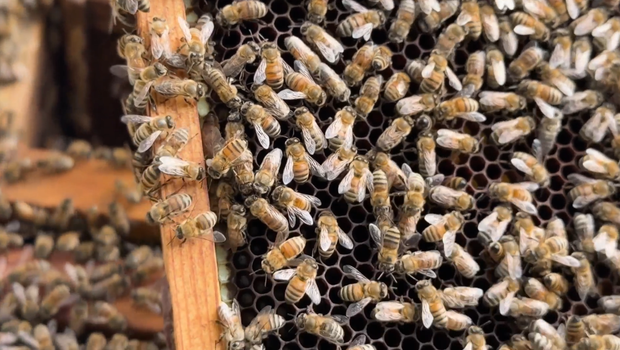
Once the lid comes off, an entire community is revealed.
Worker bees are female and perform much of the work inside the colony. Male bees, known as drones, have a much different role.
"They really just kind of hang out and eat," DeWitt said. "Their sisters feed them."
One of the most important things beekeepers look for heading into colder weather is whether a colony has enough food.
During the inspection, DeWitt pulled out a frame packed with capped honey.
"This is a beautiful frame of honey right here," she said.
While some honey could be harvested for people, Schwartz said the beekeepers are leaving it with the colony.
"This is honey that we could harvest and use for human consumption, but we're going to leave it for the bees," Schwartz said.
That stored honey becomes especially important as temperatures fall and fewer food sources are available outside the hive.
During cold weather, honeybees cluster together inside the hive. They generate and conserve heat while using stored honey for the energy they need to survive the colder months.
Food is only part of what DeWitt looks for during an inspection. She also searches for the queen.
"I'm always looking for the queen," DeWitt said while scanning a frame. "She could be on a frame like this, but I don't see her here."
Frame by frame, the search continued until DeWitt spotted her.
"Here's the queen," she said.
The queen was marked with a small white dot, making her easier to identify among thousands of bees. DeWitt said the queen is noticeably larger than the workers and is responsible for laying the eggs that sustain the colony.
The bees also communicate in ways that can be easy to miss. DeWitt pointed to workers touching antennae around the queen. The queen produces a pheromone that is passed among bees, signaling her presence throughout the colony.
For DeWitt, those small details are part of what has kept her interested in beekeeping for eight years.
"I love bees," she said. "To me, working a hive, it's like a walking meditation."
The work happening inside a hive also reaches far beyond it.
"They pollinate so many crops that we consume," Schwartz said. "They're so beneficial to the environment."
The Tara Beekeepers Association uses its College Park apiary as a teaching space, giving new beekeepers an opportunity to learn how to inspect, manage and care for honeybee colonies.


