Georgia's data center boom leave residents worried about environmental impacts

Georgia's booming data center industry is transforming the region into a hub for the digital economy, but for one Fayette County couple, the growth has come with what they call a devastating personal cost.
More than 150 data centers now operate across metro Atlanta, housing the servers that power websites, cloud storage, artificial intelligence, and business applications. Supporters argue that the facilities are essential infrastructure for a modern, connected world. But Joe and Jean Marschall say the arrival of a data center next to their rural property has turned their long-planned retirement into a daily struggle.
"This was our retirement. Our slice of heaven," said Jean Marschall.
"As close to Eden as you could get," said her husband, Joe Marschall.
The couple moved to their wooded corner of Fayette County more than 25 years ago, drawn by quiet surroundings filled with trees, wildlife, and the sounds of nature. That tranquility, they say, ended when residential land nearby was rezoned, and a data center operated by QTS Data Centers moved in next door.
"We're under interrogation every night," Joe Marschall said.
The Marschalls say the construction and ongoing operation brought near-constant industrial noise, fumes, and bright security lights that shine into their home at night.

Their biggest concern, however, flows through the creek in their backyard — part of the headwaters that eventually feed into the Flint River.
"We're at the very top of the watershed. Everything from here rolls downstream," said R.J. Gipaya, a watershed specialist for the Flint Riverkeeper.
Gipaya and the Flint Riverkeeper team have documented a thick orange substance along with sediment in the Marschalls' creek after heavy rain events. The substance, known as flocculant, is commonly used at construction sites to help sediment settle out of stormwater before it enters streams and rivers.
"You can use flocculants. That's not illegal. What's illegal is to then discharge that flocculated sediment onto your neighbor's property or into waters of the U.S. That's the illegal act," Riverkeeper Gordon Rogers said.
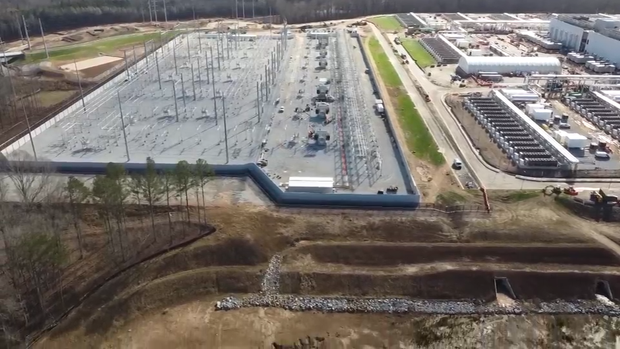
The creek on the Marschalls' land flows into the Flint River basin, which provides water to more than a million people across Georgia.
"If you pollute any part of a watershed, you're potentially polluting all of it," Rogers said.
QTS disputes claims that it is violating environmental regulations. Ryan Hunter, the company's chief operating officer, said the data center is operating within the law.
"We are doing continuous monitoring of that stream, and everything is within compliance. We don't have any concerns from that perspective," Hunter said.
In written statements, QTS said it conducts testing of all stormwaters leaving the site after rainfall events "to measure sediment levels and ensure compliance."
"We work closely with our testing consultants and the City of Fayetteville to maintain high standards of quality and oversight," the company said. "All National Pollutant Discharge Elimination System (NPDES) requirements and best management practices are followed in accordance with city and state regulations, and any necessary corrective actions are implemented promptly in coordination with the City of Fayetteville."
The company also responded to complaints about lighting on and around the site. QTS said it coordinated with Georgia Power to turn off all lighting at a nearby substation as of Feb. 20, with lights now used only during active work or maintenance.
"Additionally, the general contractor has conducted — and continues to conduct — daily audits of the construction site to ensure any temporary lighting is directed away from neighboring properties," QTS said, adding that temporary lighting is required for worker safety and compliance with Occupational Safety and Health Administration rules.
QTS said permanent street lighting is designed to shine downward, and it is working to accelerate the installation of final lighting solutions. The Marschalls said they are still dealing with lights shining into their living room.
Hunter said the company has met with the Marschalls to address their concerns.
"We've met with them directly on multiple occasions. We have disabled some of the lighting, we've repositioned lighting, we've added different sound attenuation, and we're doing continuous sampling and filtration," Hunter said. "It's a continuing conversation, and we'll continue to engage until they're happy with us as a neighbor."
The Marschalls and the Flint Riverkeeper said the changes have not gone far enough.
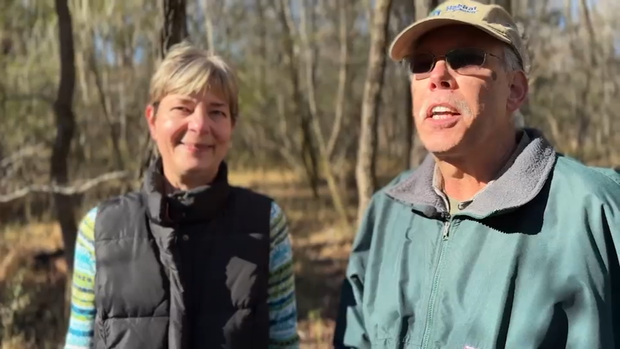
"It makes me nauseous. These creeks used to run clear. Now this is what we have," Joe Marschall said.
Jean Marschall said she hopes their experience serves as a warning for other communities facing similar development pressures.
"This could be in your backyard, too," she said.
Rogers urged residents to get involved early in local land-use decisions.
"Don't wait until you see it. Get involved when you hear a rumor," he said. "Zoning decisions happen locally — and once they're made, it's often too late."
As Georgia's reliance on data centers and cloud infrastructure continues to grow, the Marschalls and environmental advocates say their story raises a broader question: What is the cost of progress on the ground?