Georgia Tech's new Trash Lab turns plastic waste into something useful

At Georgia Tech, a school built around the idea of inventing things, students bring immeasurable talent and ambition to campus, and something else just as big that can actually be measured: Trash.
With tens of thousands of people moving through campus every day, that means a lot of plastic like water bottles and food containers. And as much as we try, not all of it gets recycled.
"We call it sometimes aspirational recycling or recycling theater," said Michael Best, the executive director of Georgia Tech's Institute for People and Technology.
The problem is what happens after someone drops that plastic bottle into the recycling bin.
Plastic has to be sorted, transported, and processed. Recycling capabilities vary from place to place, and depending on the type of plastic, contamination, and where it ends up, much of it may never be recycled at all.
"Most of it doesn't work," Best said. "A large percentage of stuff that you threw into that bin never made it into some recycling program and ended up in the landfill anyway."
Georgia Tech is trying something different.
Its newly opened Trash Lab is a makerspace dedicated to reusing plastic and what researchers call a "circular economy." It's called "upcycling" — finding ways to keep materials in constant use rather than throwing them away.
At the center of the lab is a compact machine with a name that sounds more appropriate for a coffee shop: the miniTrashpresso.
"This is the mini trash press," said Tim Trent, director of the Trash Lab. "It's sort of our keystone piece for the new Trash Lab."
Trashpresso. As in espresso. But instead of grinding beans, the Trashpresso grinds garbage.
Water bottles, milk jugs, and other plastic containers are shredded into pieces that look something like confetti. The material is cleaned, then heat, pressure, and specialized molds transform what was thrown away into something somebody might actually want.
At a demonstration for CBS News Atlanta, discarded plastic went into the process. A short time later, a newly molded upcycled object emerged bearing a Georgia Tech logo: a phone charger.
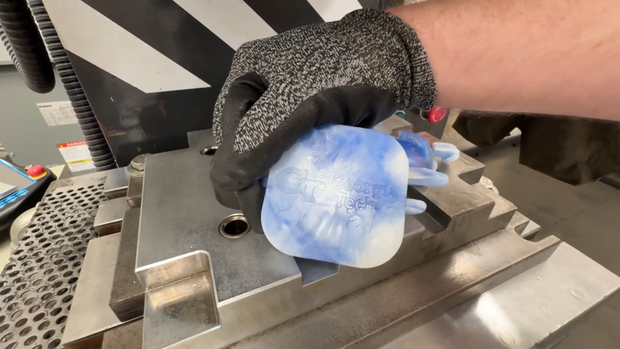
The Trashpresso can transform recovered plastic into new objects in less than five minutes, according to Georgia Tech. Developed by sustainability technology company Miniwiz, the machine installed at Georgia Tech is the first miniTrashpresso operating in North America, according to its developer.
But a phone charger is only one example of what researchers envision.
"There are thousands of different potential designs that they could create from this plastic," said Jennifer Chirico, Georgia Tech's associate vice president of sustainability.
Researchers are already exploring much larger applications. Best said that faculty and students in Georgia Tech's College of Architecture are working on ways to repurpose discarded plastic into architectural joints that could be used to secure a pavilion being created on campus.
From something that fits in your hand to building materials that could one day tower over us, the Trashpresso is a very big idea.
But part of that idea is not necessarily about going bigger. It's about staying closer to home.
Traditional recycling can require waste to be transported significant distances before it can be sorted and processed. At some point, Best said, the energy required to move those materials can undermine some of the benefits of recycling them.
"What if we could do it right here in our labs at Georgia Tech and be immediately gaining benefit of some new product that the old waste plastic is now turning into?" Best said.
The larger goal is to create a circular system in which plastic is repeatedly used and reused — potentially on the same campus where it was discarded.
Best compares the idea to the water cycle: Water falls as rain, moves through rivers, trees, and aquifers, evaporates, and eventually returns as rain again.
"What would plastic look like if it was similarly in a cycle of use and reuse, but just across, say, the campus of Georgia Tech?" Best said.
That could mean a discarded plastic container never needs to be shipped across the country to become useful again. It could instead be processed locally and return to the community as an entirely different product.
Georgia Tech says the Trash Lab, located in the Technology Square Research Building, is designed to allow students, faculty, and staff to experiment with those possibilities. The lab officially opened Sept. 1 as part of the university's Institute for People and Technology.
For Trent, there's another ingredient to making the idea work: Make trash interesting.
"Having something that's fun and exciting and engaging for folks to come in and say, 'That's cool, I'm excited about trash,'" Trent said. "That's what we wanted to do here."
Best describes the work as an effort to turn some of the promise of recycling into something tangible.
"We're trying to make more of that aspiration real," he said.
Perhaps the real magic of the Trash Lab isn't making trash disappear. "Waste not, want not," Trent said. It's making it reappear. Again and again.


