Family of Beltline stabbing suspect says it sought mental health treatment for him for years

The family of the man accused in a fatal stabbing near the Atlanta Beltline is speaking publicly for the first time, saying it spent years trying to get him long-term mental health treatment and warning that Georgia's system was failing to provide it.
CBS News Atlanta obtained a nearly 1,000-word statement from the family of Jonathan Hamby, who is accused of fatally stabbing 29-year-old Ramon Harris on Sunday afternoon.
The family asked to remain anonymous, citing privacy and safety concerns as well as what it described as severe distress following the killing.
In its statement, the family detailed what it called a long history of severe mental illness and active psychosis, along with repeated efforts to get Hamby treatment and compel him to remain in it.
"We spent years desperately fighting a broken system to prevent this exact tragedy from happening," the family wrote.
The family also questioned why Hamby, whom it described as having had more than 30 arrest cycles, was free and had access to weapons.
"This is a question our family has been asking for years," the statement said.
According to the family, relatives repeatedly sought help from the courts, including a plan that would have given them greater ability to ensure Hamby complied with treatment.
Instead, the family said Georgia law left them with few workable options.
"Our current laws offer only two extremes: brief jail stays that treat psychiatric illness as a crime or total guardianship, which is incredibly difficult to secure and often resisted by the courts," the family wrote.
Atlanta criminal and civil rights attorney Joshua Schiffer said the cycle described by the family is familiar to judges and attorneys who see people with chronic mental illness repeatedly enter and leave the criminal justice system.
"The courts are extraordinarily aware and frustrated with this cycle of discharge, arrest, discharge, arrest," Schiffer said, adding that long-term incarceration following a serious crime can ultimately become "the only long-term solution."
"In Georgia, we don't have a place or a system set up to address the needs of mentally ill people in our state," Schiffer said.
Hamby's family echoed that concern, writing that the current system "relies on a revolving door of short-term incarceration rather than long-term intervention."
DeKalb Commissioner Ted Terry said one of the biggest obstacles is capacity — both in psychiatric treatment facilities and transitional housing.
Terry said DeKalb County currently has 32 crisis beds, where someone can be held involuntarily for up to six days while being evaluated.
"But then once that six days is up, there's no mechanism to either retain them or to refer them into a transitional housing facility," Terry said.
Last month, DeKalb County received $409 million in state funding to build a 300-bed psychiatric treatment facility adjacent to its current facility, a significant expansion Terry said is badly needed.
"We've got to speed up the evaluations," Terry said. "And then once the evaluation is done, if there's a referral to the hospital, absolutely. That's going to help because that's where the treatment's needed."
But until additional capacity is available, Terry said the choices can be limited.
"Right now there's not enough hospital beds," he said. "And so either someone's going to stay in jail or they're going to be released on the street."
Schiffer argued that the shortage reflects a broader failure by the state to provide sufficient resources to address chronic mental illness.
"Atlanta is being held hostage by the state House because they won't provide the appropriate resources to effectively address this known chronic problem," he said.
The family of the accused is not alone in raising questions about the systems meant to help people in crisis.
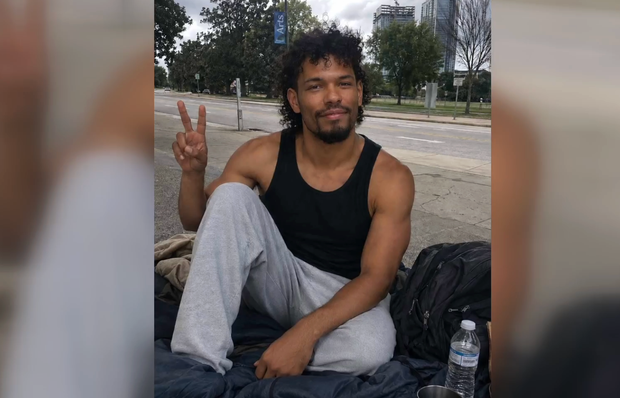
A friend of Harris told CBS News Atlanta that Harris had been experiencing housing insecurity and was living within a system the friend believes had also failed him.
"Everyone involved in this tragedy ultimately represents a failure of something much larger than one individual," the friend said in a statement. "We have created a society that too often abandons people who need support, then judges them harshly for the consequences of that abandonment."
The killing and its aftermath are now focusing attention on two problems that can often collide on Atlanta's streets: homelessness and serious mental illness.
For a family and a city now dealing with the consequences of Sunday's violence, the questions extend beyond what happened near the Beltline to what, if anything, could have happened earlier to prevent it.
And whether the safety net designed to intervene before a crisis becomes a tragedy has enough resources — and enough legal authority — to actually do so.


