Experts warning Georgians of hidden fire hazard in their laundry room: Dryer vent buildup

As families prepare for Thanksgiving and tackle laundry for holiday gatherings and overnight guests, fire safety experts are reminding homeowners not to overlook their dryer vents.
Experts say many homeowners don't realize lint can accumulate beyond the lint trap and throughout the vent system, especially in homes where vents run through ceilings, attics, or up to the roof.
"Nearly one-third of home dryer fires are caused by a failure to clean the dryer," said Atlanta Fire Rescue Lt. Monique Lamb. "Lint is highly flammable, and when it builds up, it can cause your dryer to overheat."
Benjamin Perez of Dryer Vent Wizard of Atlanta said there are typically three types of vent lines.
"There is the pass-through. That is where the dryer is located on the exterior wall of the home, and the vent line is only about 2 or 3 feet. Those vents are usually very efficient, and there is very little surface area that lint has an opportunity to catch onto," he explained.
He said maintenance on this type is usually required only once every 5 to 10 years. Many homes in Atlanta have dryers located on the second floor or the middle of the home away from an exterior wall.
"When it is near an interior part of the home, it has to run into the wall up into the ceiling and may run across to an exterior part of the home. We clean those with a rotary brush system, which has flexible nylon rods that go through 90-degree vents and can run up to 45 feet," Perez said.
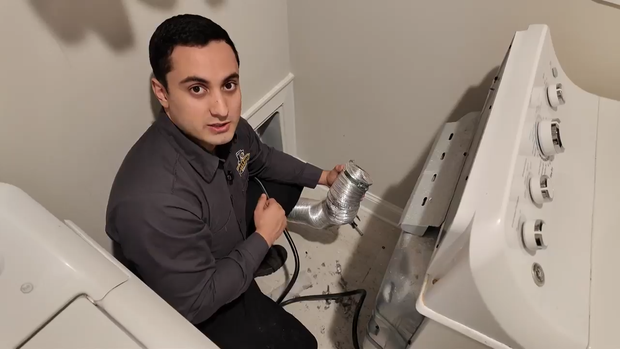
Some people may not know where their dryer vent is on the outside of their home.
"It is often way up on the roof," Perez said. "That is not a do-it-yourself situation. You will have to call a professional."
Perez said there are simple maintenance steps homeowners can do themselves.
"A really cool thing you can do yourself as far as maintenance goes that anybody can do is stick either a long brush or a vacuum attachment inside where you pull out the lint tray and clean out the lint tray cavity," he said.
Consumers should also be aware of the type of dryer sheets they use.
"It produces a waxy substance that, when run along the vent line, makes the lint sticky, and when it is sticky, it sticks to the inside of the dryer vent, causing more blockages and causing more lint to accumulate in the vent line. It is best to stick with dryer balls, which reduce the amount of static and reduce the amount of lint that sticks to the vent line, " he said.
It's important to clean your vent tray often.
"Not every day, not every week, not every month, but every single load of the lint tray must be cleaned out," Perez said.
Perez also recommends annual professional cleanings and says there is a key warning sign homeowners should pay attention to before a clogged vent becomes a fire hazard.
"Does the dryer take longer? You may not notice because it is more of a gradual decline in the efficiency of the dryer," Perez said. "It may take 45 minutes when the vent is clean and clear, but over time it may take an hour and 20 minutes when there's a clogging problem."
Manufacturers recommend professional cleaning once per year.
"Sometimes that can be excessive for some people because it depends on the size of your family, whether you have pets, and the type of clothes you are drying," he said. "Are you drying a lot of towels? Are you drying a lot of wool?"
The lint tray filter only captures about 50 to 70% of the lint, and the residual gets expelled.
"That is why it is so important to make sure the vent line is clear," he explained.
A professional cleaning may cost $200, depending on your service requirements.