Exhibit shows never-before-seen look at history and culture of Atlanta's Cabbagetown neighborhood

Step out of the Krog Street Tunnel just east of downtown Atlanta, and it can feel like stepping into another era.
Cabbagetown's narrow streets are lined with bungalows, shotgun houses and storefronts — vintage, compact and full of history. Looming over them is what was once one of Atlanta's industrial giants: the Fulton Bag & Cotton Mills.
Founded in the 1870's by German-Jewish immigrant Jacob Elsas, the mill produced feed sacks, cotton bags and later textiles. It closed in 1981 and was eventually transformed into loft apartments, but for more than a century, the mill shaped nearly every aspect of life in the neighborhood around it.
Generations of working-class families — many of them Scots-Irish who came from Appalachia in search of steady work and a future — settled nearby. Just about every family had someone who worked at the mill, and the neighborhood developed into a close-knit community of its own.
Now, a collection of photographs taken as that era was disappearing is bringing some of those families back into view.
In the late 1970s, as the mill was fading and Atlanta was beginning a period of dramatic change and gentrification, University of Georgia photography professor Barbara McKenzie began photographing the people of Cabbagetown.
She captured the last generation of residents whose lives were closely tied to the mill — children on neighborhood streets, workers inside their homes, and families going about their everyday lives.
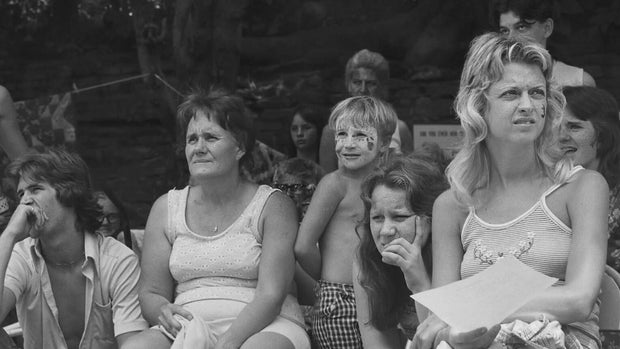
More than 700 of McKenzie's negatives remained largely unseen for decades until preservationists Henry Owings and Stephanie Quinn Jackson discovered them.
Twenty-eight of the photographs have now been meticulously curated for an exhibition at the Cabbagetown Community Center.
"It felt very sociologically pertinent," Owings said.
The photographs are striking for their intimacy and simplicity. The people in McKenzie's photographs appear remarkably comfortable in front of her camera — private moments preserved without pretense, showing a community as it actually lived.
"It was its own little town," said Jake Elsas. "People didn't have to go outside of the neighborhood to get what they wanted."
Elsas has an unusually personal connection to that history. He is the great-great-grandson of Jacob Elsas, who founded the mill more than 150 years ago.
Jake Elsas and his wife, Nina, helped make the exhibition possible, hoping the photographs will introduce visitors to the men, women and children who created the community long before Cabbagetown became one of Atlanta's most recognizable intown neighborhoods.
"The spirit that the original mill era people created has carried forth," Jake Elsas said.
For years, stories have circulated about how Cabbagetown acquired its unusual name. But Jake Elsas said his research points to an origin that is less quaint than neighborhood folklore might suggest.
According to Elsas, the name began as a slight — a derisive label used by a Northern newspaper reporter to mock the poor Scots-Irish mill workers who lived in the neighborhood during a headline-grabbing labor strike.
"It's not a pleasant story really," Elsas said. "I think through history, it became a way of referring to poor Irish communities, and that's what it was for ours."
Over time, the insult was reclaimed.
What began as a put-down became an identity — one this Atlanta neighborhood now wears with pride.
Jacob Elsas' influence also extended well beyond the mill and Cabbagetown. He helped establish both Georgia Tech and Grady Hospital. One of the original Fulton Bag & Cotton Mills feed sacks is preserved in the Georgia Tech archives.
The Cabbagetown photography exhibition runs through August at the Cabbagetown Community Center.


