Could marigolds become a new plant-based protein? UGA researchers see promise in edible flowers
Researchers at the University of Georgia recently found that marigold flowers contain protein levels comparable to established plant-based protein sources like quinoa and may offer added benefits for food production, according to a study published in ACS Food Science & Technology and a UGA release.
The study examined proteins extracted from Calendula officinalis, a common marigold species often used as an ornamental plant. Researchers found that the flower yielded about 9.2% crude protein on a dry-weight basis, with albumin making up the largest share of protein fractions at 65.47%.
Beyond protein content, the study found several functional properties that could make marigold proteins useful in food manufacturing. Researchers reported that certain protein fractions showed strong water- and oil-holding capacity, as well as emulsifying ability that helps ingredients bind together in foods like dressings and sauces.
The proteins also demonstrated thermal stability, meaning they remain stable at higher temperatures, which researchers said could make them useful in baked goods and other heat-processed foods.
"Billions of dollars of flowers are thrown away each year," said Anand Mohan, an associate professor in UGA's College of Agricultural and Environmental Sciences and corresponding author of the study, in a university release. "Can you imagine if we were able to take those flowers and use them for food instead?"
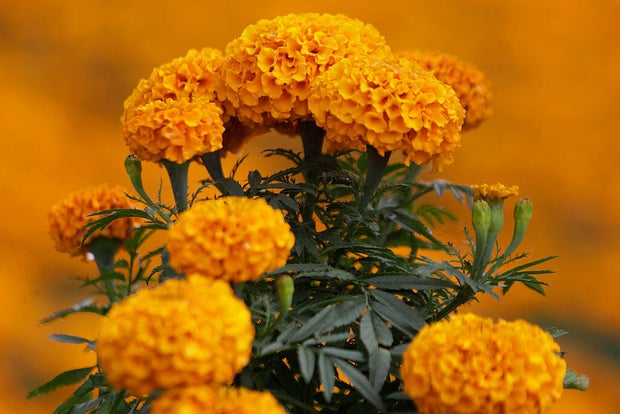
Researchers also found that marigold proteins contain amino acid profiles that may contribute flavor characteristics, including umami notes, and that the flowers contain antioxidants, fiber, and minerals such as calcium, potassium and iron.
The study also highlights broader sustainability concerns that large amounts of floral biomass are discarded annually, including in commercial flower production systems.
Fidele Benimana, a doctoral student and first author of the study, said the findings challenge how people think about flowers.
"Most people see marigolds as ornamental plants, but they also contain proteins with unique functional properties that could be useful in food formulation," Benimana said in the release.
Researchers cautioned that not all marigold species are safe to eat, and that the study focused on Calendula officinalis, commonly known as pot marigold, which has been used in food and herbal applications in some cultures.


